
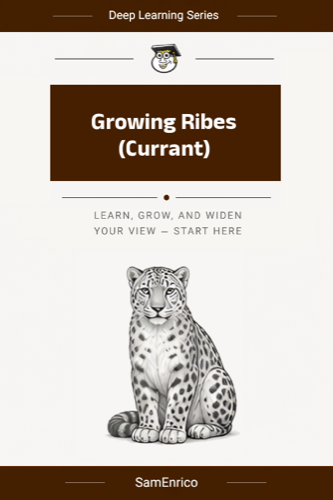
Non-FictionInformativeEducational
Growing Ribes (Currant) eBook
This publication, published by SamEnrico, covers G
by Hook Ina
This publication, published by SamEnrico, covers Growing Ribes (Currant)
Formats
Free sample
Chapter 1: The Forbidden Fruit...--–- Imagine a fruit so delicious, so nutritious, and so extraordinarily easy to grow that the United States government once sent men with shovels to your grandparents’ farm to dig it up by the roots. They came without warning, without compensation, and without apology. They ripped bushes from the soil—bushes that had fed families for generations—and burned them in piles while bewildered farmers watched from their porches. That fruit is the currant. That fruit is the Ribes.
And this chapter is the story of how a fungus, a timber industry lobby, and a fifty-year federal ban almost erased it from American soil. It is also the story of why you are lucky to be growing it today.–- Most gardening books begin with soil p H and chill hours. They open with Latin names and planting diagrams, as if the reader’s primary concern is botanical precision. This book does not. This book begins with a crime—because understanding what was taken from American gardeners is the only way to appreciate what you are about to reclaim.
The currant is not merely another berry bush. It is a botanical outlaw, a nutritional powerhouse, and one of the most forgiving fruit plants you will ever grow. Before you plant a single cane, before you test a single soil sample, you need to understand how this fruit disappeared and why it is finally, quietly, returning.The Crime: How America Lost Its Berry–- In the early decades of the twentieth century, currants and gooseberries were everywhere in North America. Farm wives canned currant jelly by the gallon. Children picked strigs of red and white berries from bushes that lined country lanes.
Immigrant communities from Europe, where Ribes had been cultivated for centuries, brought their favorite varieties with them and planted them around new homesteads from New England to the Pacific Northwest. The currant was not exotic. It was not a specialty crop. It was as ordinary and essential as the apple tree and the potato patch.–- Then came the fungus. Cronartium ribicola, a pathogen native to Asia, had been accidentally introduced to Europe and then hitchhiked across the Atlantic on nursery stock.
It found itself in a new world populated by vast forests of five-needle white pines—Eastern White Pine, Western White Pine, Sugar Pine—trees that had never encountered this pathogen and had evolved no resistance. The results were catastrophic. Infected pines developed cankers on their branches and trunks. Resin flowed from wounds like tears. Needles yellowed and dropped.
Within years, trees that had taken decades to grow were dead.–- The timber industry, then a colossal economic force in the United States and Canada, demanded action. Scientists traced the fungus’s life cycle and discovered a critical vulnerability: Cronartium ribicola requires two hosts to complete its reproduction. It infects white pines, but it also needs a Ribes plant—a currant or gooseberry—as an intermediate host. On Ribes leaves, the fungus produces spores that travel back to pines. Without Ribes, the fungus cannot spread.–- The solution seemed obvious to the timber barons and the government officials who answered to them.
Eliminate the Ribes. Save the pines.–- Between 1920 and 1930, the United States Congress passed a series of laws that effectively banned the cultivation of all Ribes species. The federal government, in cooperation with state agencies, launched eradication campaigns that swept across the Northeast and the Great Lakes region. Crews of men, sometimes accompanied by forest rangers, traveled through rural areas with maps and shovels. They knocked on farmhouse doors.
They pointed at currant bushes. They dug them up. Sometimes they offered explanations. Often they did not.–- Imagine this scene from the perspective of a farm family in upstate New York in 1924. You have tended your currant bushes for twenty years.
Your mother’s jelly recipe, written in faded ink on a card in your kitchen drawer, depends on those berries. Your children eat fresh currants from those bushes every July. One morning, strangers arrive in a government truck. They tell you the bushes must go. They do not offer to pay you for the loss.
They do not offer to replace what they take. They simply dig and burn. You watch. Then they leave.–- This was not an isolated incident. By the time the eradication campaigns wound down, uncounted thousands of Ribes bushes had been destroyed.
Home gardeners complied, often reluctantly. Commercial growers went out of business. Nurseries stopped stocking currant plants. Within a single generation, a fruit that had been as common as the raspberry became something else entirely: a memory, a rumor, a forbidden fruit.The Cover-Up: When Science Outran the Law–- Here is where the story takes a strange and revealing turn. The science that justified the ban was never wrong, exactly, but it was incomplete.
Cronartium ribicola does indeed require Ribes to complete its life cycle. Removing Ribes from white pine forests does indeed reduce the spread of blister rust. However, the ban was absolute, and it persisted long after the conditions that made it necessary had changed.–- Even as the eradication campaigns were underway, plant breeders were working on a solution. If Ribes could not be eliminated entirely—and they could not be, because wild Ribes species grow across North America, immune to any government eradication effort—then perhaps Ribes could be made safe. The goal was simple: breed currant and gooseberry varieties that were resistant or immune to white pine blister rust.
If the fungus could not infect the Ribes plant, then the Ribes plant could not infect the pine.–- By the 1950s, that goal had been achieved. Breeders in Canada, the United States, and Europe had developed rust-resistant Ribes cultivars. 'Consort,' 'Crusader,' and 'Coronet' black currants entered the market with explicit resistance to Cronartium ribicola. These varieties could be planted near white pines with minimal risk. The scientific justification for the federal ban had evaporated.–- But the law did not change.
The ban remained on the books for another sixteen years after resistant varieties became available. Why? The timber industry had moved on. White pine was no longer the economic colossus it had once been. Forestry practices had evolved.
The urgency was gone, and with it, the political will to revisit the issue. The ban persisted not because it was necessary but because it was already there.–- In 1966, the United States Department of Agriculture finally lifted the federal ban on Ribes cultivation. Regulation shifted to individual states. Some states, particularly those with significant white pine forestry, retained restrictions. Others abandoned them entirely.
Today, the legal landscape is a patchwork. Most states allow all Ribes cultivation. Some require permits for black currants. A few maintain outright bans in specific white pine protection zones. (Chapter 8 provides a complete state-by-state guide.)–- The damage, however, had been done.
Fifty years of prohibition had broken the chain of gardening knowledge. Recipes that had passed from mother to daughter were lost. Pruning techniques that had been second nature to a previous generation were forgotten. Nurseries had stopped carrying Ribes plants, and the infrastructure of commercial production had crumbled. The currant…
This is the end of the free sample. Get the eBook to keep going. Buy now
About this book
Details
- Author
- Hook Ina
- Publisher
- SamEnrico
- Language
- English
- Genre
- Non-Fiction, Informative, Educational
- Released
- 2026-06-02
- Pages (approx.)
- 147
- Available as
- eBook, Audiobook

Read better in the ZLOADR app
Your eBooks on your phone or tablet. Sign in with your SamEnrico account and start reading.
More by Hook Ina
 Team Assumption BustingHook Ina$11.99
 Protein HGH Synergy GuideHook Ina$11.99
 High School Stress Relief GuideHook Ina$11.99
 Coding Syntax PegsHook Ina$11.99
 Retirement Assets and PensionHook Ina$11.99
 Antwerp Diamond Police InterrogationHook Ina$11.99
 Nicotine During Pregnancy SolutionsHook Ina$11.99
 Menstrual Product GuideHook Ina$11.99
 Echoes of the Red Planet: The AI That Listened to MarsHook Ina$11.99
 The Shadow of Tenochtitlan: Cortes and the Fall of an Empire (1519-1521)Hook Ina$11.99
 The Silent Cartographers: Mapping the Grand Canyon’s Hidden Depths (1909-1911)Hook Ina$11.99
 AI Prompts for Sales Outreach and ProspectingHook Ina$11.99
You may also like
 Hong Kong Handover 1997Dunn Johnnie$11.99
 Zumba For Postnatal Recovery CourseNeal Christian$11.99
 Zumba for BeginnersLadner Nikia$11.99
 YouTube Comment Mining GuideHumes Pandora$12.99
 Worry Box MeditationCarlin Rudy$11.99
 Workplace Stress MeditationNguyen Lynn$11.99
 Workplace Stress and Sleep RepairHawley Ivory$11.99
 Workplace Perfectionism CureDelaney Jeffry$11.99
 Workplace Injustice Anger GuideWallen Isabelle$11.99
 Work Addiction and Burnout LinkGreenwood Ester$11.99
 Women in Yoga and WellnessBeattie Galina$11.99
 Women in Stand Up ComedyChun Evangeline$11.99