
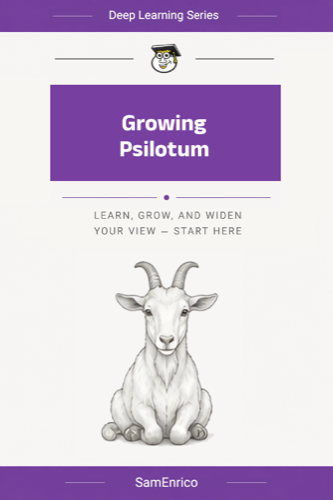
Non-FictionInformativeEducational
Growing Psilotum eBook
This publication, published by SamEnrico, covers G
This publication, published by SamEnrico, covers Growing Psilotum
Formats
Free sample
Chapter 1: The Dinosaur’s Houseplant...--–- It arrived in a plain cardboard box, no bigger than a coffee mug, with no instructions and no guarantees. The label read only Psilotum nudum – a name that meant nothing to me at the time. When I lifted the lid, I found what appeared to be a handful of green pipe cleaners jammed into a bag of moss. No leaves. No flowers.
No obvious roots. Just a cluster of thin, forked stems that looked less like a plant and more like something a child might draw if asked to imagine vegetation on Mars.I almost threw it away. I had ordered a fern, after all – something lush and green and familiar. What arrived was a skeleton.That was seven years ago, and that same plant now sprawls across a twelve-inch pot, its stems reaching outward like the arms of a miniature octopus. It has survived three cross-country moves, a month of neglect during a family emergency, an infestation of scale insects that would have killed any orchid, and a winter freeze that turned my entire greenhouse into a crypt.
Through all of it, the whisk fern endured. Not just endured – thrived. And in the process, it taught me more about patience, resilience, and the quiet art of paying attention than any self-help book ever could.This book is not a typical gardening guide. If you are looking for a step-by-step manual that promises a perfect whisk fern in thirty days, close these pages and walk away. That book does not exist, because Psilotum does not cooperate with schedules.
It grows at its own pace, in its own way, and the moment you try to force it into a box of conventional horticulture, it will die. I know this because I have killed more whisk ferns than I care to admit – each corpse a lesson written in blackened stems and rotten rhizomes.What follows is everything I wish someone had told me before I opened that first box. It is the synthesis of hundreds of conversations with botanists, growers, and indigenous plant keepers. It is the distillation of decades of academic research scattered across obscure journals and university databases. And it is, as far as I know, the first comprehensive guide to growing Psilotum nudum ever written for the home grower.Why does this plant deserve such attention?
Because Psilotum is not merely a curiosity. It is a living fossil – a direct descendant of the first vascular plants that crawled onto land over four hundred million years ago. When you grow a whisk fern, you are not cultivating a houseplant. You are hosting a survivor of the Devonian period, a witness to the age of dinosaurs, a creature that has outlasted ice ages and asteroid impacts and the rise and fall of entire mountain ranges. That is not gardening.
That is stewardship of deep time.And yet, for all its ancient pedigree, Psilotum is remarkably easy to grow – once you stop treating it like a normal plant. The secret, as you will discover in these pages, is learning to think like a whisk fern. To understand why it abandoned roots and leaves millions of years ago. To appreciate its peculiar rhythm of growth and dormancy. To recognize that what looks like a flaw – its bare, skeletal appearance – is actually a masterpiece of evolutionary efficiency.This chapter introduces you to that evolutionary journey.
Before we talk about pots and soil, before we discuss watering schedules or humidity trays, you must first understand what you are growing. Not just its name or its native range, but its story. Because once you understand the story, the cultivation becomes intuitive. You will stop asking "What should I do?" and start asking "What would the plant want?" – and that shift in perspective makes all the difference.So let us begin where all stories begin: at the very beginning, before there were flowers, before there were seeds, before there were even true leaves. Let us travel back to a world that would seem alien to our eyes – a world of giant fungi, scorpions the size of cats, and the first tentative green shoots pushing toward an oxygen-rich sky.The World Before Leaves Imagine, if you can, the Devonian period.
The year is approximately 400 million years before the present. There are no flowering plants – indeed, there are no plants at all in the sense that we understand them. The land, for the most part, is a barren expanse of rock and sand. The only green things are thin films of algae clinging to damp surfaces and the occasional moss-like plant struggling to stay upright.The atmosphere is radically different from our own. Oxygen levels are lower, carbon dioxide levels are dramatically higher.
The sun beats down without the protection of a fully formed ozone layer. Ultraviolet radiation is intense. The soil – what little exists – is shallow and nutrient-poor, lacking the organic matter that would later be built by generations of decaying plants.Into this harsh world emerged the first vascular plants: simple organisms with internal tubes for transporting water and nutrients. These pioneers – known to paleobotanists as the rhyniophytes, after the famous Rhynie chert fossil beds in Scotland – were the great-grandparents of every tree, fern, and flower on Earth today. And they looked remarkably like modern Psilotum.The fossils preserved in the Rhynie chert are extraordinary.
Imagine a chunk of brownish rock, sliced thin and placed under a microscope. What you see is not the usual blur of mineral grains, but the crisp, cellular detail of plants that died in an instant – preserved in hot spring silica before they could decay. You can see the individual cells of stems, the branching patterns, the spore cases at the tips. You can even see the mycorrhizal fungi that lived in symbiosis with these ancient plants, just as they do with Psilotum today.The most famous of these fossils is Rhynia gwynne-vaughanii, a plant that stood just a few centimeters tall, with leafless aerial stems that forked dichotomously – splitting into two equal branches, then two again. It had no roots, only a creeping, root-like stem called a rhizome.
It reproduced via spores released from terminal structures. In almost every respect, it was a whisk fern.Paleobotanists now believe that Rhynia and its relatives were not direct ancestors of Psilotum, but rather cousins – sharing a common ancestor that lived even earlier, in the Silurian period. The whisk fern lineage, known as the Psilotaceae, has been evolving independently for over four hundred million years. And remarkably, it has changed very little in all that time.This is not because Psilotum is primitive in the sense of being inefficient or poorly adapted. On the contrary, its body plan has proven so successful that natural selection has had little reason to modify it.
While other plant lineages were experimenting with leaves, roots, flowers, and seeds, the whisk fern simply refined what already worked. It stripped away everything non-essential and kept the core systems that allowed it to thrive in low-light, low-nutrient environments.Think of it this way: If the plant kingdom were a car manufacturer, most plants would be luxury sedans – loaded with features, complex to maintain, impressive…
This is the end of the free sample. Get the eBook to keep going. Buy now
About this book
Details
- Author
- Jung Charlena
- Publisher
- SamEnrico
- Language
- English
- Genre
- Non-Fiction, Informative, Educational
- Released
- 2026-06-02
- Pages (approx.)
- 143
- Available as
- eBook, Audiobook

Read better in the ZLOADR app
Your eBooks on your phone or tablet. Sign in with your SamEnrico account and start reading.
More by Jung Charlena
 The Gacy Murder KitJung Charlena$11.99
 Self Talk For ForeclosureJung Charlena$11.99
 The Reformation Battle HymnsJung Charlena$11.99
 TB And Mental Health Dual Access GuideJung Charlena$11.99
 Empowerment Without AbandonmentJung Charlena$11.99
 Blue Light and Memory SleepJung Charlena$11.99
 Chunking Computer CodeJung Charlena$11.99
 TM For SeniorsJung Charlena$11.99
 The Sobriety Identity ShiftJung Charlena$11.99
 The Day the Music Died... Twice: The Forgotten Concert That Saved a GenerationJung Charlena$11.99
 Magellan's Gambit: Storms, Mutiny, and the First Voyage Around the WorldJung Charlena$11.99
 Whiskers of War: The Secret Lives of WWII’s Heroic CatsJung Charlena$11.99
You may also like
 Hong Kong Handover 1997Dunn Johnnie$11.99
 Zumba For Postnatal Recovery CourseNeal Christian$11.99
 Zumba for BeginnersLadner Nikia$11.99
 YouTube Comment Mining GuideHumes Pandora$12.99
 Worry Box MeditationCarlin Rudy$11.99
 Workplace Stress MeditationNguyen Lynn$11.99
 Workplace Stress and Sleep RepairHawley Ivory$11.99
 Workplace Perfectionism CureDelaney Jeffry$11.99
 Workplace Injustice Anger GuideWallen Isabelle$11.99
 Work Addiction and Burnout LinkGreenwood Ester$11.99
 Women in Yoga and WellnessBeattie Galina$11.99
 Women in Stand Up ComedyChun Evangeline$11.99