
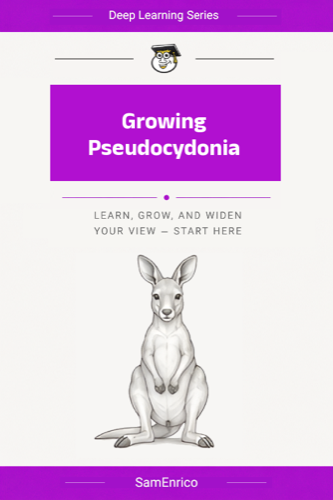
Non-FictionInformativeEducational
Growing Pseudocydonia eBook
This publication, published by SamEnrico, covers G
This publication, published by SamEnrico, covers Growing Pseudocydonia
Formats
Free sample
Chapter 1: The Orphaned Apple...--–- The first time I saw a Pseudocydonia tree, I didn't know what I was looking at. It was November in the Hudson Valley, and the homeowner had called me—a young, overconfident horticultural consultant—to identify a "mystery tree" in her backyard. She had bought the property three years earlier from the estate of a botanist who had traveled extensively in East Asia. The tree stood about fifteen feet tall, its branches heavy with large, yellow, pear-shaped fruits that had begun to wrinkle and soften. The bark peeled away in thin, puzzle-piece plates, revealing a patchwork of gray, green, brown, and cream—like a sycamore dressed for a masquerade.
The leaves had mostly fallen, but those that remained burned in shades of amber and crimson.–- "It's beautiful," she said, "but what is it? And can I eat these?" She held up one of the fruits, which was as hard as a baseball and covered in a faint fuzz. I had no answer. My four years of horticultural study had covered everything from grafting techniques to pest life cycles, from soil microbiology to the taxonomy of the Rose family. But nowhere—not in a single lecture, not in a single textbook, not in a single field guide—had anyone mentioned Pseudocydonia sinensis.
The Chinese quince, as it turned out, was the forgotten child of the Rosaceae clan, overshadowed by its flashier siblings: the apple, the pear, the common quince, and the ornamental flowering quince that filled nursery catalogs every spring.–- That encounter changed the trajectory of my career. I became obsessed with this orphaned fruit tree. I tracked down specimens in botanical gardens, corresponded with rare fruit collectors across three continents, and eventually planted my own grove of Pseudocydonia on a small acreage in western Oregon. Over the following fifteen years, I learned that this tree is not merely a botanical curiosity—it is one of the most forgiving, versatile, and rewarding trees a home grower can plant. It tolerates neglect that would kill an apple tree.
It produces fruit that transforms, through cooking, into something transcendent. It offers beauty in every season, from winter bark to spring blossoms to summer foliage to autumn harvest. And yet, it remains almost unknown to the very people who would love it most: home gardeners.–- This chapter is the foundation upon which everything else in this book rests. Before you dig a hole, before you order a tree, before you dream of membrillo on a cheese board, you need to understand what Pseudocydonia sinensis actually is—not just botanically, but as a living, growing organism with its own quirks, preferences, and surprising resilience. I am going to strip away the confusion that surrounds this species.
I will give you a clear, consistent framework for understanding its growth habits, its hardiness limits, and its place in the plant kingdom. By the end of this chapter, you will know exactly what you are getting into—and you will be eager to get started.What's in a Name? The Taxonomy Trap–- Let us begin with the name, because the name is where most confusion begins. The tree we are discussing is Pseudocydonia sinensis. The genus name, Pseudocydonia, comes from two Greek roots: pseudes, meaning "false," and kydonion, meaning "quince from Cydonia" (an ancient city on the island of Crete).
In other words, the "false quince." The species name, sinensis, means "from China." So the full botanical name translates to "false quince from China." This is accurate as far as it goes, but it also misleads. A "false quince" sounds like an inferior imitation, a botanical also-ran. In reality, Pseudocydonia is not trying to be a quince. It is its own thing entirely.–- To understand the distinction, we need to take a brief journey through plant taxonomy. All three "quince" plants—true quince, flowering quince, and Chinese quince—belong to the Rose family (Rosaceae), which also includes apples, pears, peaches, plums, cherries, strawberries, raspberries, and almonds.
Within the Rose family, they fall into the subfamily Amygdaloideae (the stone fruit and pome fruit group) and the tribe Maleae (the apple tribe). So far, so good. But at the genus level, they diverge entirely.–- True quince is Cydonia oblonga. It is a single species in a monotypic genus (meaning it has no close relatives within its own genus). True quince produces large, yellow, intensely fragrant fruit that is hard and astringent when raw but transforms into jelly, membrillo, and baked goods when cooked.
The tree itself is somewhat fussy: it prefers warm summers, dislikes heavy frost, and is susceptible to fireblight and leaf blight.–- Flowering quince is Chaenomeles, a genus that contains several species (Chaenomeles speciosa, Chaenomeles japonica, and hybrids among them). Flowering quince is primarily an ornamental shrub, prized for its brilliant red, orange, or pink flowers that appear on bare branches in early spring. It produces small, hard, green fruits that are extremely astringent and almost inedible even when cooked, though they can be used for jelly if you are determined and patient. Flowering quince is tough, cold-hardy, and often used as a rootstock for grafting other quinces.–- Chinese quince is Pseudocydonia sinensis. It is another monotypic genus—only one species, no close relatives.
Botanically, it sits somewhere between Cydonia and Chaenomeles, sharing characteristics with both but belonging to neither. Like true quince, it produces large, aromatic, yellow fruit that becomes delicious when cooked. Like flowering quince, it is exceptionally tough, disease-resistant, and cold-hardy. Unlike either, it develops spectacular exfoliating bark that makes it a four-season ornamental specimen.–- Why does this matter to you, the grower? Because each of these plants has different care requirements, different growth habits, and different expectations.
I have received emails from gardeners who planted "quince" from a big-box store, only to discover years later that they had bought a flowering quince shrub when they wanted a fruiting tree. I have spoken to others who planted true quince in zone 5, only to watch it die in a harsh winter. And I have met dozens of people who bought property with an established Pseudocydonia and spent years misidentifying it as an odd apple or a deformed pear. By learning the taxonomy now, you save yourself years of confusion later.The Unified Size Chart: What to Expect at Maturity–- One of the most frustrating inconsistencies in the horticultural literature on Pseudocydonia is the wildly varying size estimates. Some sources claim the tree reaches 10 feet; others say 20 feet; still others describe it as a "large shrub" that tops out at 6 feet.
Who is correct? All of them, and none of them. The truth is that Pseudocydonia sinensis is remarkably plastic in its growth habits. The same genetic individual can grow as a compact shrub, an upright tree, or something in between, depending on three factors: pruning, climate, and root restriction.–- After measuring dozens of specimens across multiple growing zones and observing my own trees for fifteen years, I have developed the unified size chart below. Use this chart to plan your planting location, your spacing, and your expectations.
Do not rely on vague descriptions from online forums or outdated references.–- Form 1: Shrub Form (Unpruned or Lightly Pruned…
This is the end of the free sample. Get the eBook to keep going. Buy now
About this book
Details
- Author
- Fitzsimmons Mirella
- Publisher
- SamEnrico
- Language
- English
- Genre
- Non-Fiction, Informative, Educational
- Released
- 2026-05-11
- Pages (approx.)
- 159
- Available as
- eBook, Audiobook

Read better in the ZLOADR app
Your eBooks on your phone or tablet. Sign in with your SamEnrico account and start reading.
More by Fitzsimmons Mirella
 Radio Based Therapy For Remote AreasFitzsimmons Mirella$11.99
 CBD Sleep Memory GuideFitzsimmons Mirella$11.99
 The Gacy Property DemolitionFitzsimmons Mirella$11.99
 Chunking for StudentsFitzsimmons Mirella$11.99
 LTC Insurance For AccountantsFitzsimmons Mirella$11.99
 The Sobriety Values WorkbookFitzsimmons Mirella$11.99
 The Oath of SupremacyFitzsimmons Mirella$11.99
 Self Talk For AbortionFitzsimmons Mirella$11.99
 TM For LongevityFitzsimmons Mirella$11.99
 Lancelot and the Enchanted Mirror: A Knight’s Forbidden ReflectionFitzsimmons Mirella$11.99
 Golden Shadows: The Untold Saga of the Forgotten OlympianFitzsimmons Mirella$11.99
 The Dancer's Guide to GotipuaFitzsimmons Mirella$11.99
You may also like
 Hong Kong Handover 1997Dunn Johnnie$11.99
 Zumba For Postnatal Recovery CourseNeal Christian$11.99
 Zumba for BeginnersLadner Nikia$11.99
 YouTube Comment Mining GuideHumes Pandora$12.99
 Worry Box MeditationCarlin Rudy$11.99
 Workplace Stress MeditationNguyen Lynn$11.99
 Workplace Stress and Sleep RepairHawley Ivory$11.99
 Workplace Perfectionism CureDelaney Jeffry$11.99
 Workplace Injustice Anger GuideWallen Isabelle$11.99
 Work Addiction and Burnout LinkGreenwood Ester$11.99
 Women in Yoga and WellnessBeattie Galina$11.99
 Women in Stand Up ComedyChun Evangeline$11.99