
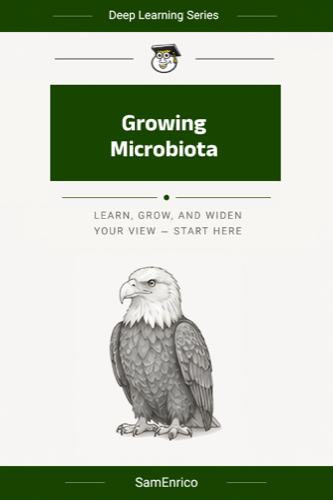
Non-FictionInformativeEducational
Growing Microbiota eBook
This publication, published by SamEnrico, covers G
by Lugo Kaye
This publication, published by SamEnrico, covers Growing Microbiota
Formats
Free sample
Chapter 1: The Myth of You--You are not who you think you are.For your entire life, you have operated under a comforting assumption: that the body you inhabit, the thoughts you think, and the decisions you make are the products of a single unified organism called “you.” Your doctor treats you as a single patient. Your mirror shows you a single person. Your mother gave you a single name.But the science of the last two decades has delivered an uncomfortable, even destabilizing truth: you are a minority in your own body.By cell count, you are outnumbered. By genetic information, you are dwarfed. And by evolutionary history, you are a newcomer.
The entity you call “self” is, in reality, a sprawling, teeming, ancient federation of trillions of invisible partners. You are not an individual. You are a holobiont—a composite organism made of human cells and an extraordinarily diverse community of bacteria, fungi, viruses, and archaea that live in and on you.This chapter is not merely an introduction to the microbiome. It is an invitation to undergo a fundamental shift in identity. Before we can talk about growing your microbiota—before we discuss prebiotics, probiotics, fermented foods, or any of the practical tools in this book—you must first accept a radical premise: your health is not solely your own.
It is shared. And the creatures you share it with have been shaping your destiny for 3.5 billion years.The Numbers That Changed Medicine Let us begin with a statistic that has haunted medical literature since 1972, when microbiologist Thomas Luckey published a now-famous calculation. Luckey estimated that the average human body contains roughly ten times as many microbial cells as human cells. Ten to one. You were, in other words, only 10% human by head count.That number has since been refined.
In 2016, a team of Israeli and Canadian researchers led by Ron Sender re-examined the data and produced a more accurate ratio: approximately 1.3 microbial cells for every one human cell. For a standard reference man (70 kilograms, 20–30 years old), that translates to roughly 39 trillion microbial cells and 30 trillion human cells.Do not let the correction comfort you. 1.3 to one still means you are carrying around a population roughly the size of the entire human civilization on Earth, times five thousand. If every microbe in your gut were a person, you would be a planet.But cell counts only tell part of the story. The genetic gap is far more staggering.
The human genome contains approximately 20,000 to 25,000 protein-coding genes. The collective genome of your microbiome—the metagenome—contains somewhere between 2 million and 20 million genes. That is not a hundredfold advantage. That is a hundredfold to thousandfold advantage.Your microbes carry the genetic instructions for functions your own cells never evolved: digesting complex plant fibers, synthesizing essential vitamins, metabolizing drugs, detoxifying carcinogens, and even producing neurotransmitters that influence your mood. You have outsourced critical aspects of your biology to an invisible army.
And that army, as you will learn throughout this book, is highly responsive to how you live, what you eat, and where you spend your time.A 3.5-Billion-Year Partnership To understand why your body is structured the way it is, you must travel back to a time before oxygen, before plants, before multicellular life of any kind. The Earth was a hostile place: hot, reducing, battered by ultraviolet radiation, and dominated by single-celled organisms living in microbial mats. Those organisms were the ancestors of everything alive today, including you.Approximately 2.5 billion years ago, a momentous event occurred. A larger archaeal cell engulfed a smaller bacterium. Instead of digesting it, the two formed a symbiotic relationship.
The bacterium produced energy in the form of ATP using oxygen, a toxic waste product at the time. The archaeal cell provided protection and nutrients. Over eons, that bacterium evolved into the mitochondrion—the power plant found in every human cell today.This was not a hostile takeover. It was a merger. And it set the template for every subsequent symbiotic relationship in your lineage.Fast forward to the present.
Your gut alone houses over a thousand species of bacteria, each occupying a specific niche. Some live freely in the lumen (the central cavity of your intestine). Others burrow into the mucus layer that lines your intestinal wall. Still others form biofilms—sticky, structured communities that resist flushing and create microenvironments.These microbes are not squatters. They are tenants who pay rent.
They break down dietary fiber into short-chain fatty acids like butyrate, propionate, and acetate. Butyrate, in particular, is the preferred energy source for your colon cells. Without it, your intestinal lining would starve and atrophy. Your microbes literally feed your own tissue.They also train your immune system. From the moment you are born, your microbiota teaches your immune cells to distinguish friend from foe.
Children raised in overly sterile environments—with limited microbial exposure—have higher rates of allergies, asthma, and autoimmune diseases. This is not a coincidence. It is the consequence of an untrained immune system attacking harmless pollen or your own tissues because it never learned the rules of engagement.The War on Germs: A Century of Misguided Violence If microbes are so essential, why has modern medicine spent the last century trying to destroy them?The answer lies in a collision of legitimate discovery and catastrophic overreach. In the late nineteenth century, Louis Pasteur and Robert Koch established the germ theory of disease: specific microbes cause specific illnesses. Pasteur showed that fermentation was a microbial process.
Koch identified the bacteria responsible for anthrax, tuberculosis, and cholera. For the first time in human history, doctors had a rational framework for understanding infectious disease.But the pendulum swung too far. The discovery of penicillin in 1928, followed by sulfa drugs and a flood of postwar antibiotics, created a culture of microbial eradication. Hand sanitizers, antibacterial soaps, disinfectant wipes, and sterilizing mouthwashes promised a germ-free existence. Advertising campaigns sold cleanliness as godliness and sterility as safety.The results were mixed at best.
Yes, antibiotics saved countless lives from bacterial pneumonia, sepsis, and wound infections. But the collateral damage was catastrophic. Broad-spectrum antibiotics do not discriminate. They kill pathogens and commensals alike. A single course of oral antibiotics can reduce gut microbial diversity by 25 to 30 percent, and some species never fully recover.Worse, the overuse of antibiotics created resistant superbugs.
Methicillin-resistant Staphylococcus aureus (MRSA), carbapenem-resistant Enterobacteriaceae (CRE), and multidrug-resistant Mycobacterium tuberculosis now kill hundreds of thousands of people annually. We waged a war on microbes, and the microbes adapted. They always do.The hygiene hypothesis—first proposed by David Strachan in 1989—offered a partial correction. Strachan observed that children in larger families had fewer allergies, likely because they were exposed to more microbes from their siblings. The hypothesis evolved into the old friends hypothesis: we evolved alongside certain microbes that play essential roles in immune development.
Removing those old friends, as modern hygiene does, leaves the immune system underdeveloped and prone to overreaction.But even the old friends hypothesis misses a deeper truth. You are not meant to be sterile. You are meant to be colonized. A sterile gut is a dead gut. A sterile home is a biological desert.
The goal is not to eliminate microbes but to cultivate the right ones.Introducing the Garden Metaphor This book will use…
This is the end of the free sample. Get the eBook to keep going. Buy now
About this book
Details
- Author
- Lugo Kaye
- Publisher
- SamEnrico
- Language
- English
- Genre
- Non-Fiction, Informative, Educational
- Released
- 2026-06-02
- Pages (approx.)
- 153
- Available as
- eBook, Audiobook

Read better in the ZLOADR app
Your eBooks on your phone or tablet. Sign in with your SamEnrico account and start reading.
More by Lugo Kaye
 Recurring Dreams and Anxiety DisordersLugo Kaye$11.99
 Mentorship for FilmmakersLugo Kaye$11.99
 Wholesaling LLC Formation GuideLugo Kaye$11.99
 Digital Health Capital DeploymentLugo Kaye$11.99
 Self Esteem for First Generation ProsLugo Kaye$11.99
 Spin 45 Minute Express RidesLugo Kaye$11.99
 The Time Slip TheoryLugo Kaye$11.99
 Fence To The Antwerp JobLugo Kaye$11.99
 Counting Down Anger GuideLugo Kaye$11.99
 The Persian Bard and the Lost Script: Unveiling the Middle East's Arthurian LegacyLugo Kaye$11.99
 The Unseen Brushstrokes: How Yayoi Kusama Reinvented the Art WorldLugo Kaye$11.99
 Baba Yaga’s Bone House: The Witch Who Walks on Chicken LegsLugo Kaye$11.99
You may also like
 Hong Kong Handover 1997Dunn Johnnie$11.99
 Zumba For Postnatal Recovery CourseNeal Christian$11.99
 Zumba for BeginnersLadner Nikia$11.99
 YouTube Comment Mining GuideHumes Pandora$12.99
 Worry Box MeditationCarlin Rudy$11.99
 Workplace Stress MeditationNguyen Lynn$11.99
 Workplace Stress and Sleep RepairHawley Ivory$11.99
 Workplace Perfectionism CureDelaney Jeffry$11.99
 Workplace Injustice Anger GuideWallen Isabelle$11.99
 Work Addiction and Burnout LinkGreenwood Ester$11.99
 Women in Yoga and WellnessBeattie Galina$11.99
 Women in Stand Up ComedyChun Evangeline$11.99