
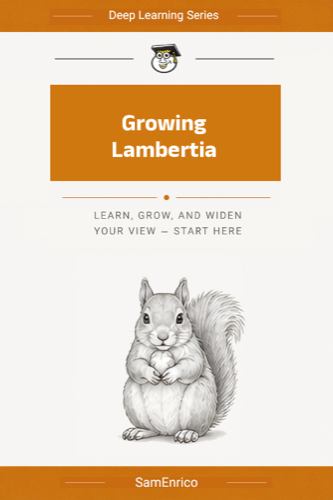
Non-FictionInformativeEducational
Growing Lambertia Audiobook
This publication, published by SamEnrico, covers G
by Webber Von
This publication, published by SamEnrico, covers Growing Lambertia
Formats
Free sample
Chapter 1: The Horned Survivor--–- It began, as most obsessions do, with a single plant that refused to die.My first encounter with Lambertia formosa was not an act of intention but of neglect. A friend had purchased a property on the New South Wales south coast, a windswept block of sandstone and sand that had been scraped clean by a bushfire two years prior. Among the blackened skeletons of introduced species—a dead photinia, a ghost of a camellia—one shrub had not only survived but thrived. It was ugly, by conventional garden standards. Its leaves were hard and prickly, like holly on steroids.
Its branches twisted in directions that seemed to have no logic. And emerging from its center were flowers the color of a warning sign: brilliant crimson-orange tubes clustered in whorls, each cluster surrounded by a collar of spiky bracts. The flowers looked like tiny explosions frozen in time.But it was the fruit that gave the plant its common name. Hard, woody, and shaped like a medieval mace, the follicles grew in pairs, each one tapering to a sharp point. They were, unmistakably, horns.
My friend, who had no interest in gardening whatsoever, called it "the devil plant." When I asked if she knew its real name, she shrugged and said, "It came with the house."That was my introduction to Lambertia formosa. And it was entirely wrong.Because Lambertia formosa is not one plant. It is ten. And the others—the round-leaved honeysuckle of Western Australia, the prickly honeysuckle of the Stirling Ranges, the many-flowered honeysuckle of the sandplains—are even stranger, even more beautiful, and even more misunderstood.The Genus That Time Forgot The genus Lambertia belongs to the Proteaceae, an ancient family that originated on the supercontinent Gondwana over one hundred million years ago. To put that in perspective: when the first Lambertia ancestors evolved, flowering plants were still a novelty.
Dinosaurs were still the dominant terrestrial vertebrates. Australia was still connected to Antarctica, South America, Africa, and India in a single landmass that stretched from the equator to the South Pole.The Proteaceae are survivors. They have weathered continental drift, dozens of ice ages, and the rise and fall of entire ecosystems. Today, their descendants are found across the southern hemisphere—Protea in South Africa, Embothrium in South America, Knightia in New Zealand, and Banksia and Grevillea and Lambertia in Australia. They are…
This is the end of the free sample. Get the Audiobook to keep going. Buy now
About this book
Details
- Author
- Webber Von
- Publisher
- SamEnrico
- Language
- English
- Genre
- Non-Fiction, Informative, Educational
- Released
- 2026-05-07
- Pages (approx.)
- 129
- Available as
- eBook, Audiobook

Listen in the VoxFlicks app
Audiobooks and audio dramas wherever you go. Sign in with your SamEnrico account and press play.
More by Webber Von
 Student Focus SystemWebber Von$11.99
 Biotin Hair Skin Nails GuideWebber Von$11.99
 Persuasive Investor Pitch DeckWebber Von$11.99
 BRCA Gene SurvivorWebber Von$11.99
 NVC for Project ManagersWebber Von$11.99
 Morning Routine Anger FixWebber Von$11.99
 House Dream Symbol JungianWebber Von$11.99
 Child Nonverbal Cues GuideWebber Von$11.99
 Anna Paquin TrueWebber Von$11.99
 Paws of the Pharaoh: The Hound of the NileWebber Von$11.99
 Dragonbone Whispers: The Lost Song of the Azure SerpentWebber Von$11.99
 The Ghosts of the Mary Celeste: The Last Voyage RevealedWebber Von$11.99
You may also like
 Hong Kong Handover 1997Dunn Johnnie$11.99
 Zumba For Postnatal Recovery CourseNeal Christian$11.99
 Zumba for BeginnersLadner Nikia$11.99
 YouTube Comment Mining GuideHumes Pandora$12.99
 Worry Box MeditationCarlin Rudy$11.99
 Workplace Stress MeditationNguyen Lynn$11.99
 Workplace Stress and Sleep RepairHawley Ivory$11.99
 Workplace Perfectionism CureDelaney Jeffry$11.99
 Workplace Injustice Anger GuideWallen Isabelle$11.99
 Work Addiction and Burnout LinkGreenwood Ester$11.99
 Women in Yoga and WellnessBeattie Galina$11.99
 Women in Stand Up ComedyChun Evangeline$11.99