
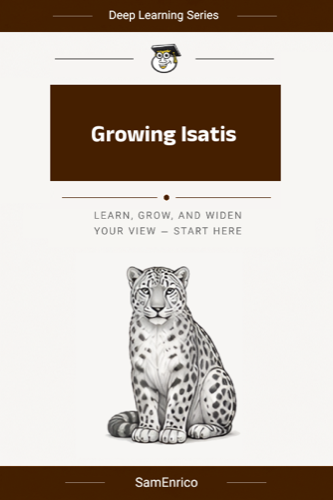
Non-FictionInformativeEducational
Growing Isatis eBook
This publication, published by SamEnrico, covers G
by Key Elane
This publication, published by SamEnrico, covers Growing Isatis
Formats
Free sample
Chapter 1: The Blue That Vanished--–- The first time I pulled a length of white silk from a woad vat and watched it turn from sickly yellow-green to a living, breathing blue in the span of ten seconds, I understood something that no history book had ever taught me. The color was not the flat, uniform blue of a synthetic dye bath. It was layered, complex, shifting between sky and storm depending on how the light fell. And it came from a plant that most people in my neighborhood would have called a weed.That morning, standing in my modest backyard in upstate New York with my hands stained indigo and my heart pounding, I realized I had stumbled into a conversation that had been interrupted for nearly two centuries. Before synthetic indigo, before globalization erased entire agricultural economies, woad—Isatis tinctoria—was empire fuel.
It was the blue that clothed peasants and kings alike. It was a crop so valuable that wars were fought over trade routes, and so culturally entrenched that in some regions, a dyer’s secret recipe was guarded like a military code.This book is not just a horticultural manual. It is an invitation to participate in a quiet revolution: the revival of a plant that shaped the Western world, one that can be grown by anyone with a patch of soil, a bit of patience, and a willingness to get their hands dirty. Over the next twelve chapters, I will teach you everything I have learned about growing Isatis—from seed stratification to pigment extraction, from managing the biennial rhythm to creating colors that will make you question why we ever abandoned natural dyes in the first place.But before we talk about soil p H or germination rates, we need to understand what we are actually growing. And to do that, we need to travel back in time.The Forgotten Empire of Blue Long before coffee or sugar became the commodities that reshaped the world, there was blue.
Specifically, there was the blue that came from a gangly, unassuming plant with small yellow flowers and deep taproots. Isatis tinctoria, or woad, was to medieval Europe what oil is to the modern Middle East: a strategic resource that determined wealth, power, and trade routes.The earliest archaeological evidence of woad use dates back to the Neolithic period, with traces of indigo found on pottery and textiles from 4000 BCE. But it was the Celts who first brought woad into the historical record. Roman historians, including Julius Caesar himself, wrote with a mixture of fascination and horror about the blue-painted warriors of Britain. Caesar claimed they painted themselves with woad before battle to terrify their enemies—a claim that has been debated by scholars ever since, but one that cemented the plant’s place in the Western imagination.Regardless of whether the Celts actually painted their skin or merely dyed their clothing, one thing is certain: by the time the Roman Empire began its decline, woad was already a major commercial crop across Gaul and Britain.
The plant thrived in temperate climates, required no tropical growing conditions, and produced a pigment that was both beautiful and remarkably stable.The economics of woad are staggering by modern standards. In the 13th century, the region around Toulouse, France, became known as the "Pays de Cocagne"—a land of plenty—entirely on the strength of its woad trade. The plant was processed into spheres called "woad balls," which were then shipped across Europe. These balls were so valuable that they were used as currency in some transactions. A single shipment could finance a merchant’s entire year.Woad dyers formed powerful guilds that controlled not just the production of the pigment but also the secrets of its use.
Dyeing with woad was notoriously difficult. Unlike the indigo from tropical Indigofera species, which could be reduced using relatively simple fermentation techniques, woad required a multi-step process that was as much alchemy as chemistry. The woad masters guarded their knowledge fiercely, passing it down through families and apprentices.Then came the 16th century, and with it, European colonialism. Portuguese and Dutch traders began importing true indigo (Indigofera tinctoria) from India and the East Indies. This indigo was up to thirty times more concentrated in pigment than woad.
It required less processing, produced brighter colors, and was ultimately cheaper to produce on colonial plantations. The European woad industry fought back—hard. In 1577, the German parliament banned the use of "the Devil's dye" (Indian indigo). France followed with similar laws, imposing the death penalty on anyone caught using indigo. England imposed heavy tariffs.But economics always wins.
By the 18th century, indigo had largely supplanted woad in commercial dyeing. The final death blow came in 1897, when German chemist Adolf von Baeyer synthesized indigo in a laboratory—a discovery that earned him a Nobel Prize and gave birth to the modern synthetic dye industry. Within two decades, natural indigo from both woad and Indigofera had all but disappeared from commercial use.The fields that had once grown woad were plowed under or converted to wheat. The dyers’ guilds dissolved. And a knowledge base that had been accumulated over five thousand years was almost lost entirely.Why Grow Woad Now?You might be wondering: if synthetic indigo is cheaper, more consistent, and more colorfast than anything I can grow in my backyard, why bother?
It is a fair question, and one that I asked myself when I first became interested in natural dyes.The answer, I have come to believe, is not about competition. It is about connection.Connection to Craft When you grow your own dye plants, you become part of an unbroken chain that stretches back to the first person who noticed that crushing certain leaves turned their fingers blue. You learn to read the land, to understand the relationship between soil chemistry and color, to anticipate the perfect harvest window with the same attention that a winemaker brings to a vintage. Synthetic indigo arrives in a plastic bucket with a Material Safety Data Sheet attached. Woad arrives in your garden, in the spring, after you have carefully stratified the seeds and coaxed the seedlings through their first fragile weeks.Connection to Place Woad is not a tropical import.
It evolved in the temperate regions of Europe and Central Asia, which means it thrives in the kind of climate that most of us actually live in. You do not need a greenhouse or a special microclimate. You need a patch of soil that gets decent sun, water once a week, and a willingness to wait through a biennial cycle. In an era when so many of our possessions come from supply chains that circle the globe, there is something profoundly satisfying about wearing a shirt dyed with pigment from leaves you harvested fifty feet from your back door.Connection to Ecology Industrial agriculture and synthetic dye production are among the most polluting industries on the planet. The synthetic indigo used to dye your blue jeans is produced from petroleum-derived aniline, a known carcinogen.
The reduction baths used to apply that indigo to fabric require sodium dithionite, which breaks down into toxic sulfates and…
This is the end of the free sample. Get the eBook to keep going. Buy now
About this book
Details
- Author
- Key Elane
- Publisher
- SamEnrico
- Language
- English
- Genre
- Non-Fiction, Informative, Educational
- Released
- 2026-06-02
- Pages (approx.)
- 143
- Available as
- eBook, Audiobook

Read better in the ZLOADR app
Your eBooks on your phone or tablet. Sign in with your SamEnrico account and start reading.
More by Key Elane
 Tension Headache Massage TechniquesKey Elane$11.99
 CPR Shock AdvisoryKey Elane$11.99
 Kapalabhati Skull Shine BreathKey Elane$11.99
 Medium Writer InfluencerKey Elane$11.99
 The Story ReleaseKey Elane$11.99
 Joyful Caregiver Gratitude GuideKey Elane$11.99
 Jonathan Ross BigKey Elane$11.99
 Coconut Telegraph Across OceansKey Elane$11.99
 John McConnell Wendy's NHLKey Elane$11.99
 The Gold Chains of Hip-Hop: How Ancient Egypt Inspired Hip-Hop’s First Fashion EmpireKey Elane$11.99
 Operation Golden Lily: The Lost Treasure Hunt of World War IIKey Elane$11.99
 The Star Keepers of Ancient Ethiopia: How the Axumite Astronomers Mapped the HeavensKey Elane$11.99
You may also like
 Hong Kong Handover 1997Dunn Johnnie$11.99
 Zumba For Postnatal Recovery CourseNeal Christian$11.99
 Zumba for BeginnersLadner Nikia$11.99
 YouTube Comment Mining GuideHumes Pandora$12.99
 Worry Box MeditationCarlin Rudy$11.99
 Workplace Stress MeditationNguyen Lynn$11.99
 Workplace Stress and Sleep RepairHawley Ivory$11.99
 Workplace Perfectionism CureDelaney Jeffry$11.99
 Workplace Injustice Anger GuideWallen Isabelle$11.99
 Work Addiction and Burnout LinkGreenwood Ester$11.99
 Women in Yoga and WellnessBeattie Galina$11.99
 Women in Stand Up ComedyChun Evangeline$11.99