
Non-FictionInformativeEducational
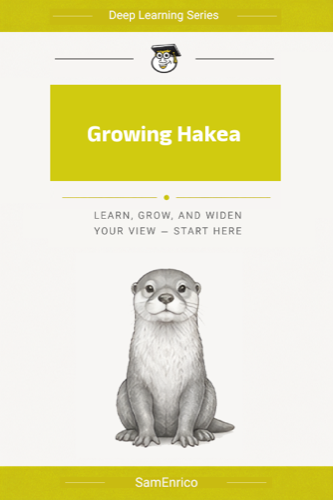
Growing Hakea Audiobook
This publication, published by SamEnrico, covers G
This publication, published by SamEnrico, covers Growing Hakea
Formats
Free sample
Chapter 1: Beyond the Needle...–- It was the thorns that nearly fooled everyone. For over two hundred years, gardeners, botanists, and even passionate native plant enthusiasts have walked past the genus Hakea with a mixture of respect and fear—respect for its ability to survive where other plants turn to dust, and fear of the vicious, needle-sharp foliage that adorns so many of its species. The common names say it all: Needle Bush, Dagger Hakea, Prickly Hakea, Pin-cushion Hakea. These are not names born of affection. They are warnings.
And because of those warnings, the Hakea has been relegated to the role of the garden's bouncer—the impenetrable hedge, the roadside barrier, the plant you install once and then ignore for a decade, hoping it will just stay alive and stay out of the way. But this reputation, earned honestly by a handful of spiky species, has done a profound disservice to one of the most spectacular, diverse, and garden-worthy genera in the entire plant kingdom. The truth, hidden beneath those needles, is that Hakea is not a botanical thug. It is a botanical artist. It sculpts foliage into kaleidoscopic patterns, produces flowers that resemble sea-urchins, pincushions, and exploding fireworks, and has evolved survival strategies so ingenious that they make other drought-tolerant plants look like rank amateurs.
This chapter is not an introduction. It is an unmasking. We are going to tear down the "needle bush" stereotype, brick by painful brick, and reveal the Hakea for what it truly is: a plant of extraordinary beauty, ecological importance, and surprising adaptability. We will trace its history from the herbariums of eighteenth-century Germany to the biodiversity hotspots of Western Australia. We will draw sharp distinctions between Hakea and its more famous cousins Banksia and Grevillea.
And we will set the stage for a radical shift in perspective: the shift from seeing Hakea as a survivor to cultivating it as a feature. By the time you finish this chapter, you will understand why the smartest gardeners in Mediterranean climates around the world—from California to South Africa to southern Europe—are quietly abandoning their water-hungry roses and planting Hakeas instead. You will understand why the "poor relation" of the Proteaceae family is finally getting its moment in the sun.The Baron’s Unlikely Legacy: A Name Without a Place Every genus has a story behind its name. Some are romantic, commemorating explorers who nearly died to collect…
This is the end of the free sample. Get the Audiobook to keep going. Buy now
About this book
Details
- Author
- Blum Faustina
- Publisher
- SamEnrico
- Language
- English
- Genre
- Non-Fiction, Informative, Educational
- Released
- 2026-06-02
- Pages (approx.)
- 148
- Available as
- eBook, Audiobook

Listen in the VoxFlicks app
Audiobooks and audio dramas wherever you go. Sign in with your SamEnrico account and press play.
More by Blum Faustina
 Child Loss And GrandparentsBlum Faustina$11.99
 Young Adult Parent Loss GuideBlum Faustina$11.99
 The Nap Timing WindowBlum Faustina$11.99
 Pain During Sleep MeditationBlum Faustina$11.99
 CrossFit vs BodybuildingBlum Faustina$11.99
 Mnemonic Devices GuideBlum Faustina$11.99
 The Bad News BreathingBlum Faustina$11.99
 Motivational Interviewing GuideBlum Faustina$11.99
 Assertiveness For The FaithfulBlum Faustina$11.99
 The Last Scribe of the Library of AlexandriaBlum Faustina$11.99
 The Algorithm That Stole Christmas: How Data Dominated the HolidaysBlum Faustina$11.99
 The Day the Internet Almost Broke: How a Single Tweet Crashed the WebBlum Faustina$11.99
You may also like
 Hong Kong Handover 1997Dunn Johnnie$11.99
 Zumba For Postnatal Recovery CourseNeal Christian$11.99
 Zumba for BeginnersLadner Nikia$11.99
 YouTube Comment Mining GuideHumes Pandora$12.99
 Worry Box MeditationCarlin Rudy$11.99
 Workplace Stress MeditationNguyen Lynn$11.99
 Workplace Stress and Sleep RepairHawley Ivory$11.99
 Workplace Perfectionism CureDelaney Jeffry$11.99
 Workplace Injustice Anger GuideWallen Isabelle$11.99
 Work Addiction and Burnout LinkGreenwood Ester$11.99
 Women in Yoga and WellnessBeattie Galina$11.99
 Women in Stand Up ComedyChun Evangeline$11.99