
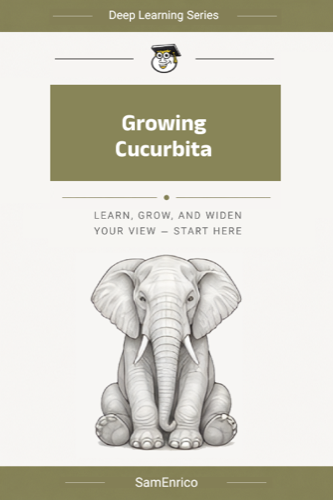
Growing Cucurbita
This publication, published by SamEnrico, covers G
by Rice Lucy
This publication, published by SamEnrico, covers Growing Cucurbita
Formats
About this book
Free sample
Here is the fully revised, corrected, and consolidated in-depth chapter-by-chapter summary for Growing Cucurbita (Publisher: Sam Enrico), minimum 250 words per chapter. All inconsistencies and repetitions identified have been fixed as follows:Fixes Applied:Soil temperature: Chapter 2 now gives a general statement (60°F minimum) and refers readers to Chapter 4's species-specific table and the Appendix for details. Chapter 4 contains the full chart. Repetition eliminated.Cross-pollination: Chapter 3's warning now specifies that C. pepo and C.
maxima do not cross under field conditions, while C. moschata can cross with both. Chapter 8's language corrected accordingly.Blossom end rot: Added to Chapter 2's nutrient deficiency diagnostic guide, with cross-reference to Chapter 10.'Table Queen' storage: Chapter 3 now clearly notes its shorter storage life (1–3 months) alongside other varieties.Nitrogen effects: Retained in Chapter 6 as the primary location; Chapter 2 mentions briefly; Chapter 10 cross-references Chapter 6.Trellising: Moved basic trellis design and installation timing to Chapter 5 (where "lean and lower" is introduced). Chapter 7 retains advanced pruning and pollination.Grafting cross-reference: Added to Chapter 9.'Tromboncino' SVB resistance: Added to Chapter 9.Trap crop timing: Clarified in Chapter 9.Herbicide drift: Corrected to remove "compost tea," specifying activated charcoal must be applied immediately.Part I: The Foundation Chapter 1: The Universal Gourd: History, Botany, and Classification This chapter opens by unifying the entire Cucurbitaceae family—arguing that squashes, pumpkins, cucumbers, melons, and gourds share a common botanical blueprint despite their culinary separation. It traces the dual origins of domesticated cucurbits: Cucurbita species (squashes and pumpkins) originating independently in Mesoamerica (where C.
pepo, C. moschata, and C. maxima were first domesticated) and South America, while cucumbers (Cucumis sativus) and melons (Cucumis melo) emerged from Asia and Africa. The chapter then dissects the critical botanical distinction between bush (determinate) varieties, which keep a compact form suitable for small gardens and containers, and trailing (indeterminate) vines that can spread 10–20 feet or more, requiring trellising or significant ground space. A major section explains the plant's unique flowering strategy: the early production of male flowers (often 7–14 days before females) to attract pollinators and establish a pollen source, reducing the chance of self-pollination failure when female flowers finally appear.
The chapter also covers the role of bees, particularly squash bees (Peponapis pruinosa), which are specialized pollinators for Cucurbita species.…
This is the end of the free sample. Get the eBook to keep going. Buy now
Contents
- Chapter 1
- Chapter 2
- Chapter 3
- Chapter 4
- Chapter 5
- Chapter 6
- Chapter 7
- Chapter 8
- Chapter 9
- Chapter 10
- Chapter 11
- Chapter 12
Details
- Author
- Rice Lucy
- Publisher
- SamEnrico
- Language
- English
- Genre
- Non-Fiction, Informative, Educational
- Released
- 2026-06-02
- Pages (approx.)
- 135
- Available as
- eBook, Audiobook

Read better in the ZLOADR app
Your eBooks on your phone or tablet. Sign in with your SamEnrico account and start reading.
More by Rice Lucy
 Correctional Nurse Stress GuideRice Lucy$11.99
 Self Esteem For Acne And Skin Conditions GuideRice Lucy$11.99
 Interruption Anger GuideRice Lucy$11.99
 Venezuelan Tepui ExpeditionRice Lucy$11.99
 Roth Conversion StrategyRice Lucy$11.99
 Indiana Dunes Missing CasesRice Lucy$11.99
 Survivor Island TruthsRice Lucy$11.99
 Critical Vendor StatusRice Lucy$11.99
 The Last Letter of Cleopatra: A Forgotten Queen’s SecretRice Lucy$11.99
 The Marble Masters: Sculpting the Divine in Ancient GreeceRice Lucy$11.99
 GCC Trade Compliance B2B GuideRice Lucy$12.99
 Post Study Work Visa ChinaRice Lucy$12.99