
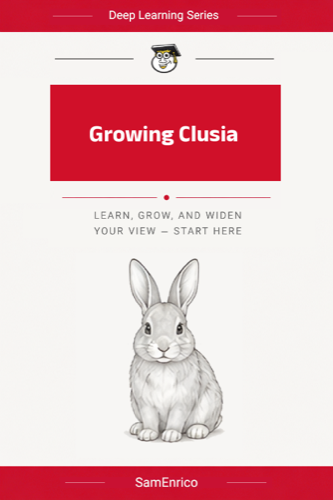
Non-FictionInformativeEducational
Growing Clusia eBook
This publication, published by SamEnrico, covers G
This publication, published by SamEnrico, covers Growing Clusia
Formats
Free sample
Chapter 1: The Strangler That Wasn't...--You have probably heard the rumor. Maybe it came from a well-meaning nursery employee, a gardening blog with outdated information, or a neighbor who once planted something they regretted. The rumor sounds something like this: "Don't plant Clusia near your house. It's a strangler fig. It will wrap around your foundation.
It will eat your other trees. It will take over your yard like something out of a horror movie."Let me stop you right there.That rumor is wrong. And not just a little wrong—the kind of spectacularly, confidently, repeatedly wrong that has caused countless gardeners to miss out on one of the most rewarding, resilient, and fascinating plants they could ever grow. The Clusia family has been saddled with a reputation it simply does not deserve, and the purpose of this chapter—indeed, a central purpose of this entire book—is to set the record straight.I have stood in front of audiences at garden clubs in Miami, at horticulture conferences in Orlando, and in front of potting benches at nurseries from Key West to Tampa. Every single time I mention Clusia, someone raises their hand and asks the same question: "Isn't that the tree that kills other trees?"The answer is no.
But the fact that the question gets asked so often tells us something important: confusion about Clusia's origins, its growth habits, and its true nature is widespread. And that confusion leads to real problems. Gardeners avoid planting Clusia altogether. Homeowners who do plant it put it in the wrong location because they misunderstood its mature size. Landscapers choose inferior plants because they believe the myths.This chapter will give you something more valuable than a simple "no." It will give you the complete, accurate, fascinating story of where Clusia comes from, who its relatives are, how it actually grows in the wild, and—most importantly—how that wild behavior translates into your garden or your living room.
By the time you finish these pages, you will know Clusia better than 99% of the people selling it. And you will never fall for the strangler myth again.The Two Faces of Clusia: A Tale of Very Different Cousins Before we can understand Clusia, we have to acknowledge a fundamental truth that most gardening books gloss over: the word "Clusia" refers to a whole genus of plants, and within that genus, there are two species that you are likely to encounter. They look different. They behave differently. They serve different purposes in the landscape.
And confusing them is the single most common mistake new growers make.Let me introduce you to the two main characters in the Clusia story.Clusia rosea. This is the large one. The dramatic one. The one that botanists call the Autograph Tree because its leaves are so thick and waxy that you can carve your name into them with a fingernail—and the mark will stay there for months, growing larger as the leaf expands, like a signature aging with the plant. Clusia rosea produces leaves that are rounded, paddle-shaped, and easily the size of your outstretched hand, sometimes larger.
In its native habitat, it can reach 30 or even 40 feet tall, though in cultivation it typically tops out between 20 and 25 feet. The branches are thick and somewhat irregular, giving mature specimens a sculptural, almost Mediterranean quality. This is a tree that demands attention. You plant Clusia rosea when you want a statement, a focal point, a living piece of art that will draw the eye from across the yard.Clusia guttifera. This is the small one.
The tidy one. The one that nursery owners often call Small Leaf Clusia (though strictly speaking, its leaves are not actually leaves in the botanical sense but rather modified stems called cladodes—a fascinating detail we will explore later). The leaves of Clusia guttifera are tiny, dense, and numerous, creating a surface that looks almost like green velvet from a distance. Here is the critical detail that many sources get wrong: Clusia guttifera is often described as a shrub that stays 6 to 10 feet tall. But that is only true if you trim it regularly.
Without pruning, Clusia guttifera will eventually reach 15 to 20 feet, just like its larger cousin. The difference is not in ultimate size potential but in how the plant responds to your maintenance. Clusia guttifera tolerates frequent trimming beautifully, which is why it has become the hedge plant of choice across Florida, the Caribbean, and increasingly in Mediterranean climates. You plant Clusia guttifera when you want a wall, a screen, a living fence that gives you privacy without giving you the maintenance nightmares of ficus hedges.I want to pause here and emphasize something important. I cannot tell you how many emails I have received from frustrated gardeners who bought a Clusia guttifera at a big box nursery, planted it under a window expecting it to stay low, and then returned from a summer vacation to find that their "small shrub" had grown past the windowsill.
The nursery label said "grows 6 to 10 feet." The label did not say "grows 6 to 10 feet if you cut it every six weeks." That omission has caused real disappointment. So let me be absolutely clear: if you want a low-growing plant that requires no pruning, Clusia—any Clusia—is not for you. But if you are willing to trim once a month during the growing season, Clusia guttifera will reward you with the densest, most attractive, most salt-tolerant hedge you have ever seen.The Collector's Corner: Rare Clusias Worth Knowing Beyond the two workhorses of the landscaping world, the Clusia genus contains over 300 species, and a handful of them are slowly making their way into the collections of serious plant enthusiasts. If you are the kind of gardener who gets excited about the unusual, the hard-to-find, the plant that makes visitors stop and say "What is that?"—then pay attention.Clusia orthoneura. Sometimes sold under the common name "Red Tip Clusia," this species features striking red or burgundy coloration on the newest growth.
The contrast between the mature green leaves and the crimson tips is genuinely beautiful, and the effect changes with the seasons—more red in bright light, more green in shade. Clusia orthoneura grows more slowly than its cousins, which makes it a better choice for container growing and indoor cultivation. It is also more sensitive to cold, so northern growers should keep it inside year-round.Clusia major. This species is often confused with Clusia rosea, and honestly, even experienced botanists sometimes struggle to tell them apart. The key difference is in the leaf margin: Clusia major has slightly serrated (toothed) edges, while Clusia rosea is completely smooth.
For the average gardener, the distinction hardly matters because their care requirements are identical. But if you are a collector who wants to be precise, look for those tiny teeth along the leaf edge.Clusia fluminensis. Native to the coastal regions of southeastern Brazil, this species has narrower, more elongated leaves than the paddle-shaped rosea. It is also more cold-tolerant than most Clusias, surviving brief dips to 25 degrees Fahrenheit without significant damage. If you live on the edge of Clusia's hardiness range (say, Zone…
This is the end of the free sample. Get the eBook to keep going. Buy now
About this book
Details
- Author
- Haines Valentine
- Publisher
- SamEnrico
- Language
- English
- Genre
- Non-Fiction, Informative, Educational
- Released
- 2026-05-09
- Pages (approx.)
- 136
- Available as
- eBook, Audiobook

Read better in the ZLOADR app
Your eBooks on your phone or tablet. Sign in with your SamEnrico account and start reading.
More by Haines Valentine
 Thrift Store Addiction HelpHaines Valentine$11.99
 The Back To School Money StressHaines Valentine$11.99
 Self Hypnosis For Squash PerformanceHaines Valentine$11.99
 Freudian Dream MythsHaines Valentine$11.99
 Caregiver Burnout PreventionHaines Valentine$11.99
 The Exit Interview RelationshipHaines Valentine$11.99
 Morning Worry RitualHaines Valentine$11.99
 George Carlin WordsHaines Valentine$11.99
 Anapanasati for PostpartumHaines Valentine$11.99
 Mount Vesuvius and the Birth of Volcanology: Sir William Hamilton’s LegacyHaines Valentine$11.99
 Thunder Over the Yalu: The Forgotten Aerial War of Korea (1950-52)Haines Valentine$11.99
 College Essay Mental Health DisclosureHaines Valentine$12.99
You may also like
 Hong Kong Handover 1997Dunn Johnnie$11.99
 Zumba For Postnatal Recovery CourseNeal Christian$11.99
 Zumba for BeginnersLadner Nikia$11.99
 YouTube Comment Mining GuideHumes Pandora$12.99
 Worry Box MeditationCarlin Rudy$11.99
 Workplace Stress MeditationNguyen Lynn$11.99
 Workplace Stress and Sleep RepairHawley Ivory$11.99
 Workplace Perfectionism CureDelaney Jeffry$11.99
 Workplace Injustice Anger GuideWallen Isabelle$11.99
 Work Addiction and Burnout LinkGreenwood Ester$11.99
 Women in Yoga and WellnessBeattie Galina$11.99
 Women in Stand Up ComedyChun Evangeline$11.99