
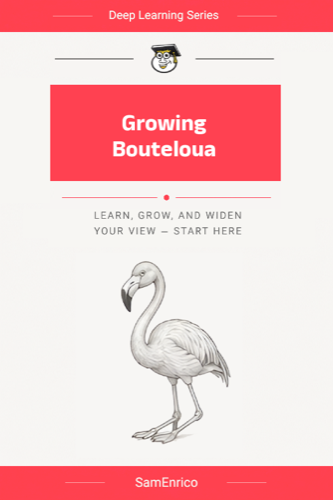
Non-FictionInformativeEducational
Growing Bouteloua
This publication, published by SamEnrico, covers G
This publication, published by SamEnrico, covers Growing Bouteloua
Formats
About this book
Free sample
Chapter 1: The Grass That Refuses to Die...–- On a blistering July afternoon in the high plains of eastern Colorado, where the temperature hovers at 102°F and no rain has fallen for fifty-three days, most plants have surrendered. The introduced Kentucky bluegrass lawns around farmhouses are crisp and brown—not dormant, but dead. The fescues have melted into patches of gray sludge. Even the resilient bindweed has curled its leaves into tight fists of desperation. But out on the prairie, where the top two inches of soil register less than 5 percent moisture, a clump of Blue Grama stands unbowed.
Its leaves have rolled into tight cylinders, reducing surface area by nearly 70 percent. Its color has shifted from vibrant green to a soft, straw-like tan. To the untrained eye, it appears dead. But beneath the soil, six feet down, a network of fine roots continues to draw just enough moisture to keep the crown alive. The plant is not dying.
It is waiting.This is the superpower of Bouteloua. And before you can grow it, before you can select the right cultivar or prepare your soil or water your first seed, you must understand what makes this genus biologically extraordinary. This chapter is not a dry botanical lecture. It is an exploration of survival architecture—a deep dive into the evolutionary toolkit that allows a handful of grass species to thrive where others perish. By the time you finish, you will see Bouteloua not as a plant but as a masterwork of engineering honed over twenty million years.The C4 Revolution: Photosynthesis on Hard Mode Let us begin with the most fundamental difference between Bouteloua and the grasses that currently occupy most American lawns.
The cool-season turf grasses—Kentucky bluegrass, perennial ryegrass, tall fescue—are C3 plants. The "C3" refers to the three-carbon compound produced during the first step of photosynthesis. This pathway evolved under conditions of moderate temperatures and consistent moisture. When temperatures rise above 85°F, C3 plants face a cruel dilemma. To prevent water loss, they close the stomata—the microscopic pores on leaf surfaces that allow gas exchange.
But with stomata closed, carbon dioxide cannot enter. Photosynthesis grinds to a halt. The plant begins to starve in the…
This is the end of the free sample. Get the eBook to keep going. Buy now
Contents
- Chapter 1
- Chapter 2
- Chapter 3
- Chapter 4
- Chapter 5
- Chapter 6
- Chapter 7
- Chapter 8
- Chapter 9
- Chapter 10
- Chapter 11
- Chapter 12
Details
- Author
- Mello Kenyetta
- Publisher
- SamEnrico
- Language
- English
- Genre
- Non-Fiction, Informative, Educational
- Released
- 2026-05-07
- Pages (approx.)
- 121
- Available as
- eBook, Audiobook

Read better in the ZLOADR app
Your eBooks on your phone or tablet. Sign in with your SamEnrico account and start reading.
More by Mello Kenyetta
 Notion Page Hierarchy Best PracticesMello Kenyetta$11.99
 Dentist Anxiety PracticeMello Kenyetta$11.99
 Detroit Giants Stadium Concrete Burial MythMello Kenyetta$11.99
 SMART Relevant GoalsMello Kenyetta$11.99
 Payday Loan Trap EscapeMello Kenyetta$11.99
 Anti NATO Protest OrganizerMello Kenyetta$11.99
 WeChat Moments Envy AnalysisMello Kenyetta$11.99
 Job Loss and Unemployment BenefitsMello Kenyetta$11.99
 La Furia de los Andes: The Untold Story of Luis Ocaña's Tour de France TriumphMello Kenyetta$11.99
 The Ballad of the Prussian Pigeon: Love, War, and the Impossible Feat of 1757Mello Kenyetta$11.99
 Natural Language to SQL for Finance TeamsMello Kenyetta$12.99
 Difficult Boss Self Care WorkbookMello Kenyetta$12.99
You may also like
 Hong Kong Handover 1997Dunn Johnnie$11.99
 Zumba For Postnatal Recovery CourseNeal Christian$11.99
 Zumba for BeginnersLadner Nikia$11.99
 YouTube Comment Mining GuideHumes Pandora$12.99
 Worry Box MeditationCarlin Rudy$11.99
 Workplace Stress MeditationNguyen Lynn$11.99
 Workplace Stress and Sleep RepairHawley Ivory$11.99
 Workplace Perfectionism CureDelaney Jeffry$11.99
 Workplace Injustice Anger GuideWallen Isabelle$11.99
 Work Addiction and Burnout LinkGreenwood Ester$11.99
 Women in Yoga and WellnessBeattie Galina$11.99
 Women in Stand Up ComedyChun Evangeline$11.99