
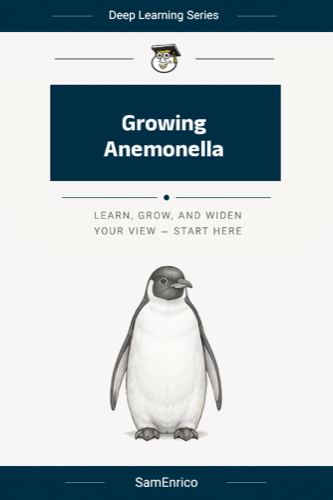
Non-FictionInformativeEducational
Growing Anemonella
This publication, published by SamEnrico, covers G
This publication, published by SamEnrico, covers Growing Anemonella
Formats
About this book
Free sample
Chapter 1: What Lies Beneath--–- The first time I killed an Anemonella, I was trying to save it. I had read somewhere that all woodland plants needed rich, deep leaf litter, so I piled on six inches of shredded hardwood mulch, tucked the tiny bare-root tubers into a shady corner of my garden, and watered them lovingly every third day. They emerged that spring with delicate, hopeful foliage—then turned yellow, collapsed, and vanished by May. I assumed they had died. I threw them on the compost pile and forgot about them for an entire year.
The following spring, I found them blooming in the compost heap, thriving in conditions no gardener would ever recommend: full sun, poor soil, and complete neglect. That was my first lesson in the great paradox of growing Anemonella thalictroides. The plant does not want your help. It wants you to get out of its way.This chapter is not a gentle introduction. It is an unmasking.
We begin not with planting instructions or cultivar recommendations—those come later, in their proper place—but with the fundamental question that every gardener must answer before buying a single tuber: what is this plant, truly, beneath its delicate flowers and its misleading common names? Because Anemonella is not what it appears to be. It is not a rue. It is not an anemone. It is not a fragile thing that needs constant coddling.
And once you understand what it actually is—its evolutionary history, its taxonomic identity, its chemical defenses, its ancient lineage within the buttercup family—you will stop treating it like a hothouse orchid and start treating it like the resilient, specific, brilliantly adapted native plant that it is.Let us begin with the name, because names carry assumptions, and assumptions kill plants.The Trouble with Common Names Walk into any native plant nursery in the eastern United States and ask for "Rue Anemone." The staff will point you toward a flat of small, delicate plants with white flowers and Thalictrum-like leaves. But here is the problem: the plant is not a rue. True rues belong to the genus…
This is the end of the free sample. Get the eBook to keep going. Buy now
Contents
- Chapter 1
- Chapter 2
- Chapter 3
- Chapter 4
- Chapter 5
- Chapter 6
- Chapter 7
- Chapter 8
- Chapter 9
- Chapter 10
- Chapter 11
- Chapter 12
Details
- Author
- Cabral Eleanore
- Publisher
- SamEnrico
- Language
- English
- Genre
- Non-Fiction, Informative, Educational
- Released
- 2026-06-03
- Pages (approx.)
- 155
- Available as
- eBook, Audiobook

Read better in the ZLOADR app
Your eBooks on your phone or tablet. Sign in with your SamEnrico account and start reading.
More by Cabral Eleanore
 NA Twelve Steps Specific Application GuideCabral Eleanore$11.99
 Letting Go of Childhood WoundsCabral Eleanore$11.99
 Goal Setting for Real EstateCabral Eleanore$11.99
 SMART Goals HandbookCabral Eleanore$11.99
 Corporate Customer Success to NonprofitCabral Eleanore$11.99
 Car Allowance NegotiationCabral Eleanore$11.99
 Frank Drake BioCabral Eleanore$11.99
 Suicide and WorkCabral Eleanore$11.99
 The Tongue of the World: The Legendary Linguist of TimbuktuCabral Eleanore$11.99
 The Phoenix of Nairobi: How a Theater Director Rebuilt a City After FireCabral Eleanore$11.99
 A Collector's Handbook to the Peugeot 404 CoupèCabral Eleanore$11.99
 Ransomware Forensic Investigation GuideCabral Eleanore$12.99
You may also like
 Hong Kong Handover 1997Dunn Johnnie$11.99
 Zumba For Postnatal Recovery CourseNeal Christian$11.99
 Zumba for BeginnersLadner Nikia$11.99
 YouTube Comment Mining GuideHumes Pandora$12.99
 Worry Box MeditationCarlin Rudy$11.99
 Workplace Stress MeditationNguyen Lynn$11.99
 Workplace Stress and Sleep RepairHawley Ivory$11.99
 Workplace Perfectionism CureDelaney Jeffry$11.99
 Workplace Injustice Anger GuideWallen Isabelle$11.99
 Work Addiction and Burnout LinkGreenwood Ester$11.99
 Women in Yoga and WellnessBeattie Galina$11.99
 Women in Stand Up ComedyChun Evangeline$11.99