
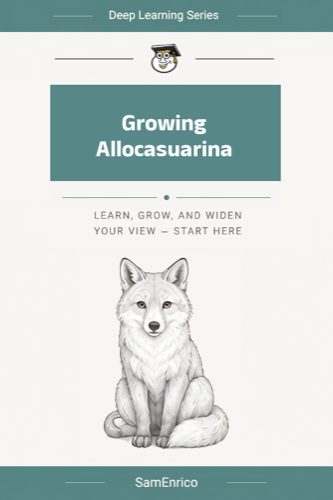
Growing Allocasuarina
This publication, published by SamEnrico, covers G
by Artis Elodia
This publication, published by SamEnrico, covers Growing Allocasuarina
Formats
About this book
Free sample
Chapter 1: The Sheoak Awakening--–- When I first encountered a mature Allocasuarina verticillata on a windswept hill in South Australia, I mistook it for a dying conifer. The drooping, needle-like foliage was gray-green, the ground beneath was carpeted with what looked like brown pine needles, and the woody cones scattered at the base reminded me of small, abandoned birdhouses. I walked past it without a second thought, dismissing it as an unremarkable, perhaps unhealthy, tree. That was my first mistake. Three years later, after watching that same tree withstand a summer drought that killed half the eucalypts in the valley, after learning that its “needles” were actually modified stems performing photosynthesis, and after discovering that its roots harbored bacteria capable of converting atmospheric nitrogen into plant food, I realized I had walked past one of the most remarkable, resilient, and misunderstood plant genera on Earth.
This book is written for everyone who has made that same mistake – and who is ready to discover why Allocasuarina deserves a place in gardens, farms, and restoration projects across the world.A Genus Apart: Why Allocasuarina Is Not Casuarina For much of the twentieth century, the trees we now call Allocasuarina were lumped together with their close relatives under the single genus Casuarina. The name came from the Latin word for cassowary – casuarius – because the drooping branchlets of some species resembled the feathers of that large, flightless bird. It was a poetic name, but taxonomically imprecise. In 1982, Australian botanist Lawrie Johnson published a landmark revision that split the group, reserving Casuarina for a handful of species (primarily the beach sheoak, Casuarina equisetifolia, and its closest relatives) and creating a new genus, Allocasuarina, for the remaining thirty-odd species. The distinction was not merely academic.
Allocasuarina species tend to have more slender, more distinctly drooping branchlets, with fewer teeth (the reduced leaves) per whorl – typically eight to twelve, compared with the twelve to twenty seen in Casuarina. Their cones are smaller, their wood is generally denser, and their ecological preferences lean toward well-drained, often rocky or sandy soils, whereas some Casuarina species tolerate waterlogged conditions.Why…
This is the end of the free sample. Get the eBook to keep going. Buy now
Contents
- Chapter 1
- Chapter 2
- Chapter 3
- Chapter 4
- Chapter 5
- Chapter 6
- Chapter 7
- Chapter 8
- Chapter 9
- Chapter 10
- Chapter 11
- Chapter 12
Details
- Author
- Artis Elodia
- Publisher
- SamEnrico
- Language
- English
- Genre
- Non-Fiction, Informative, Educational
- Released
- 2026-06-03
- Pages (approx.)
- 139
- Available as
- eBook, Audiobook

Read better in the ZLOADR app
Your eBooks on your phone or tablet. Sign in with your SamEnrico account and start reading.
More by Artis Elodia
 Grief and Marriage After Parent LossArtis Elodia$11.99
 Twelve Step Phone List UsageArtis Elodia$11.99
 Uber Late Night StrategyArtis Elodia$11.99
 Growth Hormone and Kidney FunctionArtis Elodia$11.99
 Drive Time Affirmations Audio GuideArtis Elodia$11.99
 Madalyn Murray O HairArtis Elodia$11.99
 Control of Records RetentionArtis Elodia$11.99
 Congressional Hearings on EquifaxArtis Elodia$11.99
 The Marble Masters: Michelangelo and the Birth of Renaissance SculptureArtis Elodia$11.99
 The Ball That Crossed Kingdoms: How Medieval Football Shaped Australian RulesArtis Elodia$11.99
 How to Produce a WoodchipperArtis Elodia$11.99
 A Collector's Handbook to the Packard SixArtis Elodia$11.99