
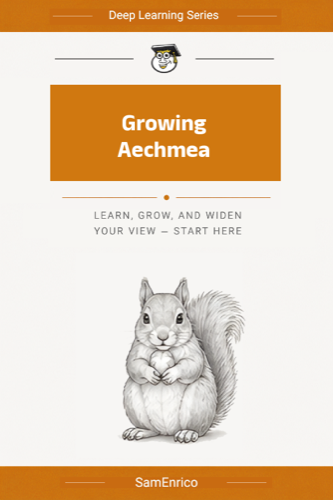
Growing Aechmea eBook
This publication, published by SamEnrico, covers G
by Guerin Trinh
This publication, published by SamEnrico, covers Growing Aechmea
Formats
Free sample
Chapter 1: Why This Plant...--You have likely killed a houseplant before. Perhaps it was a fiddle leaf fig that dropped every leaf within three months. Maybe it was a fern that turned crisp and brown despite your daily misting. Or a succulent that rotted into black mush because you loved it too much—meaning you watered it more than twice a year. If any of this sounds familiar, take a deep breath.
Your plant murdering days are over.The plant you are about to meet is different. It does not need daily attention. It does not require perfect soil. It does not throw a tantrum if you forget to water it for a week. In fact, it might actually prefer that you ignore it for a few days.
Meet Aechmea—pronounced EEK-mee-uh—the most forgiving, architectural, and rewarding houseplant you have never heard of.Here is the simple truth that the houseplant industry does not want you to know: most popular houseplants are not designed for the average home. The Monstera you see all over Instagram grows naturally in the dappled light of tropical rainforest floors, with humidity levels that would turn your living room into a mold farm. The Fiddle Leaf Fig comes from the warm, humid forests of West Africa and requires bright, consistent light that most windows simply cannot provide. These plants are sold as "easy" only because they are trendy—not because they will thrive in your specific environment.Aechmea is the opposite. It is a plant that has evolved to survive in conditions that would kill most houseplants.
In the wild, Aechmea grows as an epiphyte—a plant that lives on other plants, usually trees—in the rainforest canopies of Brazil and Central America. It does not sit in rich, loamy soil. It clings to bark. It does not receive daily rain. It captures water in its central cup and lives off that reserve for days or even weeks.
It does not rely on roots for feeding. Its leaves absorb what it needs from the air and from the debris that falls into its tank. In short, Aechmea is a survival specialist. And that makes it the perfect plant for you.The Plant That Waters Itself The most astonishing feature of Aechmea is something no other common houseplant possesses: a built-in water reservoir. The leaves of the plant grow in a tight rosette, overlapping at the base to form a natural cup or "tank" at the center.
In the wild, rainwater collects in this tank, and the plant draws moisture from it over time. As a houseplant, you simply fill the tank yourself. That is the entire watering routine. No need to soak the soil. No need to worry about root rot.
No need to water again until the tank is nearly empty.This adaptation is genius. Most houseplants die because their owners water them incorrectly—usually too often, sometimes not enough. Aechmea removes the guesswork. The tank holds enough water to keep the plant hydrated for a week or more. If you forget to refill it, the plant will begin drawing moisture from its leaves and will show you signs of thirst (curled leaves, drooping) long before any permanent damage occurs.
It is, quite literally, the plant that forgives your forgetfulness.But the tank does more than hold water. It also collects nutrients. In the wild, falling leaves, insect droppings, and other organic debris land in the tank and decompose, providing a slow-release fertilizer that the plant absorbs through specialized leaf scales called trichomes. As a houseplant, you replicate this by occasionally adding diluted fertilizer directly to the tank—a simple process we will cover in detail in Chapter 7.Why You Have Never Heard of Aechmea (Until Now)If Aechmea is so wonderful, why is it not sitting on every window sill in America? The answer is a combination of horticultural fashion and practical limitations.First, the popularity of houseplants follows trends, not logic.
Twenty years ago, orchids were the "it" plant. Ten years ago, succulents took over. Today, it is Monsteras and Pothos. Aechmea has never had its moment in the spotlight—partly because it is not as widely available at big-box stores, and partly because its form is unusual. The silver-banded leaves, the stiff, spiny edges, the central cup that holds water like a bird bath—Aechmea does not look like a typical houseplant.
It looks like something from another planet. And for many people, that strangeness is intimidating.Second, Aechmea has a life cycle that confuses first-time owners. Unlike a Philodendron that can live for decades, an Aechmea is monocarpic. That means it blooms once, then slowly dies. But here is the secret that most gardening books fail to emphasize: the "death" of the mother plant is not the end.
It is the beginning of the next generation. After blooming, the mother plant sends out small offshoots called "pups" from its base. These pups grow alongside the dying mother, and when they reach a sufficient size, they can be separated and potted on their own. One plant becomes three, five, or even eight plants. The cycle continues indefinitely.
If you own one Aechmea today, you could own dozens in five years without ever buying another plant.This book will teach you to see the death of the mother not as a tragedy but as a gift. It is the plant's way of saying, "Thank you for caring for me. Here are my children."What This Book Will Do for You Growing Aechmea is not a general bromeliad guide that spreads its attention across a dozen different genera. It is a focused, obsessive, and complete manual dedicated to a single group of plants. You will learn:How to identify the right Aechmea for your environment (Chapter 1 and Chapter 12).
Not all Aechmea are the same. Some need high light. Some tolerate low light. One species can survive frost. Another will rot if the humidity drops too low.
You will learn which species matches your home.How to water correctly without killing your plant (Chapter 4). You will master the central cup method, learn to distinguish "filling" from "flushing," and discover why tap water works for some growers but not others.How to create the perfect potting mix (Chapter 5). Forget bagged potting soil. You will mix your own from coarse orchid bark, perlite, peat, and charcoal—a blend that drains instantly and provides the oxygen Aechmea roots desperately need.How to provide ideal light, temperature, and humidity (Chapters 3 and 6). You will learn to read your plant's leaves like a dashboard, diagnosing too much sun or too little before any permanent damage occurs.How to fertilize without burning (Chapter 7).
The "monthly, weakly" method will become second nature.How to propagate pups for infinite plants (Chapter 8). You will separate, pot, and grow new plants with confidence.How to force blooms on command (Chapter 10). Using a ripe apple and a plastic bag, you will trigger flowers at will—a party trick that never fails to impress.How to design with Aechmea (Chapter 11). From solo specimen plants to mounted epiphytic displays to outdoor landscaping, you will learn to make Aechmea the centerpiece of your space.How to identify and treat every…
This is the end of the free sample. Get the eBook to keep going. Buy now
About this book
Details
- Author
- Guerin Trinh
- Publisher
- SamEnrico
- Language
- English
- Genre
- Non-Fiction, Informative, Educational
- Released
- 2026-05-08
- Pages (approx.)
- 141
- Available as
- eBook, Audiobook

Read better in the ZLOADR app
Your eBooks on your phone or tablet. Sign in with your SamEnrico account and start reading.
More by Guerin Trinh
 Recording Hypnotic PacingGuerin Trinh$11.99
 The Interruption Email Template LibraryGuerin Trinh$11.99
 Goal Tracking DashboardGuerin Trinh$11.99
 Growth Hormone and IGF 1 TestingGuerin Trinh$11.99
 DoorDash Drive Orders GuideGuerin Trinh$11.99
 Norwegian Defense of NarvikGuerin Trinh$11.99
 Grief and Exercise After Child LossGuerin Trinh$11.99
 Burnout Recovery Hydration PlanGuerin Trinh$11.99
 The Iron Masters of Meroë: Forging an Empire in the Sands of KushGuerin Trinh$11.99
 The Midnight Tunnels: The Great Breakout of Alcatraz’s Forgotten PrisonersGuerin Trinh$11.99
 How to Start a Film and Photo Club Business (Beginners Guide)Guerin Trinh$11.99
 Week Two Launch Execution PlanGuerin Trinh$12.99