
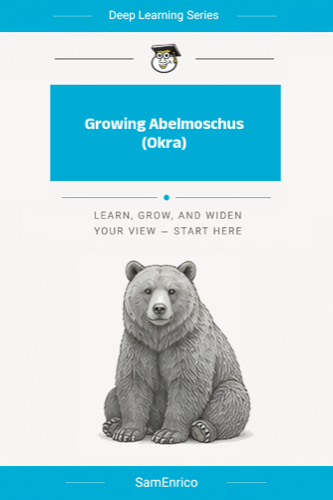
Growing Abelmoschus (Okra)
This publication, published by SamEnrico, covers G
by Moe Kali
This publication, published by SamEnrico, covers Growing Abelmoschus (Okra)
Formats
About this book
Free sample
Chapter 1: The Pod’s Secret Life...–- Most gardeners meet okra for the first time in disappointment. They plant a seed, water it faithfully, watch a handsome plant rise to chest height, produce beautiful hibiscus-like flowers, and then... nothing. Or worse, they get pods that feel like chewing on rope. The plant seems to mock their efforts.
What they don’t realize is that okra has been keeping secrets. Behind its unassuming green facade lies one of the most sophisticated survival strategies in the vegetable kingdom—and once you understand it, growing okra becomes not just easy but almost absurdly productive.This chapter is not a dry botanical lecture. It is an invitation to see okra as it truly is: a perennial from the tropics, disguised as an annual, programmed with genetic codes from ancient Africa, and equipped with a flowering system so sensitive that it can tell you exactly where you live just by how it behaves. By the time you finish these pages, you will never look at an okra plant the same way again. You will understand why your neighbor’s plants flourished while yours sulked.
You will know exactly which variety to plant for your latitude. And you will possess the single most important piece of knowledge that separates successful okra growers from frustrated ones: the secret language of photoperiodism.The African Emperor: Where Okra Came From and Why It Matters Before we talk about growing okra, we must talk about where okra learned to survive. The story begins in the Ethiopian highlands and the White Nile region of South Sudan, where wild okra (Abelmoschus esculentus var. hierochuntinus) still grows today. Unlike the domesticated version in your seed packet, wild okra is a scrappy, sprawling perennial that can live for five to seven years.
It scrambles across the ground, throws out roots at each node, and produces small, fibrous pods that are barely edible. But that wild ancestor possessed something extraordinary: resilience.Thousands of years ago, somewhere along the Nile corridor, ancient farmers began selecting the wild okra plants that produced larger pods with fewer spines. They…
This is the end of the free sample. Get the eBook to keep going. Buy now
Contents
- Chapter 1
- Chapter 2
- Chapter 3
- Chapter 4
- Chapter 5
- Chapter 6
- Chapter 7
- Chapter 8
- Chapter 9
- Chapter 10
- Chapter 11
- Chapter 12
Details
- Author
- Moe Kali
- Publisher
- SamEnrico
- Language
- English
- Genre
- Non-Fiction, Informative, Educational
- Released
- 2026-05-11
- Pages (approx.)
- 157
- Available as
- eBook, Audiobook

Read better in the ZLOADR app
Your eBooks on your phone or tablet. Sign in with your SamEnrico account and start reading.
More by Moe Kali
 Train Carriage Memory JourneyMoe Kali$11.99
 Pandemic Performance Review PivotMoe Kali$11.99
 Growth Hormone and Fat MetabolismMoe Kali$11.99
 Depression Related ProcrastinationMoe Kali$11.99
 Foster Care Language BarrierMoe Kali$11.99
 Early Warning Signs BurnoutMoe Kali$11.99
 Benzo Cognitive Fog RecoveryMoe Kali$11.99
 Dynamic Stretching GuideMoe Kali$11.99
 The Ghosts of Delagoa Bay: The Pirate Wars of the Boer GuerrillasMoe Kali$11.99
 The Last Spin of the Silver CometMoe Kali$11.99
 A Collector's Handbook to the Morris Twenty-five Series IiiMoe Kali$11.99
 How to Produce Window MagnetsMoe Kali$11.99