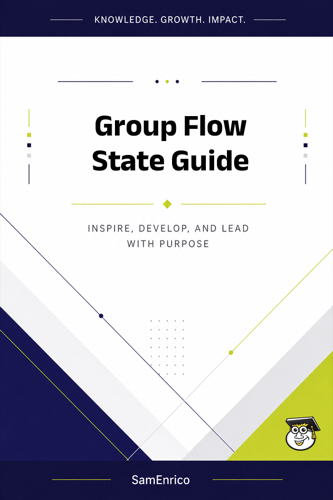
Group Flow State Guide eBook
Achieve collective immersion in creative tasks.
by Beale Gidget
Achieve collective immersion in creative tasks.
Formats
Free sample
Chapter 1: The Cult of One--–- The night before the Challenger disaster, engineers at Morton Thiokol begged their managers to delay the launch. They had data. They had expertise. They had the truth on their side. But when the teleconference ended, no one spoke up again.
Not because they were cowards. Because they were alone together.Seventeen years later, a lone programmer named Robyn Miller sat in a dark room writing code for a video game called Myst. The press would later crown him a “visionary genius.” But Miller knew the truth: the game’s most famous puzzle—the spaceship door that required a musical code—came from a midnight argument with his brother Rand. The game’s haunting score emerged from a collaboration with a composer he’d never met in person. The best-selling game of the 1990s was not a solo act.
It was a collaborative web that the world chose not to see.This chapter dismantles the most expensive myth in business, education, and creative work: the Cult of the One—the story that real breakthroughs happen in solitude, that genius arrives like lightning from a clear sky, and that collaboration is merely a support system for the truly talented. This myth is not harmless. It costs organizations billions in wasted potential. It silences the quiet contributors who hold the keys to breakthrough ideas. And it keeps teams trapped in what we will call parallel isolation—working near each other while creating almost nothing together.By the end of this chapter, you will see the hidden architecture of every major innovation in history.
You will map your own collaborative web. And you will stop waiting for the lone genius to save your team—because that person never existed in the first place.The Invention That Wasn’t Let us begin with a man who is often held up as the archetype of solitary brilliance: Steve Jobs.The myth says that Jobs locked himself in a room, emerged with the first Macintosh, and changed computing forever. The truth is messier—and more useful. The Macintosh team had thirty core members. The iconic “insanely great” interface was designed by Bill Atkinson and Bruce Horn, not Jobs.
The mouse—often attributed to Jobs’s “vision”—was demonstrated at Xerox PARC by a researcher named Doug Englebart, who had built it with a team of seventeen. Jobs’s real genius was not solitary creation. It was the ability to curate, provoke, and weave together contributions from dozens of people who rarely got the credit.The same pattern repeats across every field you admire.Darwin’s “lonely” voyage on the Beagle produced notebooks filled with observations. But On the Origin of Species emerged from decades of correspondence with botanists, breeders, geologists, and even his skeptical wife Emma, who copy-edited every chapter and challenged his weak arguments. Darwin’s collaborative web included over two thousand letters exchanged with 150 scientists.Einstein’s miracle year of 1905 produced four papers that rewrote physics.
The myth says he worked in solitude at the Swiss patent office. But the papers were shaped by late-night conversations with his “Olympia Academy”—a study group of three friends (Conrad Habicht and Maurice Solovine) who met weekly to debate Hume, Spinoza, and Poincaré. Einstein called them “the soul of my intellectual development.”Newton’s apple never existed. The story was invented decades after the fact by a biographer looking for a simple origin tale. In reality, Newton’s insights into gravity emerged from years of shared correspondence with Robert Hooke, Edmond Halley, and Christopher Wren—a collaborative web of natural philosophers who argued, borrowed, and built on each other’s work.Even the most “solitary” art forms reveal the same structure.
The painter in the studio uses pigments developed by chemists, canvases stretched by artisans, and techniques borrowed from dead teachers. The novelist’s manuscript is shaped by editors, beta readers, and the accumulated language of a civilization. The stand-up comedian’s “breakthrough” set is the product of a hundred open mics, audience reactions, and other comedians’ stolen tags.The Cult of the One is not just inaccurate. It is actively harmful.The Cost of the Myth When teams believe in the lone genius, they organize around that belief. And that organization kills flow before it can begin.Here is what happens in organizations that worship solitary brilliance:Meetings become status reports.
Each person lists what they have done alone. No one builds. No one overlaps. No one finishes another’s sentence. This is sequential reporting—the opposite of collective immersion.Credit hoarding replaces shared ownership.
The person who speaks last or loudest claims the idea. Others learn to hold back. Innovation dies by a thousand withheld suggestions.Psychological safety collapses. When the culture worships the solo hero, asking for help feels like admitting failure. Teams fragment into silos.
Information becomes currency, not oxygen.The “brilliant jerk” gets promoted. Charismatic solo performers rise to leadership, where they continue to work alone—now with the power to ignore everyone else. Their teams learn helplessness.Parallel play becomes the default. Everyone is busy. Everyone is “in flow.” But no one is flowing together.
The organization is a collection of humming engines, each pointing in a different direction.This last point is the most insidious. Individual flow feels good. It feels productive. But when a team is in parallel individual flow, they are three rowers in the same boat, each convinced they are winning the race while the boat spins in circles.We will explore the difference between individual and group flow in Chapter 2. For now, understand this: the opposite of group flow is not chaos.
It is people working hard in the same room without ever truly connecting.The Anatomy of a Collaborative Web If the lone genius is a myth, what actually produces breakthrough ideas?The answer is the collaborative web—the invisible network of feedback, shared knowledge, and social reinforcement that surrounds every creative act. Collaborative webs have five consistent features across domains, industries, and centuries.Feature 1: Density of Weak Ties Sociologist Mark Granovetter famously discovered that the most valuable job leads come not from close friends but from weak ties—acquaintances, former colleagues, second-degree connections. The same is true for ideas. Breakthroughs rarely emerge from tight-knit teams who all think alike. They emerge from webs that include outsiders, misfits, and people from different disciplines.Edison’s Menlo Park lab included machinists, chemists, draftsmen, and a former circus performer.
The Wright Brothers corresponded with engineers, cyclists, and even a Smithsonian secretary who was not an expert but asked good questions. Pixar’s best films emerge from the “braintrust”—a group that deliberately includes people from animation, writing, editing, and catering.Action insight: Map your weak ties. Who do you talk to once a month or less? Who works in a completely different department or industry? Those are your most fertile sources of novel input.Feature 2: Psychological Safety for Half-Baked Ideas Collaborative webs do not demand polished presentations.
They reward premature sharing—bringing an idea to others before it is ready, while it is still stupid, embarrassing, and incomplete.The best example is the writers’ room of The Daily Show. Head writer Tim Carvell described…
This is the end of the free sample. Get the eBook to keep going. Buy now
About this book
Details
- Author
- Beale Gidget
- Publisher
- SamEnrico
- Language
- English
- Genre
- Non-Fiction, Self-Help, Flow
- Released
- 2026-06-08
- Pages (approx.)
- 153
- Available as
- eBook, Audiobook

Read better in the ZLOADR app
Your eBooks on your phone or tablet. Sign in with your SamEnrico account and start reading.
More by Beale Gidget
 Smile Authenticity TestBeale Gidget$11.99
 Parent Remote Worker GuideBeale Gidget$11.99
 Immigrant Child Poetry DiscoveriesBeale Gidget$11.99
 Small Talk for Gym and FitnessBeale Gidget$11.99
 McKenzie Method GuideBeale Gidget$11.99
 Parental Anger at Childs WeightBeale Gidget$11.99
 Dream Time Distortion LogBeale Gidget$11.99
 The Sultan’s Forgotten Vizier: A Djinn’s BargainBeale Gidget$11.99
 The Ghosts of Kursk: The Armored Titans of WWIIBeale Gidget$11.99
 A Collector's Handbook to the Standard Flying FourteenBeale Gidget$11.99
 How to Start a Correspondence College Specialising In Higher Education Courses (degree Level) BusineBeale Gidget$11.99
 Citation for Preprints GuideBeale Gidget$12.99