
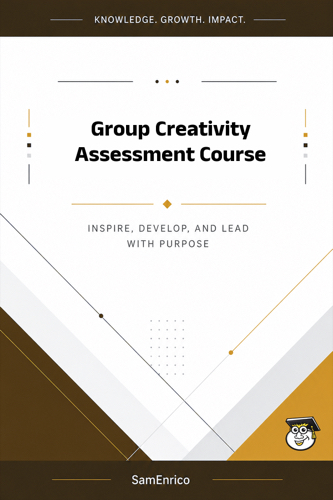
Non-FictionSelf-HelpTeam Assessment
Group Creativity Assessment Course eBook
Diagnoses team creative strengths and weaknesses u
Diagnoses team creative strengths and weaknesses using validated assessment tools.
Formats
Free sample
Chapter 1: The Lone Genius Lie--–- The conference room was silent. Eight product managers sat around a polished oak table, each holding a stack of sticky notes covered in half-formed ideas. Their leader, a brilliant engineer named Sarah who had single-handedly patented three core technologies for the company, had just asked a simple question: “Why can’t this team come up with anything original?”No one answered. Because no one wanted to say what they were all thinking: You hired the smartest people in the industry. You put us in a room together.
And somehow, we’re dumber here than we are alone.Six months earlier, this same team had been celebrated as a “dream team.” Individually, they boasted two Ph Ds, three former startup founders, and a combined forty-seven years of industry experience. Their resumes sparkled with awards, patents, and successful product launches. Leadership had assumed that putting these stars together would create a supernova of innovation.Instead, they got a black hole.Sarah’s team is not unusual. In fact, it is the rule. Across every industry—from software development to pharmaceutical research, from advertising agencies to hospital trauma units—teams of highly creative individuals consistently underperform their potential.
This is the Creativity Paradox: the sum of the parts is almost always less than the whole.This book exists because of that paradox. It exists because guessing at team creativity is management malpractice. And it exists because measurement—rigorous, validated, diagnostic measurement—is the only path out of the darkness.The Myth That Is Killing Your Team’s Creativity Let us name the enemy immediately. It is a story so deeply embedded in Western culture that most people do not even recognize it as a story. They believe it is simply reality.The myth is this: creativity is the province of the lone genius.You know the images.
Einstein with his wild hair, scribbling equations alone in a patent office. Steve Jobs pacing an empty stage, holding a single device that changed the world. J.K. Rowling in a quiet Edinburgh café, conjuring Harry Potter from thin air. The painter in a garret.
The inventor in a garage. The coder alone at 3 a.m., fueled by coffee and brilliance.These stories are not merely incomplete. They are dangerously wrong. And they are wrecking your team’s ability to create.Let us examine the evidence. Einstein’s most famous paper, on the photoelectric effect, emerged from years of conversation with friends like Michele Besso and the Olympia Academy—a study group of three young physicists who met regularly to debate philosophy, physics, and mathematics.
Steve Jobs did not invent the i Phone alone; he led a team of hundreds of engineers, designers, and programmers whose collaborative dynamics were meticulously studied and managed. J.K. Rowling benefitted from editors, publishers, and a support system that included her agent and her sister.The lone genius is a convenient fiction. It sells movie tickets and magazine covers. But it is terrible management science.The Creativity Paradox: Why Smart Teams Fail Let us define our central problem formally.The Creativity Paradox: Teams composed of highly creative individuals often produce less novel and useful output than the same individuals working alone.This statement sounds counterintuitive.
Shouldn’t putting creative people together multiply their creativity? Shouldn’t brainstorming produce more ideas than solitary thinking? Shouldn’t collaboration be inherently superior to isolation?The answer, supported by decades of research in organizational psychology, is a qualified and unsettling no.Consider a study conducted at the University of California, Berkeley. Researchers asked individual participants to generate as many uses as possible for a common object (a brick, a paperclip, a cardboard box). Participants worked alone, writing down their ideas privately.
Then, the same participants were placed in groups and asked to generate ideas together. The groups were told to brainstorm using traditional rules: defer judgment, go for quantity, build on others’ ideas.The results were consistent across dozens of trials. Groups generated fewer total ideas than the sum of individuals working alone. They generated fewer original ideas. And participants consistently rated their own group’s performance as better than it actually was—a phenomenon known as the illusion of group productivity.This is the Creativity Paradox in action.
Individual brilliance does not aggregate. It collides.Process Loss: Where Creativity Leaks Why does this happen? The answer lies in a concept called process loss.Process loss is the gap between a team’s potential creativity (what they could produce if everything worked perfectly) and their actual creativity (what they do produce in real conditions). Think of it as a leaky bucket. You can pour the most brilliant individuals into the team, but if the bucket has holes, the creativity drains out.There are several types of process loss, and understanding them is the first step toward diagnosis.
Let us name the three most common:1. Production Blocking. In a group, only one person can speak at a time. While one person talks, everyone else must wait. During that waiting period, several things happen: they may forget their own idea, they may decide their idea is not worth sharing after hearing someone else’s, or they may simply become distracted.
Production blocking is the single largest source of process loss in traditional brainstorming. The research is clear: groups produce fewer ideas not because they lack creativity but because the structure of conversation prevents them from expressing it.2. Evaluation Apprehension. Most people are afraid of looking stupid. In a group setting, this fear amplifies.
Even when a group explicitly agrees to “defer judgment,” participants self-censor. They run their ideas through an internal filter before speaking. And that filter is calibrated for safety, not originality. The result is that the most novel ideas—the ones that might actually generate breakthrough innovation—never leave the speaker’s brain. They die in transit.3.
Social Loafing (Free Riding). In a group, individual effort becomes less visible. When my contribution is pooled with others’, I can exert less effort and still receive the same credit (or blame). This is not laziness; it is rational behavior in a poorly designed system. If the team succeeds, I benefit.
If the team fails, I am not singled out. Why would I work as hard in a group as I would alone? The answer, as we will explore in Chapter 7, depends entirely on how the group is structured and measured.These three forms of process loss—production blocking, evaluation apprehension, and social loafing—explain the Creativity Paradox. They are the holes in the bucket. And they are invisible to most leaders because they look like individual failures (“my team isn’t creative”) rather than structural problems (“my team’s process is leaking creativity”).The Assessment Gap: Why Your Gut Is Lying to You Here is where most management books get it wrong.
They offer exercises, workshops, and inspirational stories. They tell you to “build trust” or “encourage risk-taking” or “think outside the box.” These suggestions are not wrong. They are simply useless without diagnosis.Imagine going to a doctor and saying, “I don’t feel well.” The doctor looks at you and says, “Have you tried feeling better? Maybe you should exercise…
This is the end of the free sample. Get the eBook to keep going. Buy now
About this book
Details
- Author
- Mayhew Florance
- Publisher
- SamEnrico
- Language
- English
- Genre
- Non-Fiction, Self-Help, Team Assessment
- Released
- 2026-06-08
- Pages (approx.)
- 152
- Available as
- eBook, Audiobook

Read better in the ZLOADR app
Your eBooks on your phone or tablet. Sign in with your SamEnrico account and start reading.
More by Mayhew Florance
 Austria Climate Bonus IncentiveMayhew Florance$11.99
 Gaming Disorder Self HelpMayhew Florance$11.99
 Workplace Stress Reduction for LGBTQ EmployeesMayhew Florance$11.99
 Ketogenic Weight Loss GuideMayhew Florance$11.99Ketogenic Weight Loss GuideMayhew Florance$11.99
 The Silent Rebellion: How a Teenager Took on the Plastic IndustryMayhew Florance$11.99
 The Clockwork Maestro: How a Self-Taught Genius Revolutionized TimekeepingMayhew Florance$11.99
 Miniature Schnauzer BreedingMayhew Florance$11.99
 Sales Tax Permit GuideMayhew Florance$12.99
 Craigslist Test Validation GuideMayhew Florance$12.99
 Understanding Chromosome 4 RingMayhew Florance$17.99
 How to Start a Hobby in PlankingMayhew Florance$11.99
You may also like
 Hong Kong Handover 1997Dunn Johnnie$11.99
 Zumba For Postnatal Recovery CourseNeal Christian$11.99
 Zumba for BeginnersLadner Nikia$11.99
 YouTube Comment Mining GuideHumes Pandora$12.99
 Worry Box MeditationCarlin Rudy$11.99
 Workplace Stress MeditationNguyen Lynn$11.99
 Workplace Stress and Sleep RepairHawley Ivory$11.99
 Workplace Perfectionism CureDelaney Jeffry$11.99
 Workplace Injustice Anger GuideWallen Isabelle$11.99
 Work Addiction and Burnout LinkGreenwood Ester$11.99
 Women in Yoga and WellnessBeattie Galina$11.99
 Women in Stand Up ComedyChun Evangeline$11.99