
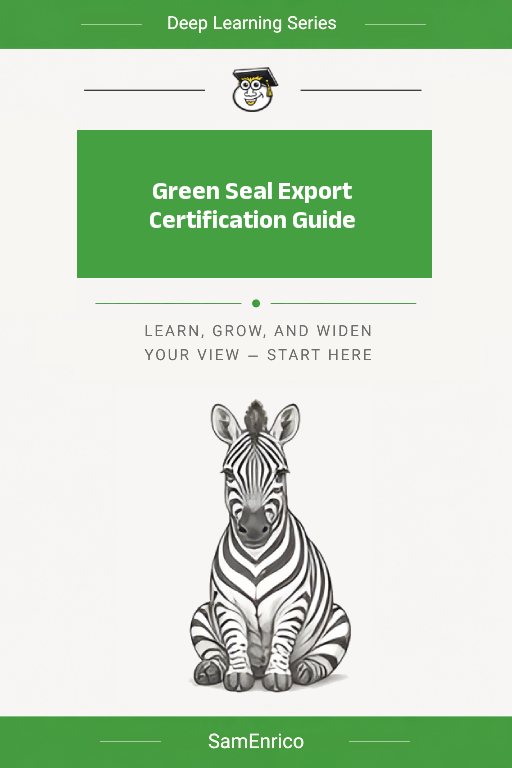
Green Seal Export Certification Guide eBook
Certify low environmental impact cleaning and pape
Certify low environmental impact cleaning and paper products for export to US and European buyers.
Formats
Free sample
Chapter 1: The $50 Million Blind Spot--–- The sun had barely risen over the industrial district of Dongguan, China, when Li Wei’s phone began buzzing with a rhythm he had learned to dread. Three missed calls from his Hamburg distributor. Two from the compliance officer at Carrefour. One from his own logistics manager, who never called before 9 a.m. unless something had gone terribly wrong.
Li wiped the sleep from his eyes and opened the email that would change the trajectory of his family’s paper mill—a business his father had built from a single secondhand winding machine in 1987.The email was brief, almost insultingly so for the damage it carried. “Effective immediately, your products are removed from our approved supplier list due to failure to provide verifiable third-party environmental certification for your tissue paper line. All outstanding purchase orders are cancelled. No re-instatement possible without Green Seal or equivalent certification.”Li stared at the screen. His company, Baiyun Paper Products, had supplied recycled toilet paper and paper towels to European retailers for eleven years.
They had never missed a shipment. Their quality was excellent. Their prices were competitive. And now, in the span of a single email, they had lost €4.7 million in annual revenue—a contract his sales team had spent eighteen months negotiating.The reason? A competitor in Vietnam had quietly obtained Green Seal certification six months earlier.
That competitor had used the certification not as a marketing afterthought but as a battering ram, walking into Carrefour’s Paris headquarters with a three-ring binder containing test results, chain-of-custody documentation, and a signed Environmental Compliance Statement. Baiyun had submitted the same product specifications, the same pricing, the same delivery terms. But they had lost because they could not prove—with third-party, audited, legally defensible evidence—that their “green” claims were true.Li’s story is not hypothetical. It is a composite drawn from interviews with six exporters across three continents who learned the hard way that environmental certification is no longer a nice-to-have differentiator. It is a non-negotiable passport to the world’s most lucrative markets.
And the fastest-growing, most respected, most commercially actionable certification for cleaning and paper products is Green Seal.The Geography of Green Tape: Why Your Product Can Be Blocked Without a Single Tariff For most of the twentieth century, international trade was governed by tariffs—explicit taxes on imported goods that governments could raise or lower to protect domestic industries. If you wanted to sell your paper towels or industrial cleaner in the United States or the European Union, you paid the duty, filled out the customs form, and shipped your container. The rules were transparent, if not always fair.That era is over. Today, the most formidable barriers to export are not taxes but non-tariff barriers—regulations, standards, and purchasing requirements that can block your product without a single euro or dollar changing hands at the border. Among the most powerful of these barriers are environmental regulations and private ecolabel mandates imposed by retailers, governments, and institutional buyers.Consider what has changed in just the past five years.
In 2020, the European Union launched its Green Deal, a sweeping set of policies designed to make Europe climate-neutral by 2050. A centerpiece of this initiative is the Circular Economy Action Plan, which directly targets disposable products like tissue paper and cleaning chemicals. In 2023, the EU adopted the Green Claims Directive, which requires that any environmental marketing claim—"biodegradable," "recycled content," "non-toxic"—must be independently verified by a third-party certifier. Self-declared claims are no longer sufficient. If you write "eco-friendly" on your label without a certificate to back it up, you are not just marketing badly.
You are breaking the law.Across the Atlantic, the United States has taken a different but equally demanding approach. The Federal Trade Commission (FTC) enforces the Green Guides, a set of detailed rules governing environmental marketing claims. While the FTC does not pre-approve labels, it has aggressively pursued enforcement actions against companies that make unsubstantiated claims. In 2022 alone, the FTC levied over $5 million in penalties against manufacturers who falsely claimed "recyclable" or "compostable" status for their products. The message is clear: if you claim it, you must prove it.But the most immediate pressure comes not from governments but from private buyers—the retailers, school districts, hospital systems, and corporate purchasing departments that actually write the checks for your products.
Walmart’s Project Gigaton requires suppliers to reduce emissions and provide verified environmental data. Amazon’s Climate Pledge Friendly program gives preferential search placement and a special badge to products with third-party certifications, including Green Seal. In Europe, Carrefour, Aldi, and Metro have all published supplier sustainability scorecards that explicitly reward or require ecolabels.The result is a new geography of trade—one where your product’s entry is determined not by the tariff code but by the color of its environmental badge. Green Seal certification has become, in effect, a non-tariff barrier navigator: a tool that allows you to bypass the green tape that stops non-certified competitors at the door.Greenwashing vs. Verified Green: The Difference That Can Cost You a Contract The term greenwashing was coined in 1986 by environmentalist Jay Westerveld, who observed that hotels encouraged guests to reuse towels to "save the environment" while making no meaningful changes to their energy or water consumption.
Today, greenwashing has evolved into a sophisticated and dangerous practice—dangerous not because it is always malicious, but because it creates a false sense of security for exporters who believe their self-declared claims will satisfy buyers.Greenwashing takes many forms. The most common is the sin of vagueness: a label that says "eco-friendly" or "green" without specifying what that means. The second is the sin of irrelevance: claiming "CFC-free" for a product that has never contained CFCs because they were banned decades ago. The third is the sin of the hidden trade-off: touting recycled content while ignoring toxic chemicals in the manufacturing process. The fourth is the sin of outright falsehood: simply lying about certification status.Here is the brutal truth that the exporters I interviewed learned too late: self-declared green claims have zero credibility with sophisticated buyers.
Walmart’s purchasing team does not read your marketing brochure. They check databases. They request certificate numbers. They call the certifier to verify active status. If you cannot produce a third-party audit report from an accredited certifier like Green Seal, your claim is not just worthless—it is a liability.Verified green, by contrast, rests on three pillars that self-declared claims cannot replicate.
First, independent auditing: Green Seal sends trained inspectors to your factory to examine your processes, test your products, and review your documentation. The auditor does not work for you; they work for Green Seal, and their job is to find problems. Second, publicly available standards: Green Seal’s GS-1, GS-37, and GS-52 standards are published online for anyone to read. You cannot claim ignorance of the requirements. Third, ongoing compliance: certification is not a one-time event.
You must recertify annually, report any formulation changes, and submit to spot audits.The difference between greenwashing and verified green is not academic. It is the difference between winning a €4.7 million contract and losing it to…
This is the end of the free sample. Get the eBook to keep going. Buy now
About this book
Details
- Author
- Christie Minh
- Publisher
- SamEnrico
- Language
- English
- Genre
- Non-Fiction, Business Brief
- Released
- 2026-05-30
- Pages (approx.)
- 152
- Available as
- eBook, Audiobook

Read better in the ZLOADR app
Your eBooks on your phone or tablet. Sign in with your SamEnrico account and start reading.
More by Christie Minh
 The Beginner's Grief MeditationChristie Minh$11.99
 Visual Imagery Trance Induction GuideChristie Minh$11.99
 Serbian Startup Ecosystem 2030Christie Minh$11.99
 Pramila JayapalChristie Minh$11.99
 Men's Body Image GuideChristie Minh$11.99
 AI Presentation Success StoriesChristie Minh$11.99
 EU RASFF vs US Recall ComparisonChristie Minh$11.99
 Strength Training For HockeyChristie Minh$11.99
 Intermittent Fasting InsulinChristie Minh$11.99
 Red Dust Chronicles: The Lost Colony of Ares-7Christie Minh$11.99
 Nefertiti's Vanishing Crown: The Pharaoh's Lost HeirChristie Minh$11.99
 The Complete Guide to the Cholesterol Lowering DietChristie Minh$11.99
You may also like
 Hong Kong Handover 1997Dunn Johnnie$11.99
 Zumba For Postnatal Recovery CourseNeal Christian$11.99
 Zumba for BeginnersLadner Nikia$11.99
 YouTube Comment Mining GuideHumes Pandora$12.99
 Worry Box MeditationCarlin Rudy$11.99
 Workplace Stress MeditationNguyen Lynn$11.99
 Workplace Stress and Sleep RepairHawley Ivory$11.99
 Workplace Perfectionism CureDelaney Jeffry$11.99
 Workplace Injustice Anger GuideWallen Isabelle$11.99
 Work Addiction and Burnout LinkGreenwood Ester$11.99
 Women in Yoga and WellnessBeattie Galina$11.99
 Women in Stand Up ComedyChun Evangeline$11.99