
Non-FictionInformativeEducational
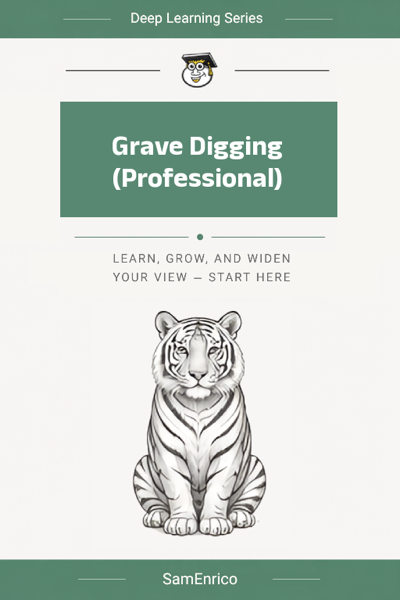
Grave Digging (Professional) eBook
A Coursebook on Grave Digging (Professional)
A Coursebook on Grave Digging (Professional)
Formats
Free sample
Chapter 1: The Final Link...--–- The gravedigger’s truck arrived at 5:47 AM, seventeen minutes before the cemetery gates would officially open to the public. Frank Mulligan, a 58-year-old sexton with three decades in the industry, killed the engine and sat in the darkness for a full two minutes. He wasn’t resting. He was listening. The cemetery had its own sounds before dawn—the creak of old oaks, the whisper of frost melting off marble headstones, and sometimes, if you paid attention, the nearly inaudible settling of ground that had been dug and refilled decades earlier.
Frank knew that sound better than his own wife’s breathing. It told him which graves were stable and which would give him trouble when he reopened them for a second interment later that week. This was not a job for the reckless or the squeamish. This was a profession for those who understood that a hole in the ground, properly executed, was the last act of dignity a person would ever receive.The public imagines gravedigging as a grim, nocturnal affair conducted by hunched figures in black cloaks, illuminated only by the flash of a shovel blade under a full moon. That image sells movie tickets, but it has nothing to do with the reality of modern cemetery operations.
The professional gravedigger—more accurately called a sexton, groundskeeper, or interment technician—arrives before sunrise, completes a safety inspection of heavy machinery, reviews burial permits, coordinates with funeral directors, and executes a precisely engineered excavation that must meet legal, environmental, and emotional standards simultaneously. One mistake—a wall collapse, a misaligned vault, a lowering device that squeaks during the service—can turn a family’s final moment of peace into a lifetime of trauma. This chapter dismantles the mythology surrounding grave digging and establishes the foundational truth of the profession: the gravedigger is not a laborer but the final link in the chain of custody between the living and the dead, a role that requires the strength of a construction worker, the precision of a surveyor, and the empathy of a chaplain.To understand why this profession demands such a high level of skill, one must first confront the uncomfortable reality that most people never think about what happens after the funeral ends. Families gather at the graveside, say their goodbyes, watch the casket descend, and then drive away to a reception hall where they eat cold cuts and tell stories about the deceased. Within an hour, the cemetery is empty.
It is then, in the silence, that the gravedigger returns to finish the job. The backfill must be compacted in six-inch lifts. The turf must be restored so seamlessly that a visitor six months later cannot tell where the ground was opened. The headstone must be leveled within a quarter-inch of plumb. And all of this must be accomplished without anyone ever witnessing the effort.
If the gravedigger does the job perfectly, no one will ever know their name. If they do it poorly, the family will return next spring to find a sunken rectangle of dead grass, and they will remember forever.This is the paradox of the profession: invisible excellence. The best gravedigger is the one you never think about.The Historical Weight of the Spade To appreciate the modern profession, one must understand its bloody, misunderstood history. The word "gravedigger" appears in English literature as early as Shakespeare’s Hamlet, where the famous scene in Act V, Scene I features two clowns digging Ophelia’s grave while engaging in dark, philosophical banter. That scene, for all its comic relief, reveals a persistent cultural truth: societies have always viewed gravediggers with a mixture of necessary respect and superstitious unease.
In medieval Europe, the job fell to the lowest members of the guild system—often the same men who handled executions, latrine cleaning, and animal carcass removal. They were paid in coins that passed through multiple hands before reaching them, a form of ritual purification for the currency. They lived on the edges of towns, and their children were forbidden from marrying into respectable families. The stain of handling the dead, even by digging the hole that received them, was considered spiritually contaminating.This stigma persisted well into the 19th century, amplified by the Gothic literature of the Victorian era. Edgar Allan Poe’s The Premature Burial (1844) and Mary Shelley’s Frankenstein (1818) played on fears of bodysnatching and resurrectionism, which were real threats in an era when medical schools paid handsomely for fresh cadavers.
Gravediggers were often accused—sometimes accurately—of supplementing their income by selling recently buried bodies to anatomists. The infamous London Burkers, William Burke and William Hare, took this to its horrific extreme by murdering victims to sell their corpses, though they were not gravediggers themselves but lodging-house keepers. The association stuck, however, and by the 20th century, the gravedigger had become a stock character in horror films: the silent, shambling figure who knows where the bodies are buried because he put them there.The reality, as always, was more mundane and more difficult. Before the invention of the backhoe in the 1950s, all graves were dug by hand. Two men with shovels could open a standard six-foot grave in four to six hours, depending on soil conditions.
They worked in all weather—blizzards, thunderstorms, heatwaves—because the funeral schedule did not pause for comfort. They developed massive calluses on their hands, chronic back problems by age forty, and a gallows humor that alienated them from polite society. They were also, by necessity, experts in soil mechanics, drainage patterns, and cemetery cartography. A good hand digger could locate a seventy-year-old grave marker that had sunk below the grass line using nothing but a probe rod and the memory of where previous interments had been placed. That knowledge, passed down orally from one generation of sextons to the next, was the original textbook of grave digging.The post-World War II economic boom changed everything.
Suburban cemeteries expanded rapidly, funeral homes professionalized their services, and the first compact excavators appeared on the market. Suddenly, a grave that took four hours to dig by hand could be opened in forty-five minutes. Cemetery owners, eager to reduce labor costs and schedule more funerals per day, invested heavily in machinery. The hand digger, once the backbone of the industry, became a specialist called in only for tight-access graves between monuments or in historic sections where machinery could not fit. The profession did not disappear; it transformed.
The modern gravedigger is as likely to hold a certification in heavy equipment operation as they are to own a shovel. They are more likely to communicate with funeral directors via text message than to share a flask of whiskey at the end of a shift. But the core of the job—the weight of responsibility, the precision of the cut, the dignity of the closure—remains unchanged.The Chain of Custody: More Than a Signature In the funeral industry, "chain of custody" refers to the documented path of the deceased from the moment of death to the moment of final interment. The hospital releases the body to the funeral home. The funeral home transports it to the crematory or…
This is the end of the free sample. Get the eBook to keep going. Buy now
About this book
Details
- Author
- Skidmore Giuseppe
- Publisher
- SamEnrico
- Language
- English
- Genre
- Non-Fiction, Informative, Educational
- Released
- 2026-06-02
- Pages (approx.)
- 127
- Available as
- eBook, Audiobook

Read better in the ZLOADR app
Your eBooks on your phone or tablet. Sign in with your SamEnrico account and start reading.
More by Skidmore Giuseppe
 Assertiveness in Dating GuideSkidmore Giuseppe$11.99
 Sleep Meditation Retreat GuideSkidmore Giuseppe$11.99
 Postnatal HIIT Return GuideSkidmore Giuseppe$11.99
 Hornist High Pressure HeroicsSkidmore Giuseppe$11.99
 The OCD Intrusive Thoughts GuideSkidmore Giuseppe$11.99
 The Hapsburgs: Masters of Imperial EleganceSkidmore Giuseppe$11.99
 How to Become a Loom StarterSkidmore Giuseppe$11.99
 Surprise and Delight GuideSkidmore Giuseppe$12.99
 Fitness App Free to PaidSkidmore Giuseppe$12.99
 The Breeder's Guide to Hereford PigsSkidmore Giuseppe$11.99
You may also like
 Hong Kong Handover 1997Dunn Johnnie$11.99
 Zumba For Postnatal Recovery CourseNeal Christian$11.99
 Zumba for BeginnersLadner Nikia$11.99
 YouTube Comment Mining GuideHumes Pandora$12.99
 Worry Box MeditationCarlin Rudy$11.99
 Workplace Stress MeditationNguyen Lynn$11.99
 Workplace Stress and Sleep RepairHawley Ivory$11.99
 Workplace Perfectionism CureDelaney Jeffry$11.99
 Workplace Injustice Anger GuideWallen Isabelle$11.99
 Work Addiction and Burnout LinkGreenwood Ester$11.99
 Women in Yoga and WellnessBeattie Galina$11.99
 Women in Stand Up ComedyChun Evangeline$11.99