
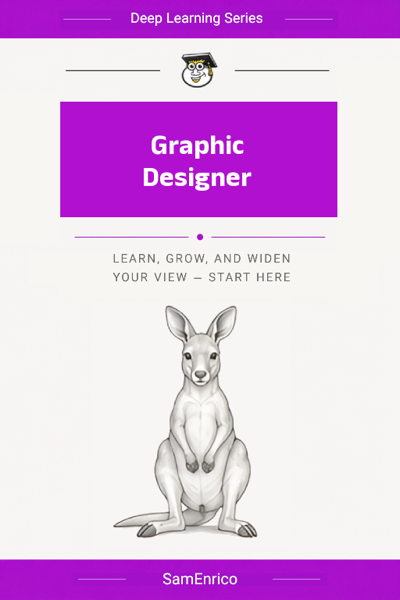
Non-FictionInformativeEducational
Graphic Designer eBook
A Coursebook on Graphic Designer
by Fite Tamekia
A Coursebook on Graphic Designer
Formats
Free sample
Chapter 1: The Mirror Test...--Every morning, you stand in front of the bathroom mirror and make a dozen design decisions before you have touched a keyboard or a sketchbook.You choose which shirt creates the right contrast with your pants. You arrange the toothpaste, the toothbrush, and the mouthwash in a proximity that makes sense for your reaching hand. You align the edge of the towel on the rack so it hangs straight, because crooked feels wrong even if you cannot explain why. You look at your reflection and ask a question that has haunted humans since we first drew bison on cave walls: What does this say about me?That question—what does this say—is the entire engine of graphic design. Not "does this look pretty." Not "do I like this font." But what does this communicate to someone who is not me?If you take nothing else from this chapter, take this: graphic design is not art.
Art asks, "What does this mean to me?" Design asks, "What does this make you do, feel, or believe?" Art is a mirror. Design is a window. You are not painting self-portraits. You are building bridges between a message and a human being who needs to receive it.This chapter will tear down everything you think you know about design. It will replace the myth of the "natural talent" with the reality of the trainable skill.
It will teach you the difference between looking and seeing. And it will prove, through a single case study, that the most important tool you own is not a 2,000laptopora2,000 laptop or a 2,000laptopora600 software subscription—it is the ability to ask the right question before you open any program at all.Welcome to the coursebook that treats you like a professional from page one. No fluff. No "design is magic." Just the repeatable, learnable, sellable skill of visual problem-solving.The Myth of the Born Designer Let us execute a myth right now, in broad daylight, so it stops haunting you.The myth says: Great designers are born with an unteachable gift. They see things the rest of us cannot see.
They have an "eye." Either you have it or you do not.This is nonsense. It is also dangerous nonsense because it convinces talented people to quit before they start and untalented people to coast on ego.Here is what actual research into design expertise has found. When cognitive scientists study expert designers—the people who have been doing this work for twenty years, who command five-figure fees, who make the invisible visible—they discover that the difference between a beginner and an expert is not raw talent. It is pattern recognition built on deliberate practice. An expert has seen ten thousand logos, five thousand posters, three thousand websites.
Their brain has built neural pathways that recognize "that headline is too close to that image" in the same way your brain recognizes "that person looks familiar" before you remember their name.You can build those pathways. It takes time, yes. It takes focused effort, yes. But it does not require a magical gift bestowed at birth by a muse with a Pantone swatch book.The second thing the research finds is that experts ask different questions than beginners. A beginner opens Photoshop and asks, "What filter looks cool?" An expert opens a brief and asks, "What problem am I solving?" A beginner shows you five logo options that are variations on the same bad idea.
An expert shows you one logo and explains why every curve, every color, every negative space choice serves a specific strategic goal.This chapter exists to rewire your first question. From now on, before you open any software, you will ask: What is the communication problem, and who is my audience?Looking vs. Seeing: The Designer's Superpower You look at things all day. You look at your phone. You look at street signs.
You look at cereal boxes. You look at websites. Looking is passive. Looking is what your eyes do automatically while your brain is thinking about lunch.Seeing is different. Seeing is active.
Seeing is what happens when you stop and say, Why did that catch my attention? Why does that poster feel urgent while that one feels sleepy? Why does that logo look expensive and that one look cheap?Graphic designers see things that non-designers only look at.Try this right now. Look around the room you are sitting in. Find a piece of printed text—a book spine, a coffee cup, a warning label on an appliance.
Now really see it. Ask these questions:What is the first thing my eye lands on? Why?What is the second thing? How does my eye move from the first to the second?What colors are used? Do they feel warm or cold?
Urgent or calm?What fonts are used? Does the font match the message? (A warning label in Comic Sans would feel wrong—but why?)What is the hierarchy? What is most important, and how does the designer signal that importance (size, color, position, weight)?What would happen if you changed one element? If the warning label's headline was the same size as the fine print, would you still read it first?This exercise is not optional.
It is the daily workout that builds your seeing muscles. Professional designers do this constantly, almost subconsciously, because they have trained their brains to analyze visual communication the way a musician's ear analyzes chords.For the next week, carry a small notebook. Every time you see a piece of design that works—or fails spectacularly—write down what you notice. Do not judge it as "good" or "bad" yet. Just describe it.
"The bus stop poster uses a huge yellow headline that I saw from across the street, then a small black subhead that I had to walk closer to read, then a tiny website URL at the bottom that I almost missed." That is seeing. That is the beginning of mastery.The Five Mediums: Where Design Lives Graphic design is not just "digital art" or "logo making." It is a profession that spans five major mediums, each with its own constraints, opportunities, and technical requirements. Before you can choose a specialty (we will spend an entire chapter on that later), you need to know what is even possible.Print Design. This is the oldest digital medium—"digital" because even print is now designed on screens, then output to paper. Print includes magazines, newspapers, books, brochures, business cards, posters, flyers, packaging, and billboards.
The constraint of print is physical: you cannot change a magazine layout after ten thousand copies are printed. The opportunity of print is tangibility: paper has texture, ink has weight, and a beautifully printed piece feels valuable in a way a screen never can.Digital Design. This is where most new designers gravitate, and for good reason: it is where the jobs are growing fastest. Digital includes websites, mobile apps, social media graphics, email newsletters, banners, dashboards, and interface elements like buttons and icons. The constraint of digital is unpredictability: your design will be viewed on a thousand different screens (i Phone 12, Android tablet, 32-inch…
This is the end of the free sample. Get the eBook to keep going. Buy now
About this book
Details
- Author
- Fite Tamekia
- Publisher
- SamEnrico
- Language
- English
- Genre
- Non-Fiction, Informative, Educational
- Released
- 2026-05-18
- Pages (approx.)
- 145
- Available as
- eBook, Audiobook

Read better in the ZLOADR app
Your eBooks on your phone or tablet. Sign in with your SamEnrico account and start reading.
More by Fite Tamekia
 Blockchain for Supply Chain FinanceFite Tamekia$12.99
 Self Talk for Depression RecoveryFite Tamekia$11.99
 Childrens Influencer DisclosureFite Tamekia$11.99
 Beneficiary Designation Coordination CourseFite Tamekia$11.99
 Governor's Rural ChallengeFite Tamekia$11.99
 The Senior Move Manager Selection GuideFite Tamekia$11.99
 Silk and Shadows: The Spies of ConstantinopleFite Tamekia$11.99Blockchain for Supply Chain FinanceFite Tamekia$12.99
 Startup Shutdown Depression HandbookFite Tamekia$12.99
 Understanding Isthmian CoarctationFite Tamekia$17.99
 How to Become a Nuclear Medicine TechnologistFite Tamekia$11.99
You may also like
 Hong Kong Handover 1997Dunn Johnnie$11.99
 Zumba For Postnatal Recovery CourseNeal Christian$11.99
 Zumba for BeginnersLadner Nikia$11.99
 YouTube Comment Mining GuideHumes Pandora$12.99
 Worry Box MeditationCarlin Rudy$11.99
 Workplace Stress MeditationNguyen Lynn$11.99
 Workplace Stress and Sleep RepairHawley Ivory$11.99
 Workplace Perfectionism CureDelaney Jeffry$11.99
 Workplace Injustice Anger GuideWallen Isabelle$11.99
 Work Addiction and Burnout LinkGreenwood Ester$11.99
 Women in Yoga and WellnessBeattie Galina$11.99
 Women in Stand Up ComedyChun Evangeline$11.99