
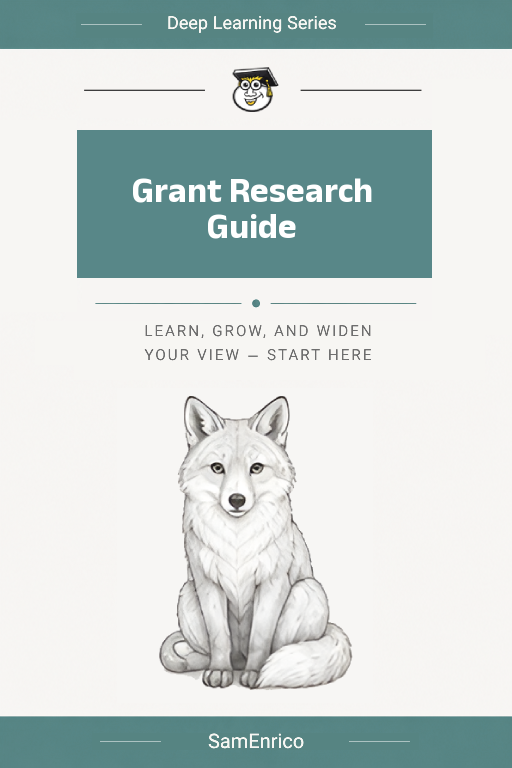
researchProfessional's Cheat SheetFunding Proposals
Grant Research Guide eBook
Find grant opportunities for nonprofits in US, UK,
Find grant opportunities for nonprofits in US, UK, and Kenya. Databases, funder directories, and alerts.
Formats
Free sample
Chapter 1: The Hunting Mindset--–- Most grant seekers begin their journey in exactly the wrong place. They open a word processor, type “Dear Sir or Madam,” and start drafting a passionate plea about their organization’s worthy mission. Then, after weeks of polishing prose, they search Google for “grants for nonprofits,” find a handful of outdated links, submit their masterpiece, and wait. And wait. And then receive a form letter that begins, “Thank you for your interest, but…”This book flips that sequence entirely.
Before you write a single sentence of a proposal, you must first become a hunter. Not a writer. Not a storyteller. A forensic researcher who knows exactly where the funding hides, how to track it, and when to strike.The difference between organizations that win grants consistently and those that survive on scraps is rarely about writing quality. It is almost always about research quality.
The best proposal in the world sent to the wrong funder is a waste of paper. A mediocre proposal sent to a funder that has already given three grants to organizations exactly like yours has a fighting chance.This chapter establishes the hunting mindset — the foundational shift from passive applicant to active investigator. You will learn why most grant research fails, how professional grant hunters think differently, and the three principles that will guide every subsequent chapter in this book. By the end, you will never again open a word processor before you have opened a database.The Three Deadly Myths of Grant Research Before we build a new mindset, we must demolish the old one. Across the United States, the United Kingdom, and Kenya, grant seekers cling to three myths that guarantee failure.
These myths are taught in workshops, repeated in online forums, and embedded in the culture of countless nonprofits. They are also dangerously wrong.Myth One: “The best grants will appear on the first page of Google.”This is the most pervasive and destructive myth. The vast majority of private foundations — over ninety percent in the US and UK — do not maintain public websites that search engines can crawl. They are family trusts, corporate giving programs, and small charitable foundations that operate through professional advisors, word-of-mouth, or invitation only. Their grant guidelines are not indexed by Google because they do not exist online.
They exist in tax filings, annual reports, and the memories of previous grantees.When you search Google for “education grants,” you are competing against every other organization that knows how to type. You are also missing the foundations that do not advertise. The best opportunities are hidden by design. Funders who do not accept unsolicited proposals have no incentive to build a website. Funders who receive hundreds of requests already have no need to promote themselves.
Google is a tool for finding what is public. Most grants are not public.Myth Two: “More applications mean more chances.”Nonprofit staff often measure productivity by the number of proposals submitted. Ten proposals this month feels better than five. This is a trap. Submitting a poorly matched proposal damages your reputation with that funder.
Some foundation program officers keep internal lists of organizations that wasted their time. Worse, you are diverting hours of staff energy away from the handful of opportunities where you actually have a competitive advantage.Professional hunters do not fire a shotgun into the forest and hope to hit something. They track one deer at a time. They study its patterns. They position themselves where they know it will pass.
Grant research works the same way. A single perfectly matched opportunity researched deeply has a higher probability of success than fifty random applications.Myth Three: “Writing is the hardest part.”This myth persists because writing is visible. Everyone can see the proposal document. No one sees the weeks of research that precede it. But ask any experienced grant professional what separates winning organizations from losing ones, and they will tell you: preparation.
The organizations that win spend seventy percent of their time researching and thirty percent writing. The organizations that lose do the opposite.Writing is a skill that can be learned. Research is a discipline that must be practiced. This book exists because the market is flooded with proposal-writing guides and starving for research instruction. By mastering the hunting mindset, you gain an advantage that ninety percent of your competitors will never develop.What Professional Grant Hunters Do Differently Let us look inside the workflow of a successful grant hunter.
Not a theory. Not a consultant’s pitch. The actual daily habits of people who consistently find and win funding across the US, UK, and Kenya.They start with eligibility, not passion.A passionate organization with a powerful story is still ineligible if it operates outside the funder’s geography. Professional hunters begin every search by filtering for three things: location, mission keywords, and budget size. They do not fall in love with a potential funder until they have confirmed that the funder could legally say yes.
This saves hundreds of hours.They build systems, not sprints.Most grant research happens in desperate bursts. A deadline approaches. Someone stays late. They frantically search for anything that fits. The result is chaos.
Professional hunters build ongoing systems: saved searches inside databases, weekly review routines, and spreadsheets that track prospects through a pipeline. They research even when no deadline is imminent. They treat grant research as a continuous process, not an emergency response.They reverse-engineer success.Instead of asking “Will this funder like us?” they ask “Who has this funder already funded?” They find similar organizations in the funder’s grant history and study those grantees’ annual reports, project descriptions, and budget sizes. They learn the funder’s language, priorities, and patterns. Then they mirror those patterns in their own proposals.
This is not copying. This is evidence-based alignment.They embrace rejection as data.A rejected proposal is not a failure. It is a data point. Did the funder say “outside our geographic focus”? That is a geography problem.
Did they say “too many requests this cycle”? That is a timing problem. Did they say nothing at all? That may be a match problem. Professional hunters log every rejection, track patterns, and adjust their research criteria accordingly.
They do not take rejection personally. They treat it as intelligence.Principle One: Research Before Writing This principle is so important that it appears in the subtitle of this book. Research before writing. Not research alongside writing. Not research after the first draft.
Research first, before a single word of proposal narrative exists.Why does order matter so much? Because research determines everything that follows. The funder’s language becomes your language. The funder’s priority areas become your project focus. The funder’s average grant size becomes your request amount.
If you write first, you are guessing. If you research first, you are responding.Consider two organizations applying to the same foundation. Organization A writes a beautiful proposal about youth empowerment. The proposal is well structured, emotionally compelling, and professionally formatted. Organization B writes a competent proposal about youth employment.
But before writing, Organization B discovered that the foundation’s last five grants all included the word “employability skills” in their…
This is the end of the free sample. Get the eBook to keep going. Buy now
About this book
Details
- Author
- Lacroix Mason
- Publisher
- SamEnrico
- Language
- English
- Genre
- research, Professional's Cheat Sheet, Funding Proposals
- Released
- 2026-06-01
- Pages (approx.)
- 122
- Available as
- eBook, Audiobook

Read better in the ZLOADR app
Your eBooks on your phone or tablet. Sign in with your SamEnrico account and start reading.
More by Lacroix Mason
 Lean Canvas Adaptation GuideLacroix Mason$11.99
 Persuasion for Sales CallsLacroix Mason$11.99
 Low Income Relationship EsteemLacroix Mason$11.99
 Sexual Addiction and PerfectionismLacroix Mason$11.99
 The Star-Kissed Courts of Axum: Astronomy and Royalty in Ancient EthiopiaLacroix Mason$11.99
 Learn to Play the KemencheLacroix Mason$11.99
 How to Start a Pickling Preparations for Metal Treatment Business (Beginners Guide)Lacroix Mason$11.99
You may also like
 Scientific Research On TM GuideMartens Nathanial$11.99
 Research Proposal Methodology Section MasteryPauley Debroah$11.99
 Research Proposal Appendix CompilationRaines Tyisha$11.99
 Academic Researcher Distraction GuideFord Virgil$11.99
 TM Research and ScienceCovert Nicki$11.99
 Social Anxiety Research ReviewRoberge Cole$11.99
 Research Proposal Significance Section GuideBock Tory$12.99
 Research Proposal Reviewer PsychologyLugo Tawanda$11.99
 Research Proposal Research Questions DesignLara Robbi$11.99
 Research Proposal References and CitationsPatten Shanice$11.99
 Research Proposal Mixed Methods DesignCameron Omega$11.99
 Research Proposal Data Management PlanAnderson Roberto$12.99