
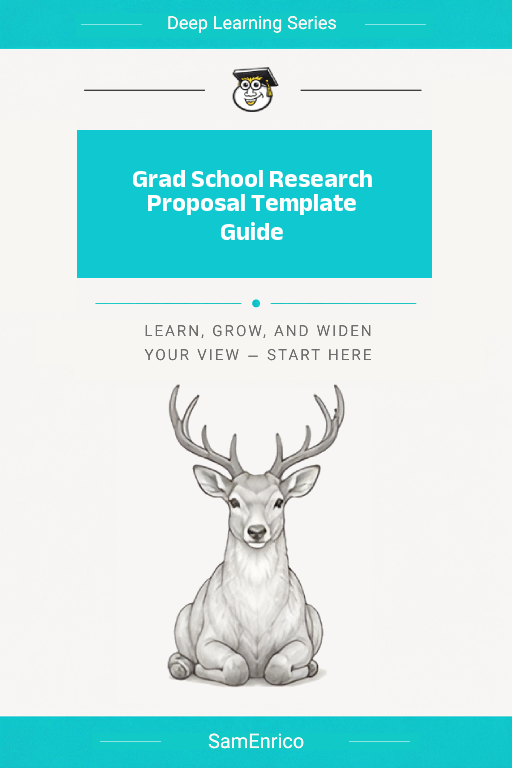
researchStudent's ShortcutWriting Templates
Grad School Research Proposal Template Guide
Use fill in the blank templates for each proposal
Use fill in the blank templates for each proposal section while learning why each component matters for admissions.
Formats
About this book
Free sample
Chapter 1: The Silent Rejection...--You have probably read dozens of articles, watched countless videos, and maybe even asked your professors for advice on writing a grad school research proposal. And despite all that effort, you still feel like you are guessing. You are guessing what the admissions committee wants. You are guessing whether your idea is “big enough.” You are guessing if your proposal will end up in the accepted pile or the silent rejection pile.That uncertainty is not your fault.The problem is that almost everything you have been told about the research proposal is wrong.Most applicants believe the proposal is a formal research contract. They think they are promising to execute a specific study exactly as written.
They spend months obsessing over every methodological detail, terrified that if they change one variable later, they will be accused of breaking a promise. This misunderstanding is the single greatest reason why otherwise brilliant applicants receive rejection letters that say nothing more than “we had a very competitive pool this year.”Here is the truth that the top 10 percent of admitted applicants understand, and that this book will teach you:The research proposal is not a contract. It is a sample of your scholarly potential as filtered through feasibility.That single sentence is the foundation of everything that follows. Let me break it down.A “sample of your scholarly potential” means the committee is reading your proposal to answer one question: Can this person think like a scholar? Do you know how to identify a genuine gap in existing knowledge?
Can you frame a question that matters? Do you understand the difference between a curiosity and a research problem? These are cognitive skills, not contract promises.But potential alone is not enough. Hence the second part: “as filtered through feasibility.” The committee is also asking: Does this person understand how to design a study that can actually be completed within a reasonable timeframe? Do you know how to scale ambition to reality?
Can you name your limitations before someone else does?Neither half alone will get you admitted. A brilliant but impossible idea…
This is the end of the free sample. Get the eBook to keep going. Buy now
Contents
- Chapter 1
- Chapter 2
- Chapter 3
- Chapter 4
- Chapter 5
- Chapter 6
- Chapter 7
- Chapter 8
- Chapter 9
- Chapter 10
- Chapter 11
- Chapter 12
Details
- Author
- Cordero Dusty
- Publisher
- SamEnrico
- Language
- English
- Genre
- research, Student's Shortcut, Writing Templates
- Released
- 2026-06-01
- Pages (approx.)
- 152
- Available as
- eBook, Audiobook

Read better in the ZLOADR app
Your eBooks on your phone or tablet. Sign in with your SamEnrico account and start reading.
More by Cordero Dusty
 Homicide Scene ReconstructionCordero Dusty$11.99
 Playlist Organization for HypnosisCordero Dusty$11.99
 Retiree Time Blocking GuideCordero Dusty$11.99
 The Startup Financial DashboardCordero Dusty$11.99
 Imposter Support Group GuideCordero Dusty$11.99
 Blind Advocate for Parking JusticeCordero Dusty$11.99Blind Advocate for Parking JusticeCordero Dusty$11.99
 Project Manager Time BlockingCordero Dusty$11.99
 Deep Work For EntrepreneursCordero Dusty$11.99
 Ash and Fury: The Untold Story of the 1980 Mount St. Helens CataclysmCordero Dusty$11.99
 How to Produce Drain CleanersCordero Dusty$11.99
 College Essay Revision ChecklistCordero Dusty$12.99
You may also like
 Scientific Research On TM GuideMartens Nathanial$11.99
 Research Proposal Methodology Section MasteryPauley Debroah$11.99
 Research Proposal Appendix CompilationRaines Tyisha$11.99
 Academic Researcher Distraction GuideFord Virgil$11.99
 TM Research and ScienceCovert Nicki$11.99
 Social Anxiety Research ReviewRoberge Cole$11.99
 Research Proposal Significance Section GuideBock Tory$12.99
 Research Proposal Reviewer PsychologyLugo Tawanda$11.99
 Research Proposal Research Questions DesignLara Robbi$11.99
 Research Proposal References and CitationsPatten Shanice$11.99
 Research Proposal Mixed Methods DesignCameron Omega$11.99
 Research Proposal Data Management PlanAnderson Roberto$12.99