
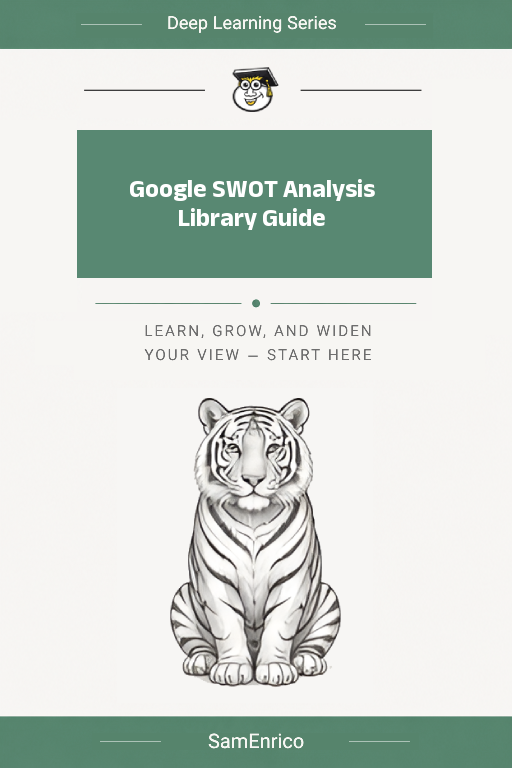
Non-FictionStrategic AtlasAdTech Analysis
Google SWOT Analysis Library Guide eBook
Analyze search monopoly, YouTube strength, AI comp
by Hester Tonja
Analyze search monopoly, YouTube strength, AI competition from OpenAI, and DOJ antitrust pressure.
Formats
Free sample
Chapter 1: The Profitability of Order...--–- In 1998, a pair of Stanford graduate students named Larry Page and Sergey Brin wired a server made from spare computer parts into a dormitory closet and changed the economic logic of the entire world. They did not set out to build a surveillance engine, a data monopoly, or a profit machine. They wanted to organize the world's information and make it universally accessible and useful. That mission statement, which still hangs on Google's corporate website today, sounded like pure idealism. Twenty-five years later, we know it was also the most profitable business model ever devised.The quiet bargain at the heart of Google's empire is so familiar that most users never stop to examine it.
You type a question into a white box. You receive ten blue links in return. You click one. The service costs you nothing. This transaction, repeated more than eight billion times per day, has produced a company worth over two trillion dollars.
But the transaction is not free. You are paying with something far more valuable than money. You are paying with the continuous, systematic surveillance of your curiosity, your doubts, your desires, and your location. Google does not sell your data directly, as the company frequently reminds regulators. It does not need to.
It auctions access to you in real time, every fraction of a second, to the highest bidder.This chapter argues that Google's foundational strength is not superior technology, faster algorithms, or even better engineers. It is the economic ordering of information itself. Google transformed a public utility—the act of asking a question and receiving an answer—into a ruthless profit engine. It did so by perfecting a system that scholars call Digital Welfare Capitalism: the trade where users receive seemingly free services in exchange for continuous behavioral surveillance. The chapter traces Google's evolution from a quirky startup with the motto "Don't Be Evil" to a surveillance-driven colossus.
It forces the reader to confront the true cost of free—data extraction, price discrimination, and the algorithmic shaping of reality. And it concludes with a paradox that will echo through every subsequent chapter: the very order Google profits from is a constructed, biased utility, and that construction is both the company's greatest strength and its deepest vulnerability.The Invention of Free To understand Google's power, one must first understand what it replaced. Before Google, search was a transaction. Early search engines like Alta Vista, Lycos, Excite, and Web Crawler operated on a simple model: users paid nothing, and advertisers paid very little. The technology was primitive.
Search results were based on crude keyword matching. A query for "apple" might return pages about fruit, computers, or the Beatles' record label in equal measure. Relevance was a hope, not a guarantee.Page and Brin's breakthrough was Page Rank, an algorithm that treated links as votes. A page was important if important pages linked to it. This insight, borrowed from academic citation analysis, produced results that felt magical.
Type "apple" and the first result was Apple Computer. Type "Paris" and you got the city, not the socialite. The algorithm seemed to understand intent. Users flocked to Google not because it was free, but because it worked better.The crucial decision came early. Google could have charged for search.
It could have built a subscription service, a pay-per-query model, or a licensing business. Instead, it chose advertising. In 2000, Google launched Ad Words, a system that sold keywords to advertisers. A plumber in Chicago could pay to appear when someone searched "leaky faucet." An airline could pay to appear when someone searched "flights to Boston." The user saw ads alongside organic results, marked with a subtle shading that most eyes skipped over.This model was not invented by Google. Overture (formerly Go To.com) had pioneered paid search listings years earlier.
But Google did something Overture could not: it kept the organic results remarkably good while monetizing the attention around them. Users stayed because the free product was excellent. Advertisers paid because the targeting was precise. And Google collected data on every single interaction. Every query, every click, every result that was ignored—all of it fed back into the algorithm.The term "free" became Google's competitive weapon.
Yahoo, Microsoft, and others could not compete with free. They could not charge users when Google gave away the same service for nothing. But free was never free. The true cost was surveillance. And surveillance, once scaled, became the most valuable commodity on earth.Digital Welfare Capitalism: The Bargain You Never Negotiated Shin Joung Yeo, in her essential book Behind the Search Box, gives a name to this arrangement: Digital Welfare Capitalism.
The term captures something crucial about Google's social contract. Welfare capitalism historically referred to the system where employers provided benefits to workers in exchange for loyalty and quiescence. Ford Motor Company offered five-dollar days and company housing. Eastman Kodak provided health care and pensions. Workers received security.
Employers received control.Google has perfected this model for the digital age. Instead of wages, Google provides free services: search, email, maps, documents, photos, cloud storage, calendars, translation, and navigation. Instead of a workplace, Google offers an ecosystem. The more you use, the more you receive. Gmail users get fifteen gigabytes of free storage.
Google Photos users get unlimited compressed storage. Google Docs users get collaborative editing without paying for Microsoft Office.The cost, as Yeo demonstrates, is continuous behavioral surveillance. Every email you send teaches Google about your relationships. Every document you write reveals your projects and plans. Every map search exposes your movements and intentions.
Every photo you upload trains Google's computer vision models. You are not a customer. You are not even a product, in the old sense of the term. You are a data source, continuously refreshing the reservoir that powers Google's predictive machinery.Consider the scale. Google processes over 8.5 billion searches per day.
That is more than 99,000 searches every second. Each search includes the query text, the location of the user (down to street level, if location services are enabled), the time of day, the device used, the browser settings, the operating system, the IP address, and a unique identifier that ties this search to every other search you have ever made. Google does not need to know your name. It knows your pattern. And patterns are more valuable than names.This surveillance is not hidden.
Google publishes privacy policies. It offers dashboard tools to view your data. It allows you to delete your history. But these gestures toward transparency obscure the deeper reality. The system is designed to extract maximum data with minimum friction.
Deleting your history is a multi-click process that most users never attempt. Opting out of personalized ads requires navigating labyrinthine settings. And even when you opt out, Google still collects your data; it simply claims not to use it for ad targeting.The bargain, then, is not a contract. It is a trap. You can stop using Google.
You can switch to Duck Duck Go, Proton Mail, Open Street Map, and Nextcloud. But the friction is enormous. And your friends, colleagues, and family are still on Google. They will send you Google Docs…
This is the end of the free sample. Get the eBook to keep going. Buy now
About this book
Details
- Author
- Hester Tonja
- Publisher
- SamEnrico
- Language
- English
- Genre
- Non-Fiction, Strategic Atlas, AdTech Analysis
- Released
- 2026-06-01
- Pages (approx.)
- 135
- Available as
- eBook, Audiobook

Read better in the ZLOADR app
Your eBooks on your phone or tablet. Sign in with your SamEnrico account and start reading.
More by Hester Tonja
 The Joy of ReadingHester Tonja$11.99
 Senior Spiritual Esteem GuideHester Tonja$11.99
 Parent Teacher ShameHester Tonja$11.99
 Graduate Student EQ GuideHester Tonja$11.99
 The Wandering Mind Meditation GuideHester Tonja$11.99
 The Torso in the Suitcase: Australia’s Forgotten Dismemberment CaseHester Tonja$11.99
 Understanding MyocarditisHester Tonja$17.99
 Payroll Accounting Formulas ExplainedHester Tonja$12.99
 Associate ProfessorHester Tonja$11.99
 How to Become a Spotter IHester Tonja$11.99
You may also like
 Hong Kong Handover 1997Dunn Johnnie$11.99
 Zumba For Postnatal Recovery CourseNeal Christian$11.99
 Zumba for BeginnersLadner Nikia$11.99
 YouTube Comment Mining GuideHumes Pandora$12.99
 Worry Box MeditationCarlin Rudy$11.99
 Workplace Stress MeditationNguyen Lynn$11.99
 Workplace Stress and Sleep RepairHawley Ivory$11.99
 Workplace Perfectionism CureDelaney Jeffry$11.99
 Workplace Injustice Anger GuideWallen Isabelle$11.99
 Work Addiction and Burnout LinkGreenwood Ester$11.99
 Women in Yoga and WellnessBeattie Galina$11.99
 Women in Stand Up ComedyChun Evangeline$11.99