
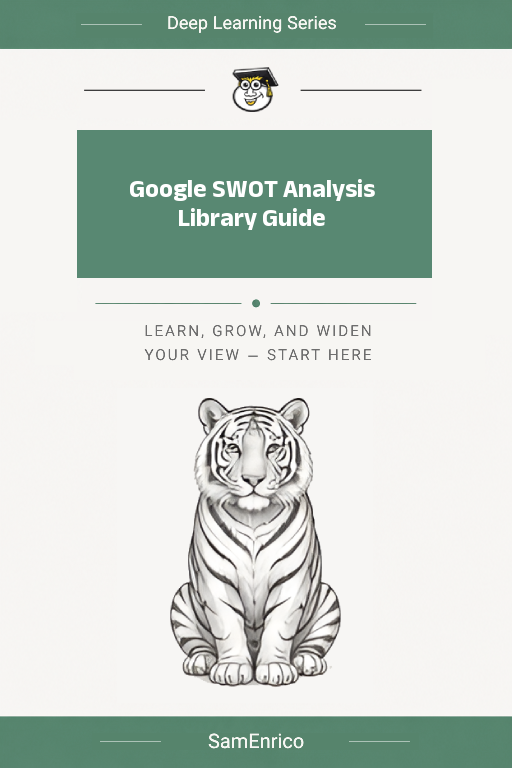
Non-FictionStrategic AtlasAdTech Analysis
Google SWOT Analysis Library Guide
Analyze search monopoly, YouTube strength, AI comp
by Hester Tonja
Analyze search monopoly, YouTube strength, AI competition from OpenAI, and DOJ antitrust pressure.
Formats
About this book
Free sample
Chapter 1: The Profitability of Order...--–- In 1998, a pair of Stanford graduate students named Larry Page and Sergey Brin wired a server made from spare computer parts into a dormitory closet and changed the economic logic of the entire world. They did not set out to build a surveillance engine, a data monopoly, or a profit machine. They wanted to organize the world's information and make it universally accessible and useful. That mission statement, which still hangs on Google's corporate website today, sounded like pure idealism. Twenty-five years later, we know it was also the most profitable business model ever devised.The quiet bargain at the heart of Google's empire is so familiar that most users never stop to examine it.
You type a question into a white box. You receive ten blue links in return. You click one. The service costs you nothing. This transaction, repeated more than eight billion times per day, has produced a company worth over two trillion dollars.
But the transaction is not free. You are paying with something far more valuable than money. You are paying with the continuous, systematic surveillance of your curiosity, your doubts, your desires, and your location. Google does not sell your data directly, as the company frequently reminds regulators. It does not need to.
It auctions access to you in real time, every fraction of a second, to the highest bidder.This chapter argues that Google's foundational strength is not superior technology, faster algorithms, or even better engineers. It is the economic ordering of information itself. Google transformed a public utility—the act of asking a question and receiving an answer—into a ruthless profit engine. It did so by perfecting a system that scholars call Digital Welfare Capitalism: the trade where users receive seemingly free services in exchange for continuous behavioral surveillance. The chapter traces Google's evolution from a quirky startup with the motto "Don't Be Evil" to a surveillance-driven colossus.
It forces the reader to confront the true cost of free—data extraction, price discrimination, and the algorithmic shaping of reality. And it concludes with a paradox…
This is the end of the free sample. Get the eBook to keep going. Buy now
Contents
- Chapter 1
- Chapter 2
- Chapter 3
- Chapter 4
- Chapter 5
- Chapter 6
- Chapter 7
- Chapter 8
- Chapter 9
- Chapter 10
- Chapter 11
- Chapter 12
Details
- Author
- Hester Tonja
- Publisher
- SamEnrico
- Language
- English
- Genre
- Non-Fiction, Strategic Atlas, AdTech Analysis
- Released
- 2026-06-01
- Pages (approx.)
- 135
- Available as
- eBook, Audiobook

Read better in the ZLOADR app
Your eBooks on your phone or tablet. Sign in with your SamEnrico account and start reading.
More by Hester Tonja
 The Joy of ReadingHester Tonja$11.99
 Senior Spiritual Esteem GuideHester Tonja$11.99
 Parent Teacher ShameHester Tonja$11.99
 Graduate Student EQ GuideHester Tonja$11.99
 The Wandering Mind Meditation GuideHester Tonja$11.99
 The Torso in the Suitcase: Australia’s Forgotten Dismemberment CaseHester Tonja$11.99
 Understanding MyocarditisHester Tonja$17.99
 Payroll Accounting Formulas ExplainedHester Tonja$12.99
 Associate ProfessorHester Tonja$11.99
 How to Become a Spotter IHester Tonja$11.99
You may also like
 Hong Kong Handover 1997Dunn Johnnie$11.99
 Zumba For Postnatal Recovery CourseNeal Christian$11.99
 Zumba for BeginnersLadner Nikia$11.99
 YouTube Comment Mining GuideHumes Pandora$12.99
 Worry Box MeditationCarlin Rudy$11.99
 Workplace Stress MeditationNguyen Lynn$11.99
 Workplace Stress and Sleep RepairHawley Ivory$11.99
 Workplace Perfectionism CureDelaney Jeffry$11.99
 Workplace Injustice Anger GuideWallen Isabelle$11.99
 Work Addiction and Burnout LinkGreenwood Ester$11.99
 Women in Yoga and WellnessBeattie Galina$11.99
 Women in Stand Up ComedyChun Evangeline$11.99