
Non-FictionInformativeEducational
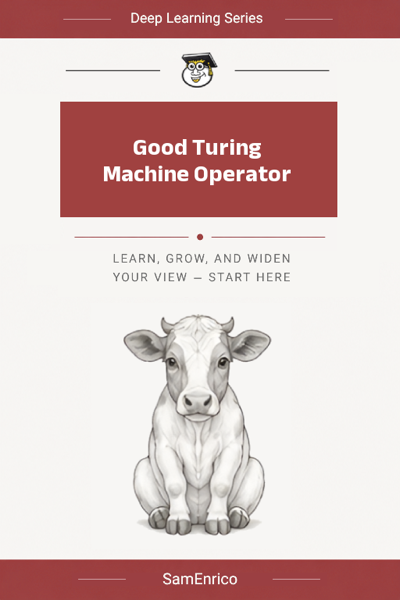
Good Turing Machine Operator eBook
A Coursebook on Good Turing Machine Operator
A Coursebook on Good Turing Machine Operator
Formats
Free sample
Chapter 1: The Ghost in the Console...--–- The first thing you must understand about a Turing machine is that it has no soul. No intuition. No sense of when it has been spinning its wheels too long. The machine will happily follow an infinite loop until the magnetic drum wears smooth or the vacuum tubes glow white-hot. It will not stop because it is tired, or bored, or because the answer is obviously never coming.
The machine has only one virtue: it does exactly what you tell it to do, nothing more and nothing less. This makes it both the most reliable and the most dangerous tool ever devised by human hands.The year is 1952. You are standing in a room the size of a modest kitchen, surrounded by twenty-seven relay cabinets that hum at a frequency just below human hearing. The air smells of hot metal, ozone from the cooling fans, and the faint acrid tang of heated Bakelite. Before you is a console: a sloped metal panel perhaps three feet wide, covered in switches, neon lamps, and a row of cathode ray tubes that glow a soft green.
This is the Ferranti Mark I, the world's first commercially available stored-program computer. And you are about to become its operator.Your title will be "Turing Machine Operator," though nobody in 1952 uses that phrase. They say "computer" – meaning the human who computes – or "operator" or "the girl" (most operators are women, a legacy of the wartime code-breaking colossi). But the abstract machine that lives inside these cabinets is Turing's machine, exactly as he described it in his 1936 paper "On Computable Numbers." There is an infinite tape (implemented as a spinning magnetic drum holding 4,096 twenty-bit words). There is a read/write head (the playback and record heads that float a hair's breadth above the drum's surface).
There is a finite state machine (the control circuitry that interprets instructions). And there is a human operator – you – who decides when the machine has done enough.This chapter is about the anatomy of that machine. Not the abstract mathematics – we will get to that in later chapters – but the physical console you will touch, the switches you will flip, the lights you will read, and the sounds you will learn to interpret. A pilot does not need to understand the thermodynamics of jet engines to fly a plane, but she must know what every dial, switch, and warning light means. The same is true for a Turing machine operator.
By the end of this chapter, you will be able to walk up to a Ferranti Mark I (or its modern simulator) and name every major component. You will know what each control does, what each display shows, and what the machine is telling you through its clicks, buzzes, and glowing indicators.Let us begin with the most important truth about this machine: it is not a thinking thing. It is a tape-reading thing. Everything else follows from that.The Infinite Tape, Made Finite In Turing's 1936 paper, the machine operates on an infinite tape divided into squares, each square containing one symbol from a finite alphabet. The tape stretches forever in both directions.
This infinity is mathematically convenient – it guarantees the machine never runs out of workspace – but it is physically impossible. No real machine has an infinite tape. The Ferranti Mark I solves this problem with a magnetic drum: a brass cylinder, twelve inches long and six inches in diameter, coated in a reddish-brown magnetic oxide. The drum spins at 3,000 revolutions per minute. Arranged around its circumference are thirty-two read/write heads, each fixed in place, each reading a separate circular track.
The drum does not move left or right relative to the heads; instead, the heads wait for the desired address to spin underneath them.This is the electronic store – the machine's main memory. In the Ferranti Mark I, the electronic store holds 4,096 words. Each word is twenty bits: enough to store a single instruction or a single integer between -524,288 and +524,287 (in the machine's representation). Four thousand ninety-six words is not infinite. It is barely enough for a few hundred instructions and a small array of data.
The machine compensates by treating the magnetic drum as a cache for a larger tape system: programs and data that do not fit in the drum are stored on external magnetic tape reels, which can be swapped by the operator. The operator's job includes deciding what belongs on the drum and what belongs on tape – a precursor to modern virtual memory management, but with no hardware assistance. You make the decision. You move the blocks. You keep track of where everything is.The drum spins continuously from the moment the machine is powered on until it is shut down.
There is no "seek time" in the modern sense – the heads are fixed, and the drum rotates. To read a word, the control circuitry waits until the desired track's address marker passes under the head, then samples the bits. This means that memory access is not uniform: some addresses become available sooner than others depending on the drum's rotational position. Good operators learn to arrange instructions and data so that the machine does not waste time waiting for the drum to spin. This is the art of "drum optimization," and it is one of the first skills that separates a good operator from a merely adequate one.The Console: Your Window Into the Machine The console is the only interface between you and the machine's internal state.
There is no keyboard, no screen, no mouse. There are switches and lights. The console is mounted on a sloping panel so you can see it while standing. From left to right, the major components are:The Hand Switches (H switches). A row of twenty toggle switches, labeled H0 through H19.
Each switch corresponds to one bit of a twenty-bit word. When the machine is in MAN mode (more on that in Chapter 2), flipping these switches allows you to enter a binary number directly into the machine. For example, to enter the number 42 (binary 000000000000101010), you would flip H4, H6, H8, H10 – wait, that is not correct. Let us be precise: bits are numbered from 0 (least significant) to 19 (most significant). The number 42 in binary is 101010, which occupies bits 1 through 5.
Flipping H1, H3, and H5 would set the appropriate bits. You will practice this until it becomes second nature, because in Chapter 3 you will be keying entire boot programs by hand using these switches.The Accumulator Tubes. A set of twenty neon lamps, one per bit, showing the current contents of the Accumulator. The Accumulator is the machine's primary working register – all arithmetic operations happen here. If you have ever used an old mechanical adding machine, the Accumulator is the display that shows the running total.
The lamps glow orange when the bit is 1 and remain dark when the bit is 0. A good operator glances at the Accumulator Tubes constantly, reading the binary pattern as easily as you read decimal numbers. By the end of this course, you will be able to look at a row of twenty lamps and know the value within a second.The B-Tube. A…
This is the end of the free sample. Get the eBook to keep going. Buy now
About this book
Details
- Author
- Hadden Nannie
- Publisher
- SamEnrico
- Language
- English
- Genre
- Non-Fiction, Informative, Educational
- Released
- 2026-06-02
- Pages (approx.)
- 148
- Available as
- eBook, Audiobook

Read better in the ZLOADR app
Your eBooks on your phone or tablet. Sign in with your SamEnrico account and start reading.
More by Hadden Nannie
 NVC Trainer Certification GuideHadden Nannie$11.99
 Teen Confidence Builder WorkbookHadden Nannie$11.99
 Canva Brand Identity for Cleaning ServicesHadden Nannie$11.99
 The Labeling and Mislabeling AngerHadden Nannie$11.99
 The Silk & Gold Runway: How African Designers Defied Colonial Fashion in the 19th CenturyHadden Nannie$11.99
 Learn to Play the WhistleHadden Nannie$11.99
 AI for Multi-Echelon InventoryHadden Nannie$12.99
 How to Start a Carburettors and Such for All Internal Combustion Engines Business (Beginners Guide)Hadden Nannie$11.99
You may also like
 Hong Kong Handover 1997Dunn Johnnie$11.99
 Zumba For Postnatal Recovery CourseNeal Christian$11.99
 Zumba for BeginnersLadner Nikia$11.99
 YouTube Comment Mining GuideHumes Pandora$12.99
 Worry Box MeditationCarlin Rudy$11.99
 Workplace Stress MeditationNguyen Lynn$11.99
 Workplace Stress and Sleep RepairHawley Ivory$11.99
 Workplace Perfectionism CureDelaney Jeffry$11.99
 Workplace Injustice Anger GuideWallen Isabelle$11.99
 Work Addiction and Burnout LinkGreenwood Ester$11.99
 Women in Yoga and WellnessBeattie Galina$11.99
 Women in Stand Up ComedyChun Evangeline$11.99