
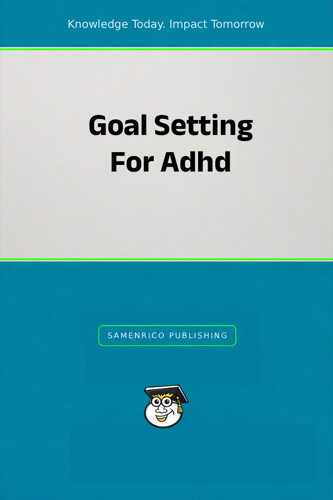
Goal Setting For Adhd eBook
Breaks tasks into hyperfocus friendly chunks.
by Stone Virgil
Breaks tasks into hyperfocus friendly chunks.
Formats
Free sample
Chapter 1: The Willpower Trap--–- Sarah had been staring at her laptop for four hours. The cursor blinked mockingly on a blank document titled "Q3 Report – Draft." She had opened the file at 9:00 AM. It was now 1:00 PM. In those four hours, she had: checked her email seventeen times, organized her desktop folders by color, researched the best ergonomic keyboard (she did not buy one), cleaned her coffee mug twice, watched three videos about shipwrecks, and cried in the bathroom for seven minutes. The report required her to write approximately 800 words.
She had written zero.Her husband texted: "How's the report going?" She typed back: "Almost done." Then she closed the laptop, walked to the kitchen, ate cold pasta standing up, and told herself she would start again at 3:00 PM. At 3:00 PM, she opened the laptop, stared at the blank document, and felt her chest tighten. At 3:07 PM, she closed the laptop and decided she would wake up at 5:00 AM tomorrow to finish it. She did not wake up at 5:00 AM. She woke up at 7:30 AM, rushed to work, and submitted the report at 4:59 PM on Friday—barely meeting the deadline, having produced something she knew was mediocre.
That night, she told her husband: "I just need to try harder."Sarah has ADHD. She was diagnosed at thirty-two, after her second child was born and her carefully constructed system of Post-it notes, phone alarms, and guilt finally collapsed. She had spent her entire adult life believing that her struggles with follow-through, her chronic lateness, her habit of starting projects with explosive enthusiasm and abandoning them at 70% completion, were moral failures. She was lazy. She was undisciplined.
She didn't care enough. These were the stories she told herself. These were the stories the world had taught her.This book exists because those stories are lies.The Great Lie of Modern Productivity Let us name the enemy. For the past forty years, the self-help industry, the corporate training complex, and the productivity gurus of Silicon Valley have sold the world a seductive promise: anyone can achieve anything if they simply apply the right system. Wake up at 5:00 AM.
Make your bed. Write down three priorities. Use the Pomodoro Technique. Break tasks into smaller steps. Eliminate distractions.
Apply willpower. Try harder.These systems work beautifully for neurotypical brains. They fail catastrophically for the ADHD brain. Not because the ADHD brain is broken, but because these systems were designed for a different operating system entirely. Telling someone with ADHD to "just use a to-do list" is like telling someone with a broken leg to "just walk faster." The problem is not motivation.
The problem is neurology.Consider the evidence. A 2019 study published in the Journal of Attention Disorders found that adults with ADHD attempted an average of 4.7 different productivity systems over the course of a decade. Every single participant reported that the systems worked—for three to fourteen days. Then the system stopped working. The participants universally blamed themselves.
They were not lazy. They were using gasoline in a diesel engine.This chapter will dismantle the three most dangerous myths about ADHD and goal achievement, introduce the concept of the Interest-Based Nervous System, and establish the foundational shift that will define every page of this book: the move from Effort to Design. By the end of this chapter, you will understand why "try harder" is not just unhelpful but actively harmful, and you will have taken the first step toward a system that actually fits your brain.Myth #1: You Have a Deficit of Attention The single most damaging word in "Attention Deficit Hyperactivity Disorder" is the word deficit. It implies scarcity. It implies lack.
It implies that your brain contains less attention than a neurotypical brain, as if attention were a bucket of water and yours has a hole in it.This is not true.What looks like a deficit of attention is actually a dysregulation of attention. You do not have less ability to focus. You have less ability to choose what you focus on. Anyone who has watched someone with ADHD spend six hours building an elaborate spreadsheet to track their movie collection, or researching the history of submarines instead of filing their taxes, or reorganizing their entire kitchen at 11:00 PM the night before a deadline, knows that the ADHD brain is capable of extraordinary focus. The problem is not the quantity of attention.
The problem is the direction.Dr. Russell Barkley, the foremost researcher on ADHD, puts it this way: "ADHD is not a disorder of knowing what to do. It is a disorder of doing what you know." This distinction is everything. The ADHD brain knows the report is due. It knows the dishes need washing.
It knows the email needs a response. The knowledge is present. The ability to translate that knowledge into action, at the moment action is required, is what breaks down.This breakdown has a name: executive dysfunction. Executive functions are the brain's management system—working memory, inhibitory control, cognitive flexibility, and the other cognitive processes that allow you to pause, consider, plan, and execute. In the ADHD brain, executive functions are not absent, but they are inconsistent.
They work beautifully under conditions of high interest, novelty, urgency, or challenge. They fail under conditions of routine, repetition, delayed consequences, or low stimulation.This is why you can spend six hours building that spreadsheet (high interest, high novelty, self-imposed challenge) but cannot spend six minutes opening a bill (low interest, routine, external demand). The capacity for focus is identical. The conditions that unlock that capacity are radically different.Myth #2: You Just Need to Find the Right Productivity System The second myth is that somewhere, hidden in the vast ecosystem of planners, apps, and methods, there is a system that will finally work for you. You have tried bullet journaling (abandoned in March).
You have tried Notion (too many templates, too much setup). You have tried Trello, Asana, Todoist, and a paper planner from Japan that cost sixty dollars. Each system worked for exactly as long as it was novel. Then the novelty wore off, and the system became invisible, and you stopped using it.You blamed yourself. "I lack discipline," you said.
"I give up too easily," you said. "Maybe I just don't care enough," you said.Here is the truth that will set you free: every single one of those systems failed because they were designed for neurotypical brains. They assume that consistency is a matter of habit, not neurology. They assume that once a behavior is learned, it will continue without conscious effort. They assume that the primary obstacle to productivity is lack of clarity, not lack of dopamine.The ADHD brain does not form habits in the same way as the neurotypical brain.
Neurotypical habit formation relies on the basal ganglia, which automates repeated behaviors through a cue-routine-reward loop. The ADHD brain has altered dopamine signaling in this same circuit. What this means in practice: a neurotypical person who flosses every day for sixty days will find that flossing becomes automatic, requiring minimal effort. A person with ADHD who flosses every day for sixty days may still find that flossing requires the same conscious…
This is the end of the free sample. Get the eBook to keep going. Buy now
About this book
Details
- Author
- Stone Virgil
- Publisher
- SamEnrico
- Language
- English
- Genre
- Non-Fiction, Self-Help, ADHD
- Released
- 2026-06-05
- Pages (approx.)
- 130
- Available as
- eBook, Audiobook

Read better in the ZLOADR app
Your eBooks on your phone or tablet. Sign in with your SamEnrico account and start reading.
More by Stone Virgil
 Sheppard Media Circus TrialStone Virgil$11.99
 Nap and Caffeine InteractionStone Virgil$11.99
 Pet Loss and SleepStone Virgil$11.99
 Morning Routine BlueprintStone Virgil$11.99
 Dream Ritual NotebookStone Virgil$11.99
 The Study Music GuideStone Virgil$11.99
 The Cohousing Retirement OptionStone Virgil$11.99
 The Spartan Spy: Lysander’s Shadow WarStone Virgil$11.99
 The Desert Phantom: The Unsolved Murder of Lady Hester Stanhope (1839)Stone Virgil$11.99
 How to Start a Air Traffic Control BusinessStone Virgil$11.99
 Service Providers Guide to Website Design & DevelopmentStone Virgil$11.99
 How to Produce Kitchen Tools and UtensilsStone Virgil$11.99
You may also like
 Hong Kong Handover 1997Dunn Johnnie$11.99
 Zumba For Postnatal Recovery CourseNeal Christian$11.99
 Zumba for BeginnersLadner Nikia$11.99
 YouTube Comment Mining GuideHumes Pandora$12.99
 Worry Box MeditationCarlin Rudy$11.99
 Workplace Stress MeditationNguyen Lynn$11.99
 Workplace Stress and Sleep RepairHawley Ivory$11.99
 Workplace Perfectionism CureDelaney Jeffry$11.99
 Workplace Injustice Anger GuideWallen Isabelle$11.99
 Work Addiction and Burnout LinkGreenwood Ester$11.99
 Women in Yoga and WellnessBeattie Galina$11.99
 Women in Stand Up ComedyChun Evangeline$11.99