
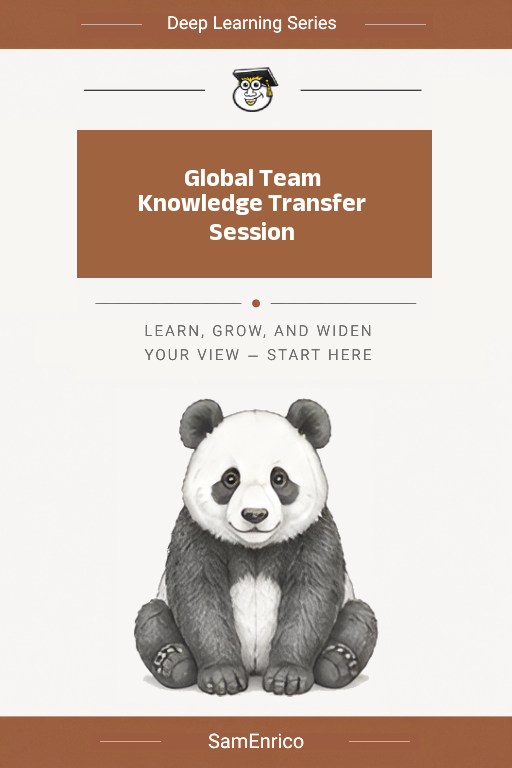
Non-FictionProfessional's Cheat Sheet
Global Team Knowledge Transfer Session eBook
Record all training and pair junior with senior ac
Record all training and pair junior with senior across regions for 30 minute weekly shadow calls.
Formats
Free sample
Chapter 1: The Big Handover Lie--We have been lying to ourselves about how expertise moves from one human to another.The lie sounds reasonable. It sounds efficient. It sounds like management. The lie is this: “If we just document everything—every process, every decision, every relationship—then knowledge will survive forever.” We have built entire careers, software platforms, and consulting practices around this lie. We call it knowledge management.
We call it a learning management system. We call it a wiki, a playbook, a runbook, a handbook. We give it noble names like “The Source of Truth” and “The Single Source of Reality.”But none of it works.Not really. Not the way we need it to.I have watched this lie play out in more than two hundred global organizations over fifteen years. I have seen the pattern repeat in San Francisco startups and London hedge funds, in Tokyo manufacturing giants and São Paulo logistics firms.
A senior expert is about to leave—retirement, promotion, or a better offer. A junior is assigned to absorb that expert’s knowledge. A meeting is scheduled. Three hours. Sometimes four.
The senior opens a shared drive. “All my files are here,” they say. “Let me walk you through them.” They click through folders. They explain acronyms. They tell war stories.
The junior nods. The junior takes notes. The junior smiles. The junior understands almost nothing.Three weeks later, the senior is gone. The junior is alone.
And the junior discovers the first real problem—a client with an unusual request, a server with a strange error, a negotiation that requires a specific tone—and realizes that nowhere, in any folder, in any document, in any recording, is the answer written down. The answer was never in the files. The answer was in the senior’s head. And that head has walked out the door.This is not a failure of effort. It is a failure of understanding.
We have misunderstood what knowledge actually is. We have treated it like a physical object—something that can be picked up, placed in a container, and handed over. But the knowledge that matters most—the knowledge that decides whether a client stays or leaves, whether a bug gets fixed in five minutes or five days, whether a negotiation succeeds or fails—is not a thing. It is a performance. It is a live, embodied, reactive, intuitive performance.
And you cannot document a performance. You can only watch it.This chapter dismantles the three most dangerous assumptions about knowledge transfer. First, the assumption that more time equals better transfer. Second, the assumption that documentation replaces demonstration. And third, the assumption that juniors will tell you when they do not understand.
By the end of this chapter, you will see the traditional handover for what it really is: a ritual of reassurance that produces almost zero durable learning. And you will be ready for the alternative.The Cognitive Limits You Cannot Negotiate With Let us begin with the biology of learning, because the biology does not care about your deadlines.The human working memory is a remarkably small door. Cognitive psychologists have known this since George Miller’s famous 1956 paper, “The Magical Number Seven, Plus or Minus Two,” which argued that the average human can hold between five and nine discrete pieces of information in conscious awareness at once. Subsequent research has revised that number downward. The current consensus, supported by decades of studies in cognitive load theory (Sweller, 1988; Kirschner, Sweller, & Clark, 2006), is that working memory can comfortably process only three to five novel elements at any given moment.Three to five.Let that sink in.When you sit a junior down for a three-hour handover, you are not transferring one hundred pieces of information.
You are transferring three to five. The rest passes through the junior’s ears, bounces around the short-term memory buffer for perhaps twenty seconds, and then vanishes—overwritten by the next sentence, the next slide, the next file name.This is not a character flaw. It is not a training deficiency. It is not a lack of effort. It is physiology.
The junior cannot remember more because the human brain was not designed to remember more. Our working memory evolved to track a small number of immediate threats—a predator here, a food source there, a social cue from a tribesmate. It was not designed to absorb a three-hour monologue about spreadsheet macros or client escalation protocols.I have run a simple experiment with more than five hundred professionals across fifteen countries. I ask a senior to deliver a ten-minute explanation of a moderately complex process—say, how to approve a purchase order above fifty thousand dollars. The junior listens.
Then I ask the junior to explain the process back to me. The average retention rate after ten minutes is about forty percent. After sixty minutes, it drops below twenty percent. After three hours, it falls to less than five percent.Five percent of a three-hour handover is nine minutes of retained information. Nine minutes.And yet organizations continue to schedule four-hour handovers as if they are doing something productive.
Worse, they treat the completion of the handover as a milestone. The senior checks a box. The junior updates their timesheet. The manager congratulates everyone on a successful transition. And then, three days later, the junior is stuck, and no one can understand why.This is the first lie: that time equals transfer.
It does not. More time simply means more forgotten information. The relationship between session length and retention is not linear. It is a steep decline that begins around the fifteen-minute mark and accelerates after forty-five minutes.Tacit vs. Explicit: The Distinction That Changes Everything If we cannot transfer knowledge simply by talking about it, how does expertise actually move from one person to another?The answer lies in a distinction first made by the chemist and philosopher Michael Polanyi in his 1966 book, The Tacit Dimension.
Polanyi famously wrote, “We can know more than we can tell.” That single sentence contains the entire problem of knowledge transfer in organizations.Explicit knowledge is what we can tell. It is the knowledge that can be written down, codified, stored in a database, and retrieved on demand. The capital of France is Paris. The formula for calculating compound interest is P(1+r)^n. The steps to reset a user’s password are listed in the IT knowledge base.
Explicit knowledge is wonderful. It is portable, scalable, and searchable. It is also, for most high-value tasks, almost useless.Tacit knowledge is everything else. It is the knowledge that we cannot fully articulate because it lives in our muscles, our intuitions, our habits, and our moment-to-moment judgments. A master carpenter cannot write down exactly how they know that a piece of wood will split if cut at a certain angle.
A senior salesperson cannot fully explain why they waited seven seconds before responding to a client’s objection. A veteran software engineer cannot document the exact pattern recognition that makes them suspect a race condition before they have even seen the code.Tacit knowledge is not mysterious or mystical. It is simply knowledge that has been embodied…
This is the end of the free sample. Get the eBook to keep going. Buy now
About this book
Details
- Author
- Daniels Leroy
- Publisher
- SamEnrico
- Language
- English
- Genre
- Non-Fiction, Professional's Cheat Sheet
- Released
- 2026-05-30
- Pages (approx.)
- 160
- Available as
- eBook, Audiobook

Read better in the ZLOADR app
Your eBooks on your phone or tablet. Sign in with your SamEnrico account and start reading.
More by Daniels Leroy
 The 30 Day Gambling Free Challenge GuideDaniels Leroy$11.99
 Food Addiction And ADHD GuideDaniels Leroy$11.99
 Feynman Challenger CommissionDaniels Leroy$11.99
 Cannabis Use Disorder GuideDaniels Leroy$11.99
 Weekly Review Deep Dive HandbookDaniels Leroy$11.99
 Remote Public Affairs CommunicationDaniels Leroy$11.99
 Growth Hormone Osteoarthritis PreventionDaniels Leroy$11.99
 The Call Center OverdoseDaniels Leroy$11.99
 Murdoch MySpaceDaniels Leroy$11.99
 Velvet & Venom: The Scandal That Toppled an EmpireDaniels Leroy$11.99
 The Philosophers of the Nile: Egypt's Eternal WisdomDaniels Leroy$11.99
 The Great Emu War: When Birds Outsmarted an ArmyDaniels Leroy$11.99
You may also like
 Hong Kong Handover 1997Dunn Johnnie$11.99
 Zumba For Postnatal Recovery CourseNeal Christian$11.99
 Zumba for BeginnersLadner Nikia$11.99
 YouTube Comment Mining GuideHumes Pandora$12.99
 Worry Box MeditationCarlin Rudy$11.99
 Workplace Stress MeditationNguyen Lynn$11.99
 Workplace Stress and Sleep RepairHawley Ivory$11.99
 Workplace Perfectionism CureDelaney Jeffry$11.99
 Workplace Injustice Anger GuideWallen Isabelle$11.99
 Work Addiction and Burnout LinkGreenwood Ester$11.99
 Women in Yoga and WellnessBeattie Galina$11.99
 Women in Stand Up ComedyChun Evangeline$11.99