
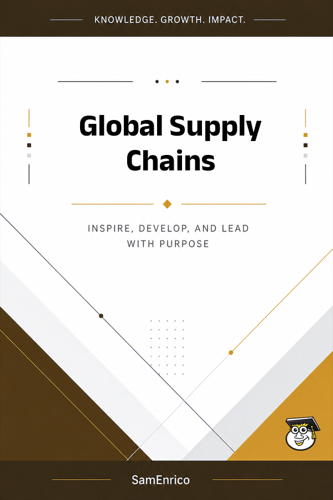
Non-FictionBusiness BriefGlobal Economics
Global Supply Chains eBook
Analyze international production networks and thei
Analyze international production networks and their vulnerability to disruptions.
Formats
Free sample
Chapter 1: The Steel Box...--The object in front of you is unremarkable. It is a rectangular prism of corrugated steel, rust-streaked along its seams, with heavy double doors at one end and reinforced brackets at each corner. You have seen thousands of them stacked on ships, piled in railyards, or rumbling past on the backs of eighteen-wheelers. You have never given it a second thought.But this steel box—this集装箱, this conteneur, this Container—is the single most important manufactured object in the modern world. More than the microchip.
More than the smartphone. More than the airplane. One humble box, standardized across the planet, has done more to reshape the geography of human civilization than any invention since the railroad. It is the reason you can buy strawberries in January, a t-shirt for five dollars, or a television from a brand you have never heard of. It is also the reason that a virus in Wuhan could empty shelves in New York, why a ship stuck in a canal could freeze global trade, and why the price of your next car might double overnight.This is the story of how that box changed everything—and how it created the fragile, invisible, terrifyingly efficient system that rules your life.The World Before the Box To understand what the container made possible, you must first understand the chaos it replaced.Imagine the Port of New York in 1950.
Not the gleaming automated terminals of today, but a warren of crowded piers stretching along the Hudson River. A cargo ship has just arrived from Liverpool. It carries, among other things, whiskey, wool, machinery parts, and china. The ship is tied to the dock, but the work has barely begun.A gang of longshoremen—muscular, profane, fiercely independent—swarms aboard. They are not employees of the shipping line.
They are casual laborers, hired by the shift, who show up each morning at the "shape-up" on the pier, hoping to be chosen. Those not selected drift to nearby bars or gambling dens. Those who are chosen grab hooks, ropes, and pallets, and begin the brutal, dangerous work of unloading.Each item on that ship is packed differently. The whiskey is in wooden barrels, hooped with iron. The wool is in burlap bales, stitched shut with twine.
The machinery parts are in custom-built wooden crates, each one a different size. The china is in straw-packed cartons marked "FRAGILE" in red paint. Everything must be handled by hand. A longshoreman hooks a barrel, swings it to the edge of the hold, and a crane operator—stationed high above on the dock—lowers a sling. The barrel is hoisted up, swung over the pier, and lowered onto a waiting truck.
Repeat for the next barrel. Then the bales. Then the crates.This is called "break-bulk" shipping: every unit of cargo is broken down, handled individually, and reassembled. It is agonizingly slow. A single ship can take ten days to unload.
It is staggeringly expensive. In 1950, the cost of loading and unloading a ship accounted for nearly 75 percent of total shipping costs. It is also incredibly dangerous. Longshoremen died by the hundreds each year—crushed by swinging loads, crushed between ship and dock, crushed when pallets collapsed.And it is theft-ridden. At the Port of New York in the 1950s, cargo theft was so rampant that shipping companies budgeted for a "leakage rate" of 5 to 10 percent.
Whiskey barrels arrived in Liverpool mysteriously lighter. Wool bales lost pounds somewhere between ship and warehouse. Silk, cigarettes, and whiskey—the high-value, easily sellable goods—were particularly vulnerable. Longshoremen had a saying: "I never saw a truck that didn't leak."This was the world before the box. Global trade existed—the British Empire had built global trade over centuries—but it was slow, expensive, risky, and limited.
Only high-value, low-weight goods (spices, silks, whiskey, machinery) could bear the cost of transport. Bulk commodities like grain, ore, and lumber moved in specialized holds. Everyday goods—furniture, clothing, tools—were produced locally or regionally. There was no global supply chain for a toaster because shipping a toaster from Shanghai to Chicago would cost more than the toaster itself.Then a truck driver from North Carolina had an idea.The Madman with a Vision Malcom Mc Lean was not a shipping magnate. He was not a naval architect or a logistics expert.
He was a trucker. In the 1930s, he had built a small trucking company in rural North Carolina, hauling farm produce and tobacco. By the 1950s, Mc Lean Trucking was one of the largest in the South. But Mc Lean was plagued by a frustration that would become his obsession: the wait.Every day, his trucks would drive to the ports of New York, Norfolk, or Charleston, carrying goods destined for Europe or Latin America. And every day, those trucks would sit.
For hours. Sometimes for days. Longshoremen would unload each trailer by hand, transferring the cargo into break-bulk ships. Mc Lean, a man of furious impatience, would stand on the dock and fume. There had to be a better way.His insight was deceptively simple: what if you could lift an entire truck trailer—wheels and all—and place it directly onto a ship?
The cargo would never be touched. The longshoremen would simply hook the trailer, swing it aboard, and drive it off at the destination. No handling, no theft, no breakage, no delay.The shipping industry laughed at him. The railroads had tried "piggyback" service (loading truck trailers onto flatcars) with limited success. The unions would never allow it, they said—longshoremen would strike.
The ports weren't designed for it. The ships weren't built for it. It would never work.Mc Lean ignored them. In 1955, he sold his trucking company for $25 million (roughly $250 million today) and poured every cent into a new venture: Mc Lean Industries, a shipping company built around a radical idea. He abandoned the original plan of loading entire truck trailers—the wheels took up too much space.
Instead, he designed a standardized steel box that could be lifted off a truck chassis, stacked on a ship, and lifted onto another chassis at the destination. The box would be 20 feet long, 8 feet wide, 8 feet tall. It would have reinforced corners, heavy doors, and slots for lifting hooks. It would be exactly the same everywhere.On April 26, 1956, the SS Ideal X, a converted oil tanker, sailed from Port Newark, New Jersey, to Houston, Texas. Bolted to its deck were 58 of Mc Lean's steel boxes.
The longshoremen, expecting a traditional break-bulk cargo of drums and crates, found nothing to do. The boxes were loaded in eight hours—a job that would have taken three days with break-bulk. The cost of loading fell from $5.86 per ton to just 16 cents.The world changed on that voyage. Almost no one noticed.The Standardization War The Ideal X proved that the container could work. But proving it could work everywhere, for everyone, took another fifteen years of brutal, often bloody, competition.Mc Lean's genius was not the container itself—similar ideas had been tried for decades.
His genius was understanding that the container was worthless unless everyone used the same box. A 20-foot box from New…
This is the end of the free sample. Get the eBook to keep going. Buy now
About this book
Details
- Author
- Hundley Micheline
- Publisher
- SamEnrico
- Language
- English
- Genre
- Non-Fiction, Business Brief, Global Economics
- Released
- 2026-06-09
- Pages (approx.)
- 128
- Available as
- eBook, Audiobook

Read better in the ZLOADR app
Your eBooks on your phone or tablet. Sign in with your SamEnrico account and start reading.
More by Hundley Micheline
 Metta Meditation For BeginnersHundley Micheline$11.99
 Online Learning Stress ManagementHundley Micheline$11.99
 Specific Phobia DiagnosisHundley Micheline$11.99
 Repo Agent Stress ManagementHundley Micheline$11.99
 Research Proposal for IRB Expedited ReviewHundley Micheline$11.99
 Finance Talent MigrationHundley Micheline$11.99
 Scapegoat Child RecoveryHundley Micheline$11.99
 Hadrian’s Wall: The Roman Legacy of Britain’s Northern FrontierHundley Micheline$11.99
 The Great Storm of '87: When the Winds Stole the SkyHundley Micheline$11.99
 The Mineral Guide to CelestineHundley Micheline$11.99
 Mutual Connection LeverageHundley Micheline$12.99
 South Africa Business Credit RoadmapHundley Micheline$12.99
You may also like
 Hong Kong Handover 1997Dunn Johnnie$11.99
 Zumba For Postnatal Recovery CourseNeal Christian$11.99
 Zumba for BeginnersLadner Nikia$11.99
 YouTube Comment Mining GuideHumes Pandora$12.99
 Worry Box MeditationCarlin Rudy$11.99
 Workplace Stress MeditationNguyen Lynn$11.99
 Workplace Stress and Sleep RepairHawley Ivory$11.99
 Workplace Perfectionism CureDelaney Jeffry$11.99
 Workplace Injustice Anger GuideWallen Isabelle$11.99
 Work Addiction and Burnout LinkGreenwood Ester$11.99
 Women in Yoga and WellnessBeattie Galina$11.99
 Women in Stand Up ComedyChun Evangeline$11.99