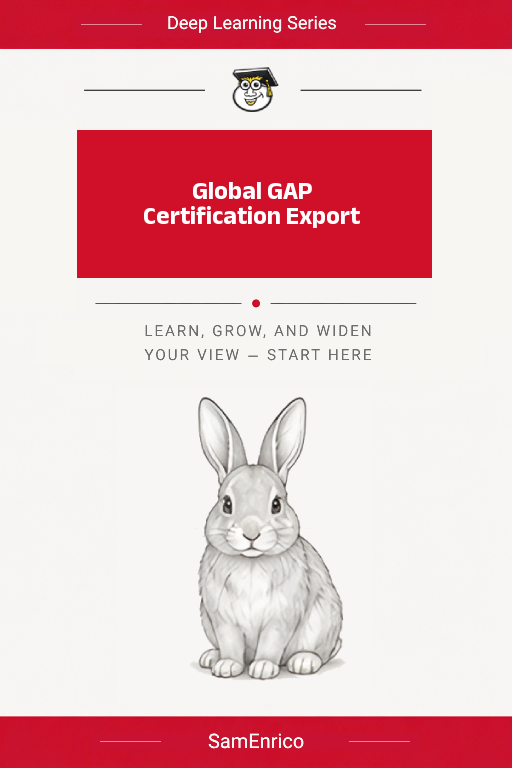
Global GAP Certification Export eBook
Certify fresh produce under GlobalGAP for European
Certify fresh produce under GlobalGAP for European supermarket supply chains.
Formats
Free sample
Chapter 1: The Hidden Gatekeeper--The first time Miguel lost a container of passion fruit, he blamed the shipping line. The second time, he blamed the weather. The third time – the one that cost him $47,000 and nearly his farm – he finally blamed the right thing: a piece of paper he had never heard of.Miguel’s farm in Colombia was not bad. His passion fruit was sweet, his harvest crews were efficient, and his packhouse was clean. He had been selling to a German importer for three years with no major complaints.
Then one day, the email arrived. Short. Professional. Devastating.“Dear Miguel, effective immediately, our supply chain requires all fresh produce suppliers to hold valid Global G.A.P. certification.
Please provide your certificate number by end of month. Without it, we cannot schedule further shipments.”Miguel had never heard of Global G.A.P. He spent two weeks searching online, downloading PDFs, and calling other farmers. When he finally understood what was required, he realized he was months away from being ready. The importer did not wait.
Three containers already in transit were redirected to a discount market at half price. Two more sitting in his cold storage never shipped at all. By the time Miguel could have been certified, his buyer had already replaced him with a certified farm in Ecuador.Miguel’s story is not rare. It happens every month, to farms on every continent that exports fresh produce. The only thing unusual about Miguel is that he eventually got certified and found a new buyer.
Most farmers in his position simply exit the European market forever.This book exists so you never become Miguel.The Gate You Did Not See Coming If you are reading this, you are likely a fresh produce farmer, an export manager, or a cooperative leader in a country that sends fruit and vegetables to Europe. You have good land, good growing practices, and good relationships with buyers. You believe that quality speaks for itself – that the best passion fruit, the sweetest mangoes, or the crispest green beans will always find a home in the European market.That belief was true in 1995. It is dangerously false today.Between 1997 and today, a quiet revolution transformed how European supermarkets buy fresh produce. It was not a law passed by the European Parliament.
It was not a treaty signed by governments. It was an agreement among thirteen retailers sitting in a room in Germany, frustrated by the chaos of dealing with hundreds of farms using hundreds of different food safety standards.One farm would show a detailed hygiene log. Another farm would show nothing. One farm would test its water monthly. Another farm had never tested water at all.
The retailers could not compare suppliers. They could not trust the food safety claims on the boxes. They could not guarantee to their customers that the lettuce from Spain and the lettuce from Kenya met the same basic standard.So they created their own standard. They called it EUREP-GAP – a clunky acronym for Euro-Retailer Produce Working Group Good Agricultural Practices. It applied only to fresh produce.
It applied only to farms selling to those thirteen retailers. It was, in theory, voluntary.Today, that standard is called Global G.A.P. It covers more than 200,000 certified producers in over 130 countries. It is required not just by the original thirteen retailers but by virtually every major supermarket chain in Northern Europe. It has expanded from fresh produce to livestock, aquaculture, flowers, and tea.
And it has stopped being voluntary in any meaningful sense of the word.What “Voluntary” Really Means Let us be precise about language because this is where many farmers make their first and most expensive mistake.Global G.A.P. is technically a private standard. The European Union does not mandate it. No law says you must be certified to sell produce in Europe. If you grow carrots in France and sell them at a farmers market in Lyon, you do not need Global G.A.P.
If you are a small farm in Morocco selling herbs to a local distributor who sells to a local restaurant in Casablanca, you do not need Global G.A.P.But if you want to sell fresh produce to a supermarket in Germany, the Netherlands, the United Kingdom, Belgium, Austria, or Scandinavia – you need Global G.A.P. Not because of a law. Because the supermarket will not buy from you without it.This is the difference between legal mandatory and commercially mandatory. No government will fine you for lacking Global G.A.P. But your buyer will simply not answer your emails.
Your containers will be rejected at the port of entry. Your long-term contracts will be cancelled with thirty days notice.The numbers tell the story. A 2022 survey of European fresh produce buyers across twelve countries found that 87 percent required Global G.A.P. certification as a minimum condition for new supplier approval. Among German retailers – the largest fresh produce market in Europe – that number rose to 96 percent.The remaining 4 percent?
Mostly specialty buyers who purchase organic-only or local-only products. If you are shipping internationally, you are not in that 4 percent.The Cost of Ignorance Miguel lost $47,000 on his third rejected container. Let me break down what that number represents, because it is not just the price of the fruit.A standard shipping container of fresh produce from a developing country to Europe costs between 4,000and4,000 and 4,000and8,000 in freight alone, depending on origin and season. The product inside – let us say premium passion fruit – might be worth 25,000to25,000 to 25,000to40,000 at wholesale prices. That is the first loss: the product you cannot sell.Then there is the rejected container fee.
When a shipment arrives without required certification, the buyer typically refuses it. The shipping line charges for the failed delivery, the port storage, and the return or disposal. Depending on the port, these fees can reach 5,000to5,000 to 5,000to10,000 before the container is even opened.Then there is the destroyed product. Fresh produce cannot sit on a dock for two weeks while paperwork is disputed. Most rejected shipments are destroyed.
Some are donated to food banks. A few are sold on the spot market at 10 to 20 percent of their original value. In every case, you are paid nothing or close to nothing.Then there is the relationship cost. Once you fail a buyer’s certification requirement, you are flagged in their supplier system. Some buyers will give you one chance to fix the problem.
Most will simply move to the next farm on their list. European retailers have hundreds of potential suppliers waiting. They do not need to be patient with yours.Then there is the opportunity cost. While you are scrambling to certify, your competitors are shipping. While you are explaining to your banker why your export revenue dropped by 40 percent, your neighbor is expanding their certified acreage.
The farmer who gets certified first does not just win the current season – they win the buyer relationship for years.Add all of these together, and a single rejected container can cost a farm between 30,000and30,000 and 30,000and60,000 in direct losses. That is not a bad year.…
This is the end of the free sample. Get the eBook to keep going. Buy now
About this book
Details
- Author
- Medlin Ivette
- Publisher
- SamEnrico
- Language
- English
- Genre
- Non-Fiction, Business Brief, GlobalGAP
- Released
- 2026-05-29
- Pages (approx.)
- 148
- Available as
- eBook, Audiobook

Read better in the ZLOADR app
Your eBooks on your phone or tablet. Sign in with your SamEnrico account and start reading.
More by Medlin Ivette
 Design Thinking For EnterpriseMedlin Ivette$11.99
 Partner Mood Dependency GuideMedlin Ivette$11.99
 Couple Breathing ExerciseMedlin Ivette$11.99
 Dysthymia and AppetiteMedlin Ivette$11.99
 Alcoholism and Empty Nest Syndrome RecoveryMedlin Ivette$11.99
 Senior Housing Regulation GuideMedlin Ivette$11.99
 Real Estate Food AddictionMedlin Ivette$11.99
 Tangaroa Rises: The Ocean’s Wrath in Polynesian MythMedlin Ivette$11.99
 The Last Stand of Dara: Heraclius' Gambit Against the PersiansMedlin Ivette$11.99
 How to Start a Engines (internal Combustion) for Motorcycles Business (Beginners Guide)Medlin Ivette$11.99
 How to Produce Gun GripsMedlin Ivette$11.99
 A Collector's Handbook to the Delaunay-belleville S6Medlin Ivette$11.99