
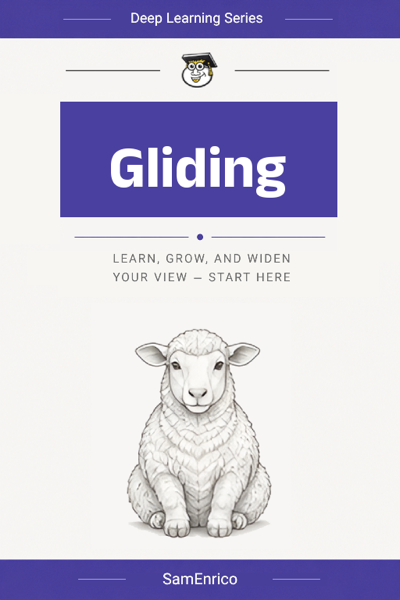
Non-FictionInformativeEducational
Gliding eBook
A Coursebook on Gliding
A Coursebook on Gliding
Formats
Free sample
Chapter 1: The Silent Descent...–- On a clear summer morning, before the thermals have begun to rise and while the towplanes are still being fueled, a glider sits motionless on the grass. Its canopy faces into the wind. Its wings, thirty meters from tip to tip, hold no fuel, no engine, no propeller. To the casual observer, it looks incomplete—a beautiful but useless bird with feathers but no muscles. The pilot climbs in, straps a parachute across her lap, and waits.
Fifteen minutes later, a rope connects her to a noisy, vibrating towplane. The towplane roars down the runway. The glider follows, rising not because it has power but because its wings have found a bargain with the air: speed in exchange for altitude. At two thousand feet, she pulls the yellow knob. The rope falls away.
And then—silence.That silence is not empty. It is filled with the sound of wind over the canopy, the creak of the fuselage as it bends under G-load, and the soft whisper of the variometer telling her that somewhere below, a patch of sun-warmed earth is releasing a bubble of rising air. She turns toward it, not because she sees anything but because she feels a slight lift under the left wing. The bubble lifts her three hundred feet. She circles.
The bubble breaks free and rises faster. She follows. For the next four hours, she will climb and descend, turn and glide, never once touching the ground, never once using an engine. She will travel ninety kilometers using nothing but sunlight, wind, and the shape of her wings. This is the silent descent—the art of falling with style, of turning gravity into a journey rather than a crash.The Paradox of Gliding Every child who throws a paper airplane understands the basic tragedy of unpowered flight: what goes up must come down.
A glider does not defeat this tragedy. It embraces it. The glider pilot does not ask, “How do I stay up forever?” She asks, “How do I make the coming down last as long as possible, carry me as far as possible, and teach me as much as possible about the sky?” This chapter introduces the paradox at the heart of all soaring: a glider is a machine designed to fall slowly, and the skill of gliding is the skill of managing that fall so creatively that it feels like flying.The word “gliding” suggests passivity—a leaf drifting, a feather floating. But real gliding is active, aggressive, and deeply strategic. A glider pilot is never a passenger.
Every control input changes the glide path. Every turn trades altitude for direction. Every decision to fly toward a cloud or away from it is a bet about where the next rising air will be found. The ground is always coming up. The only question is how far away it will be when you finally decide to meet it.What This Book Is (And What It Is Not)This book is a coursebook.
It assumes you want to learn not just about gliding but how to glide. It is structured like a flight syllabus, moving from first principles (why wings work) through basic maneuvers (straight-and-level, turns, stalls) to advanced techniques (thermal centering, ridge soaring, cross-country navigation). Each chapter ends with practical exercises, common error checklists, and key concepts. The book synthesizes the ten most respected texts in the sport—from the FAA’s Glider Flying Handbook to Derek Piggott’s Understanding Gliding to the Soaring Society of America’s training syllabi—into a single, logical progression.But this book is not a replacement for an instructor. Gliding is a hands-on skill.
You cannot learn to feel a thermal from a page any more than you can learn to ride a bicycle from a diagram. What you can learn here is the language of gliding—the concepts, the terminology, the physics, and the decision-making frameworks—so that when you do climb into a glider, your instructor’s words will already make sense, and your body will already know what to feel for.A Very Short History of Falling Intentionally Humanity’s dream of flight began not with engines but with wings. The myth of Icarus, the medieval monk who jumped from a tower with feathered wings, the Renaissance sketches of da Vinci’s ornithopter—all imagined flight as a matter of flapping. But the real breakthrough came when engineers realized that a fixed wing, if shaped correctly, could produce lift without any moving parts. In 1853, Sir George Cayley’s coachman became the first adult to fly in a heavier-than-air craft: a glider launched from a hillside.
The coachman reportedly landed, climbed out, and announced, “I wish to give notice. I was hired to drive, not to fly.”Otto Lilienthal, the “Glider King” of 1890s Germany, made over two thousand flights in seventeen different glider designs. He photographed each flight, documented every crash, and published his aerodynamic data for anyone to use. When he fell to his death in 1896—his glider stalled at fifty feet—his last words were reportedly, “Sacrifices must be made.” The Wright Brothers studied Lilienthal’s notes obsessively. They added one innovation—roll control via wing-warping—and launched the powered era.
But their first flights were glider flights. They learned to soar before they added an engine.In the decades since, gliding has evolved from a daredevil’s stunt to a scientific sport. Modern sailplanes are miracles of carbon fiber and computational fluid dynamics. They have glide ratios of 50:1 or better—meaning they can travel fifty kilometers forward for every kilometer of altitude lost. They can climb to twenty thousand feet in mountain wave, fly over a thousand kilometers in a single day, and land exactly where they intended, having burned not a single drop of fuel.
The technology has changed, but the fundamental challenge has not: find rising air, use it to climb, then glide to the next rising air, repeating until you decide to come down.The Badge System: Your Roadmap to Mastery The Fédération Aéronautique Internationale (FAI) oversees the badge system that has defined glider pilot progression since the 1930s. These badges are not merely certificates; they are milestones that mark your growing mastery of the sky. Each badge requires specific achievements, and each achievement requires specific skills. The badges create a natural curriculum for this book.The A Badge is your first. It requires that you fly solo for at least thirty seconds in calm conditions, demonstrating that you can launch, fly a straight line, and land without instructor assistance.
This badge says: You are safe enough to be alone in the glider.The B Badge adds duration: a solo flight of at least thirty minutes. This requires that you find and use at least one thermal, staying aloft not by luck but by skill. This badge says: You can sustain flight using atmospheric energy.The C Badge requires a solo flight of at least five hours. This is not a test of endurance but of judgment. You must manage fatigue, hydration, changing weather, and the psychological challenge of solitude.
This badge says: You are a competent recreational glider pilot.Above these are the Silver Badge (five hours duration, 1,000 meters…
This is the end of the free sample. Get the eBook to keep going. Buy now
About this book
Details
- Author
- Cobb Lorraine
- Publisher
- SamEnrico
- Language
- English
- Genre
- Non-Fiction, Informative, Educational
- Released
- 2026-06-02
- Pages (approx.)
- 151
- Available as
- eBook, Audiobook

Read better in the ZLOADR app
Your eBooks on your phone or tablet. Sign in with your SamEnrico account and start reading.
More by Cobb Lorraine
 Chunking for InnovationCobb Lorraine$11.99
 Remote Onboarding PlaybookCobb Lorraine$11.99
 The Anger Journaling ProtocolCobb Lorraine$11.99
 Student Support Network BuildingCobb Lorraine$11.99
 Money Scarcity Mindset CourseCobb Lorraine$11.99
 The Sapphire Serpent Heist: A Thief, a Legend, and a Vanishing CrownCobb Lorraine$11.99
 Icebound Secrets: The Scientists Who Solved Franklin's Arctic MysteryCobb Lorraine$11.99
 How to Start a Automobile Racing Team BusinessCobb Lorraine$11.99
 Redbubble AI Art Group BoardsCobb Lorraine$12.99
 Scrum for Slack StartupsCobb Lorraine$12.99
 Understanding EnterobiasisCobb Lorraine$17.99
You may also like
 Hong Kong Handover 1997Dunn Johnnie$11.99
 Zumba For Postnatal Recovery CourseNeal Christian$11.99
 Zumba for BeginnersLadner Nikia$11.99
 YouTube Comment Mining GuideHumes Pandora$12.99
 Worry Box MeditationCarlin Rudy$11.99
 Workplace Stress MeditationNguyen Lynn$11.99
 Workplace Stress and Sleep RepairHawley Ivory$11.99
 Workplace Perfectionism CureDelaney Jeffry$11.99
 Workplace Injustice Anger GuideWallen Isabelle$11.99
 Work Addiction and Burnout LinkGreenwood Ester$11.99
 Women in Yoga and WellnessBeattie Galina$11.99
 Women in Stand Up ComedyChun Evangeline$11.99