
Non-FictionSelf-HelpRelationship Skills
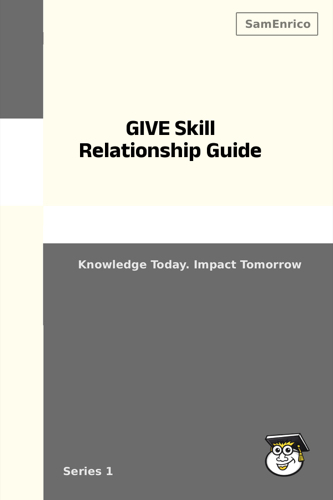
GIVE Skill Relationship Guide eBook
Maintain relationships while getting your needs me
Maintain relationships while getting your needs met using this DBT skill.
Formats
Free sample
Chapter 1: The Three Doors--–- You are standing in a hallway. Not a real one, but the kind your mind builds right before a conversation you dread. At the end of this hallway are three doors. You have stood here hundreds of times without ever noticing them. Behind Door Number One is what you want—the thing, the outcome, the change you are hoping for.
Behind Door Number Two is the relationship itself—intact, warm, still breathing. Behind Door Number Three is your own face in the mirror at the end of the day, and whether you can look yourself in the eye.Most people never see the doors. They just charge forward, swing at the first handle they find, and then wonder why they end up in a room they never wanted to enter. They ask for what they need and watch the other person’s face close. Or they stay silent to keep the peace and feel the resentment curdle in their own chest.
Or they tell themselves they “don’t care what anyone thinks” and then lie awake at three in the morning wondering why they feel so alone.This chapter is about seeing the doors. Before you learn a single technique, before you practice a single script, you have to know what you are actually trying to accomplish. Because here is the truth that most relationship advice avoids: you cannot always get all three. Sometimes you have to choose. And most of the damage in relationships comes not from choosing badly, but from not knowing you were choosing at all.The Three Priorities That Run Your Life Every difficult conversation you have ever had was driven by one or more of three priorities.
Dialectical Behavior Therapy, the clinical foundation of everything in this book, names them clearly. They are not complicated, but they are almost always invisible in the moment.Objective Effectiveness is the first door. This is your drive to get a concrete outcome. You want the late fee waived. You want your partner to pick up their socks.
You want your boss to approve your time off. You want your teenager to come home by eleven. Objective Effectiveness is about changing the world outside of you. It is measurable, verifiable, and often urgent. When you are in Objective Effectiveness mode, you care about results.
You want to win.Relationship Effectiveness is the second door. This is your drive to preserve or improve the bond between you and another person. Sometimes you do not care as much about the specific outcome as you care about how the other person feels about you when the conversation ends. You want your partner to still want to cuddle on the couch tonight. You want your boss to see you as a team player.
You want your teenager to keep telling you about their life. Relationship Effectiveness is about the space between people. It is softer, harder to measure, and often more important than any single outcome.Self-Respect Effectiveness is the third door. This is your drive to act according to your own values, to look at yourself in the mirror without flinching. Sometimes you need to tell the truth even if it costs you the relationship or the outcome.
Sometimes you need to say no even when saying yes would be easier. Sometimes you need to walk away. Self-Respect Effectiveness is about integrity. It is the quietest door, the one most people forget exists, and the one that, when ignored, produces the deepest regret.Here is what makes relationships so hard. These three priorities are often in direct conflict with one another.
You can get what you want (Objective) but damage the relationship (Relationship) and feel like a bully afterward (Self-Respect). You can preserve the relationship (Relationship) but swallow your needs (Objective) and feel like a doormat (Self-Respect). You can stand up for your values (Self-Respect) but lose the relationship entirely and fail to get what you wanted.The secret is not to pretend these conflicts do not exist. The secret is to know, before you open your mouth, which door matters most right now.The Store Clerk and the Spouse Let me show you what I mean with an example so simple it will stick in your head forever. You are returning a defective product to a store.
The clerk is someone you will never see again. Your objective is clear: get your money back. You do not care about a relationship with this person. You will not lose sleep over whether the clerk likes you. Your self-respect might matter a little—you do not want to be cruel—but the primary driver is Objective Effectiveness.
Get the refund. Move on.Now imagine the same scenario with your spouse. You want to return something, but the conversation is not about a product. It is about a broken agreement, a hurt feeling, an unmet need. Here, the relationship matters.
You will see this person at breakfast tomorrow. You will share a bed tonight. If you treat your spouse like a store clerk—purely focused on winning the argument—you might get your point across, but you will damage something precious. The calculus is different.Most people make one of two mistakes. Either they treat every conversation like a store transaction (aggressive, outcome-focused, indifferent to the relationship), or they treat every conversation like a hostage negotiation (terrified, appeasing, willing to sacrifice anything to keep the peace).
The GIVE skill, which you will learn in the coming chapters, is designed specifically for conversations where the relationship matters. It is not for the store clerk. It is for the spouse, the parent, the child, the boss, the friend—the people you will see again.But before you can use GIVE, you have to know that you are in a relationship-priority conversation. And that requires a moment of brutal honesty with yourself.The Question You Have Never Been Asked Stop for a moment. Think about the last difficult conversation you had.
Maybe it was with your partner about money. Maybe it was with your mother about boundaries. Maybe it was with your boss about workload.Now answer this question honestly: which door were you trying to open?Most people cannot answer. They were not trying to open any specific door. They were just reacting.
They wanted to be right. They wanted to stop feeling bad. They wanted the other person to shut up. They wanted to escape. They were not pursuing a priority; they were fleeing discomfort.This is not a moral failing.
It is a skill deficit. No one ever taught you to pause before speaking and ask yourself what you actually want. You were taught to be honest, or to be polite, or to stand up for yourself—but no one taught you that honesty, politeness, and self-respect can conflict, and that you need to choose which one matters more in this specific moment.The GIVE skill will teach you how to speak. But this chapter, right now, is teaching you when to speak—and when to use a different tool altogether.The Three Questions That Replace Reactivity Before any conversation that matters, you are going to ask yourself three questions. Write them down.…
This is the end of the free sample. Get the eBook to keep going. Buy now
About this book
Details
- Author
- Dickinson Everette
- Publisher
- SamEnrico
- Language
- English
- Genre
- Non-Fiction, Self-Help, Relationship Skills
- Released
- 2026-06-07
- Pages (approx.)
- 148
- Available as
- eBook, Audiobook

Read better in the ZLOADR app
Your eBooks on your phone or tablet. Sign in with your SamEnrico account and start reading.
More by Dickinson Everette
 Macros for BreastfeedingDickinson Everette$11.99
 Nobel Prize for the Muon NeutrinoDickinson Everette$11.99
 Pandemic Board Crisis PlaybookDickinson Everette$11.99
 Mindfulness of Breath GuideDickinson Everette$11.99
 Foster Care Bedtime StoriesDickinson Everette$11.99
 Grief and Hobbies AloneDickinson Everette$11.99
 Gig Platform Scheduling GuideDickinson Everette$11.99
 The Siege of Nicosia: A Nun’s Courage in the Fall of CyprusDickinson Everette$11.99
 How to Produce WicksDickinson Everette$11.99
 How to Produce MashersDickinson Everette$11.99
 Indian BPO Vendor Selection CriteriaDickinson Everette$12.99
 Qatar B2B Sales Culture GuideDickinson Everette$12.99
You may also like
 Hong Kong Handover 1997Dunn Johnnie$11.99
 Zumba For Postnatal Recovery CourseNeal Christian$11.99
 Zumba for BeginnersLadner Nikia$11.99
 YouTube Comment Mining GuideHumes Pandora$12.99
 Worry Box MeditationCarlin Rudy$11.99
 Workplace Stress MeditationNguyen Lynn$11.99
 Workplace Stress and Sleep RepairHawley Ivory$11.99
 Workplace Perfectionism CureDelaney Jeffry$11.99
 Workplace Injustice Anger GuideWallen Isabelle$11.99
 Work Addiction and Burnout LinkGreenwood Ester$11.99
 Women in Yoga and WellnessBeattie Galina$11.99
 Women in Stand Up ComedyChun Evangeline$11.99