
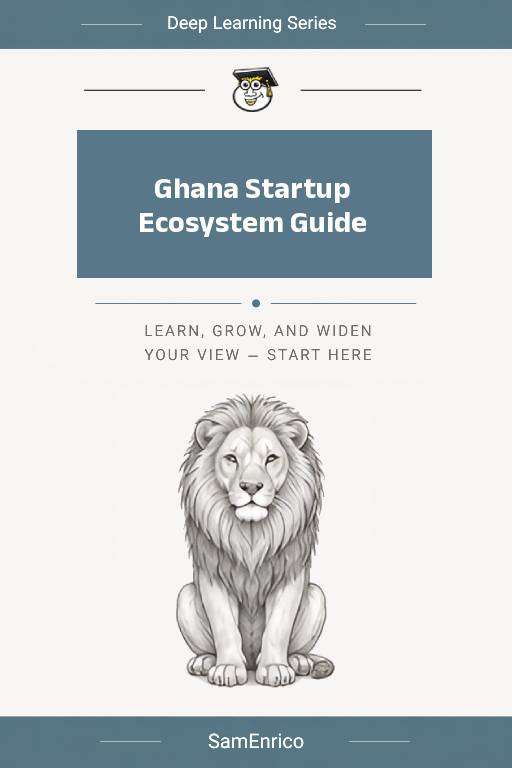
Non-FictionStartup GuideLocal Context
Ghana Startup Ecosystem Guide eBook
Navigate Ghana's growing startup ecosystem. Accra
Navigate Ghana's growing startup ecosystem. Accra hubs, incubators, and support for local founders.
Formats
Free sample
Chapter 1: The Jugaad Paradox--In the crowded courtyards of Nima and the buzzing tech hubs of Airport City, two very different Ghanaian entrepreneurs are building their futures. The first, a young woman who dropped out of university to sell phone credits and sachet water door-to-door, dreams of one day owning a shop. She is a necessity entrepreneur—driven by survival, constrained by capital, and invisible to the venture capitalists who publish their funding announcements on Tech Cabal. The second, a diaspora returnee with a computer science degree from a Canadian university, has just raised $150,000 in pre-seed funding for a logistics platform. She has never driven a trotro or negotiated with a market woman, but she knows how to pitch to angels, structure a SAFE agreement, and use the word "scalability" without flinching.This book is not for the second entrepreneur alone.
And it is certainly not for the first entrepreneur as she currently operates. This book is for the space between them—the space where necessity meets opportunity, where grassroots innovation meets structured support, and where the concept we call "Jugaad" becomes the foundation of something scalable.If you picked up this guide expecting a dry directory of incubators and a list of legal requirements, you will find those things in later chapters. But you will find them wrapped in a central truth that most ecosystem guides are too polite to say: Ghana's startup scene is not a silicon savannah. It is not a tropical clone of Lagos. It is a unique, messy, resilient, and deeply cultural ecosystem where the most successful founders are those who master what we will call throughout this book the Jugaad Paradox—the ability to build world-class ventures using resourceful, improvised, sometimes beautifully scrappy methods, while simultaneously learning to speak the language of global capital, term sheets, and corporate governance.Let us begin where all startups begin: not with a pitch deck, but with a mind.The Myth of the Overnight Success Walk through any co-working space in Osu on a Wednesday afternoon, and you will hear the same stories repeated with slight variations.
Someone knows someone who knew the founder of a startup that raised a million dollars after six months of coding. Someone else has a cousin who just got accepted into MEST and is now building the next Paystack. These stories are not lies, but they are dangerously incomplete. They erase the years of struggle, the failed pivots, the months of unpaid rent, and the quiet desperation that precedes every visible success.The Ghanaian media ecosystem, hungry for heroes, amplifies the exits and ignores the corpses. For every startup featured in a "Top 10 Ghanaian Startups to Watch" list, nine others have quietly dissolved, their founders returning to salaried jobs or restarting as solo consultants.
This is not a failure of the ecosystem. It is the normal, brutal mathematics of entrepreneurship everywhere. What makes Ghana different is not the survival rate but the survival strategies.In Lagos, the dominant narrative is "hustle"—aggressive, relentless, often ruthless. In Nairobi, it is "innovation"—slick, polished, heavily influenced by European development programs. In Accra, the dominant ethos is something closer to "patience with pressure." Ghanaian founders move slower than their Nigerian counterparts but often build more sustainable unit economics.
They negotiate longer but close deals with more trust. They complain about "GMT" (Ghana Maybe Time) while secretly benefiting from the relationship-building that slower timelines enable.This chapter is about unlearning the myths you have absorbed from Silicon Valley movies, Medium blog posts, and the carefully curated Linked In profiles of founders who have already made it. It is about understanding who you actually are as a Ghanaian entrepreneur—whether you grew up in Dansoman or Dusseldorf—and how to turn your specific background into an unfair advantage.Defining the Entrepreneurial Archetype Let us begin with a distinction that will run through every subsequent chapter of this book: the difference between necessity entrepreneurship and opportunity entrepreneurship. These terms appear throughout the academic literature on development economics, but they have visceral, lived meanings in Accra.A necessity entrepreneur is someone who starts a business because they have no other option. They cannot find a formal job.
They have bills to pay. They have children to feed. They sell phone credits, prepare banku to go, or run a small provision shop. Their goal is survival, not scale. Their time horizon is tomorrow, not five years.
They are the invisible majority of Ghanaian "entrepreneurs," and they are not the primary audience for this book—not because they are less worthy, but because they face constraints that no guidebook can solve. Structural poverty, lack of access to formal credit, and the daily grind of survival leave little room for the kind of strategic planning this book requires.An opportunity entrepreneur, by contrast, starts a business because they have identified a market gap that can be scaled. They have some savings, family support, or access to capital. They may have a university degree or professional experience. They are building a venture, not just a job.
This book is for opportunity entrepreneurs—but with a crucial twist: many of the best opportunity entrepreneurs in Ghana began as necessity entrepreneurs. They learned resilience in the markets of Agbogbloshie before they learned growth hacking in the classrooms of MEST.Drawing on the competence frameworks outlined in Entrepreneurial Success [2][6], we can identify three psychological attributes that distinguish successful Ghanaian founders from the general SME population. These are not personality traits you are born with; they are muscles you can train.Risk-Taking, Ghanaian Style The first attribute is risk-taking. But risk in Ghana looks different than risk in San Francisco. A Silicon Valley founder risks a year of their life and a few million dollars of other people's money.
A Ghanaian founder risks their family's savings, their reputation in a tight-knit community, and their ability to ever borrow money again if they fail.I have interviewed dozens of Ghanaian founders who took what they considered "crazy risks." In almost every case, the risk was not quitting a stable job—because they did not have a stable job to quit. The risk was convincing their mother to let them use the family living room as an office. The risk was taking a loan from a susu collector at 20% monthly interest because no bank would lend to them. The risk was spending three months building a product without knowing if anyone would pay for it.The successful founders were not the ones who avoided these risks. They were the ones who calculated them differently.
They built minimum viable products that cost almost nothing to test. They used Whats App as their first platform instead of hiring developers. They validated demand by talking to 100 potential customers before writing a single line of code. Their risk-taking was not reckless; it was methodical poverty.Proactiveness in a Passive Culture The second attribute is proactiveness. Ghanaian business culture, for all its warmth and relationship-orientation, can be deeply passive.
Deals move at the speed of trust, not the speed of contracts. Decisions require consensus, not command. The phrase "we will see" (or its Twi equivalent, "yɛbɛhwɛ") can mean yes, no, maybe, or simply "I am…
This is the end of the free sample. Get the eBook to keep going. Buy now
About this book
Details
- Author
- Pelletier Celena
- Publisher
- SamEnrico
- Language
- English
- Genre
- Non-Fiction, Startup Guide, Local Context
- Released
- 2026-05-29
- Pages (approx.)
- 137
- Available as
- eBook, Audiobook

Read better in the ZLOADR app
Your eBooks on your phone or tablet. Sign in with your SamEnrico account and start reading.
More by Pelletier Celena
 Military Deployment Relationship StressPelletier Celena$11.99
 The VC Term Sheet Valuation GuidePelletier Celena$11.99
 Email Template Library GuidePelletier Celena$11.99
 Moai Social Connection LongevityPelletier Celena$11.99
 Fiber Increase for FullnessPelletier Celena$11.99
 The Golden Scribes of Timbuktu: Africa's Renaissance of KnowledgePelletier Celena$11.99
 Understanding Webster–deming SyndromePelletier Celena$17.99
 How to Start a Blasting of Construction Sites Business (Beginners Guide)Pelletier Celena$11.99
 WIPO Trademark ImagesPelletier Celena$12.99
 SpotterPelletier Celena$11.99
You may also like
 Hong Kong Handover 1997Dunn Johnnie$11.99
 Zumba For Postnatal Recovery CourseNeal Christian$11.99
 Zumba for BeginnersLadner Nikia$11.99
 YouTube Comment Mining GuideHumes Pandora$12.99
 Worry Box MeditationCarlin Rudy$11.99
 Workplace Stress MeditationNguyen Lynn$11.99
 Workplace Stress and Sleep RepairHawley Ivory$11.99
 Workplace Perfectionism CureDelaney Jeffry$11.99
 Workplace Injustice Anger GuideWallen Isabelle$11.99
 Work Addiction and Burnout LinkGreenwood Ester$11.99
 Women in Yoga and WellnessBeattie Galina$11.99
 Women in Stand Up ComedyChun Evangeline$11.99