
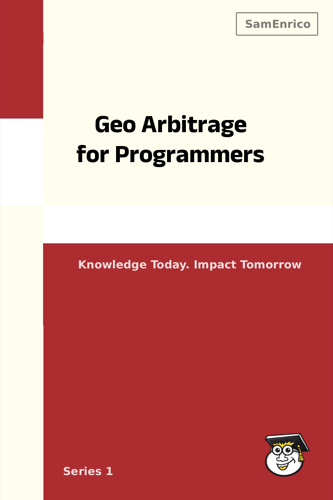
Non-FictionBusiness BriefSoftware Engineering
Geo Arbitrage for Programmers eBook
Strategic guide to coding for Silicon Valley salar
by Ashmore Fae
Strategic guide to coding for Silicon Valley salaries from South East Asia.
Formats
Free sample
Chapter 1: The Geography Compiler--–- The most valuable programming language you will ever learn is not Rust, Go, or Python. It is geography.In the spring of 2024, two senior backend engineers sat down to review their annual savings reports. Both were thirty-two years old. Both had seven years of experience. Both worked for the same San Francisco-based Saa S company, earning identical base salaries of $180,000.
Both were competent, diligent, and on track for senior staff promotions within two years.One of them saved $20,000 that year. The other saved $144,000.The difference between them was not talent, intelligence, or work ethic. It was not the company they worked for, the stock market's performance, or an inheritance from a wealthy relative. The difference was a decision that had nothing to do with code and everything to do with coordinates.The first engineer, whom we will call Mike, lived in a one-bedroom apartment in San Francisco's Mission District. He paid $3,800 in rent, $200 for parking, $150 for utilities, and $500 for a therapist to help him manage the anxiety that came from watching his peers buy homes he could never afford.
He spent $400 per month on groceries at Whole Foods, $600 on restaurants and delivery apps, and $200 on Ubers because owning a car in San Francisco was more expensive than leasing a small yacht.The second engineer, whom we will call Alex, lived in a two-bedroom villa with a private pool in Canggu, Bali. He paid $1,200 in rent, $50 for a scooter rental, $80 for fiber internet that was faster than anything Comcast had ever delivered, and $300 for a housekeeper who also cooked his meals. He spent $200 on fresh produce from the local market, $100 on warungs (local family-owned restaurants where a meal costs $2-3), and $40 on a monthly membership at a co-working space with ergonomic chairs and redundant fiber.Mike saved $20,000. Alex saved $144,000.This is not a story about frugality. Alex was not living like a monk.
He had a pool. He had a housekeeper. He ate out daily. He traveled to Vietnam and Thailand on long weekends. He lived better than Mike by almost any material measure, except one: he lived somewhere the cost of living was a fraction of what Silicon Valley demanded.This is the core insight of geo-arbitrage, and it is the single greatest wealth-building lever available to programmers in 2026.The Most Expensive Programming Language You Will Never Compile Let us begin with a definition that will appear throughout this book.
Geo-arbitrage is the practice of decoupling your income geography from your expense geography. You earn your salary from a high-cost-of-living labor market—in this case, Silicon Valley, Seattle, New York, or any other major US tech hub—while living in a low-cost-of-living location that offers comparable or superior quality of life.This is not remote work. Remote work, as most companies define it, means you work from your home in the same expensive city where your employer is located. You save on commuting costs and perhaps on dry cleaning, but your rent, groceries, and utilities remain anchored to the same inflated market. True geo-arbitrage requires physical relocation to a different economic zone entirely.The mathematics is simple, but the implications are profound.
If you earn $180,000 in San Francisco, you are competing for housing, transportation, and services against everyone else who also earns $180,000 or more. The landlord of that $3,800 apartment knows exactly what the market will bear. The restaurant charging $28 for a bowl of pho knows that its customers earn tech salaries. You are not escaping the system; you are running on a treadmill that gets faster every year.If you earn the same $180,000 in Bali, you are competing against a local economy where the median monthly income is approximately $400. Your $1,200 villa is the equivalent of three months of local wages.
The landlord who charges you that rate is not exploiting you; they are providing you with a luxury that would cost $8,000 in San Francisco. You are no longer on the treadmill. You are floating.The Tax-Adjusted Reality: Why the Numbers Matter Before we go further, we need to correct a piece of misinformation that circulates widely in remote work communities. You will often hear claims that geo-arbitrage allows you to save five or even ten times more than your peers. These claims almost always ignore taxes, and ignoring taxes is a recipe for bankruptcy.Let us run the accurate, tax-adjusted numbers for Mike and Alex.
We will use 2025 tax rates because they are the most recent available and are unlikely to change dramatically before publication.Mike in San Francisco earns $180,000 as a W-2 employee. His tax burden breaks down as follows:Federal income tax: approximately $28,000 (progressive rates from 10% to 24%)California state income tax: approximately $11,000 (9.3% marginal rate for his bracket)Social Security and Medicare (FICA): approximately $13,500 (7.65% up to the Social Security wage base)Total taxes: approximately $52,500Annual rent and utilities: $48,000 ($4,000 per month)Other living expenses (food, transportation, insurance, discretionary): $24,000Total expenses including taxes: $124,500Savings: $55,500Mike is not a spendthrift. He is a reasonably frugal professional living in one of the most expensive cities in the world. His savings rate is approximately 31 percent of gross income, which is respectable by any standard.Now consider Alex, who has chosen the Transparent Negotiator path (we will explore the two paths in detail in Chapter 3). Alex negotiated with his employer to move to Bali, took a 15 percent pay cut to $153,000, and received written permission to work from Indonesia.
He then obtained an E33G visa, which grants him legal residence and zero Indonesian tax liability on foreign-sourced income.Alex's tax burden:Foreign Earned Income Exclusion (FEIE): the first $126,500 of his income is excluded from US federal taxation Taxable income: $153,000 - $126,500 = $26,500Federal income tax on $26,500: approximately $2,900California state tax: zero, because Alex severed his residency (see Chapter 2)FICA taxes: still owed because he is a W-2 employee, approximately $11,700Total US taxes: approximately $14,600Indonesian tax: zero (E33G visa provision)Annual rent and utilities in Bali: $14,400 ($1,200 per month for a villa with pool, fiber internet, and housekeeper)Other living expenses: $10,000 (scooter, food, co-working, travel, healthcare)Total expenses including taxes: $39,000Savings: $114,000Mike saves $55,500 per year. Alex saves $114,000. That is not a five-times multiplier; it is approximately twice as much. Over five years, assuming conservative 5 percent investment returns, Mike accumulates approximately $320,000. Alex accumulates approximately $660,000.The difference is $340,000.
That is a down payment on a house in most American cities. That is a decade of early retirement. That is the difference between working until you are sixty-five and retiring at forty-two.The Stealth Arbitrageur: A Second Path with Different Math But what if Alex had chosen the Stealth Arbitrageur path instead? What if he had simply moved to Bali without telling his employer, maintained a US address for payroll, and never obtained a proper visa?This is the path that many digital nomads take, and it is the path that carries the highest risk. But for the sake of completeness, let us examine the math.Stealth Alex earns the full $180,000 because he never told HR about his move.
However, because he is hiding his foreign residence, he cannot claim the FEIE. The FEIE requires documentation of foreign residence—lease agreements, utility bills, tax filings—that would immediately alert his employer to his location.Stealth Alex's taxes:Federal income tax…
This is the end of the free sample. Get the eBook to keep going. Buy now
About this book
Details
- Author
- Ashmore Fae
- Publisher
- SamEnrico
- Language
- English
- Genre
- Non-Fiction, Business Brief, Software Engineering
- Released
- 2026-06-09
- Pages (approx.)
- 136
- Available as
- eBook, Audiobook

Read better in the ZLOADR app
Your eBooks on your phone or tablet. Sign in with your SamEnrico account and start reading.
More by Ashmore Fae
 Aggressive to Assertive TransformationAshmore Fae$11.99
 Teacher Guide to Teen ConfidenceAshmore Fae$11.99
 Scheduling for Shift WorkersAshmore Fae$11.99
 IBS Herbal Medicine GuideAshmore Fae$11.99
 Focus Windows Strategy GuideAshmore Fae$11.99
 The Low Profile FreelancerAshmore Fae$11.99
 Driving Music for CalmnessAshmore Fae$11.99
 The Fire Below: Katia and Maurice Krafft’s Dance with VolcanoesAshmore Fae$11.99
 Echoes of the Lost Colony: The Roanoke EnigmaAshmore Fae$11.99
 The Complete Guide to the Mcdougall DietAshmore Fae$11.99
 Automation SpecialistAshmore Fae$11.99
 How to Start a Mosque Business (Beginners Guide)Ashmore Fae$11.99
You may also like
 Hong Kong Handover 1997Dunn Johnnie$11.99
 Zumba For Postnatal Recovery CourseNeal Christian$11.99
 Zumba for BeginnersLadner Nikia$11.99
 YouTube Comment Mining GuideHumes Pandora$12.99
 Worry Box MeditationCarlin Rudy$11.99
 Workplace Stress MeditationNguyen Lynn$11.99
 Workplace Stress and Sleep RepairHawley Ivory$11.99
 Workplace Perfectionism CureDelaney Jeffry$11.99
 Workplace Injustice Anger GuideWallen Isabelle$11.99
 Work Addiction and Burnout LinkGreenwood Ester$11.99
 Women in Yoga and WellnessBeattie Galina$11.99
 Women in Stand Up ComedyChun Evangeline$11.99