
Non-FictionSelf-HelpWater Relaxation
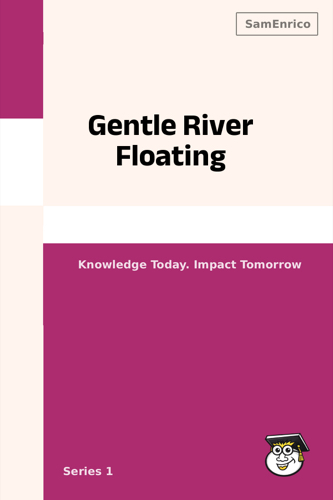
Gentle River Floating eBook
Lie on a raft drifting down a slow river under dap
Lie on a raft drifting down a slow river under dappled sunlight.
Formats
Free sample
Chapter 1: The Paddle We Carry...--–- I did not know I was holding a paddle until the river tried to take it from me. It was a Tuesday afternoon in July, and I had done everything wrong. The raft was a cheap inflatable pool lounger that had already developed a slow leak. The river was one I had never floated before, chosen at random from a map. I had no sunscreen, no water, no dry bag, and no plan.
What I had was a paddle. A beautiful, expensive, wooden paddle that I had bought years ago for kayaking trips I never took. It was the only thing I brought that cost more than twenty dollars, and I gripped it like a promise.The current caught me immediately. Not aggressively—this was not whitewater, just a slow, meandering creek with a name I have since forgotten. But the moment I felt the water pull, my hands tightened.
My knuckles went white. My shoulders went up toward my ears. And I began to steer. Left. Right.
Correction. Adjustment. The raft did not respond, of course. It had no rudder, no skeg, no way to translate my anxious paddling into direction. I was not steering the raft.
I was fighting the river. And the river, indifferent as always, simply flowed around me.After twenty minutes, my arms ached. After forty, I was exhausted. And then, at the next bend, a low-hanging branch reached out and snatched the paddle from my hands. Just like that.
One moment I was holding it, the next it was gone, floating away downstream, spinning lazily in the current like a fallen leaf. I watched it go. I did not chase it. I could not. There was no way to paddle after it because I no longer had a paddle.
And in that moment of absolute helplessness, something shifted. My shoulders dropped. My jaw unclenched. My hands relaxed. I lay back on the leaky raft, looked up at the cottonwoods, and discovered that I was still floating.
The river had not swallowed me. The world had not ended. I was just drifting. And it was wonderful.That was ten years ago. I have floated hundreds of rivers since then, on rafts of every description: inner tubes, air mattresses, wooden platforms, foam pads, even a door I found at a salvage yard.
I have floated alone and with friends, in summer heat and autumn chill, on wide lazy rivers and narrow creeks so shallow I could feel the gravel scraping the bottom. And in all that time, I have never once missed the paddle. Not once. Because the paddle was never helping me. It was only pretending to help.
The real work—the floating, the drifting, the surrendering—was always being done by the river.This book is an invitation to let go of your paddle. Not the physical paddle you might have in your garage. The invisible one. The one you carry everywhere. The one that tells you to steer, correct, adjust, optimize, improve, fix, manage, control.
The one that whispers that doing nothing is a waste of time, that rest must be earned, that you are only valuable when you are producing. That paddle is heavier than you think. And the river has been waiting to take it from you.The Invisible Paddle We All Carry Let me describe the invisible paddle. You will recognize it immediately. It is made of guilt and obligation and the quiet fear that you are falling behind.
Its shaft is polished smooth by thousands of hours of scrolling, checking, refreshing, replying. Its blade is worn thin by the constant work of correcting course—this email should have been worded differently, that conversation should have gone another way, that project should be further along by now. The invisible paddle is always in your hands, even when you are sleeping. Even when you are eating. Even when you are reading a book about letting go of paddles.You did not choose this paddle.
It was given to you. By your parents, who meant well but could not imagine a life that was not measured in achievement. By your teachers, who graded your performance and called it your potential. By your employers, who pay you for output and call it value. By your culture, which celebrates the exhausted and calls them successful.
You were handed this paddle so early and so consistently that you forgot you were holding it. It became an extension of your body, like a third hand or a second heart. You do not remember a time when you were not steering.Here is what the invisible paddle costs you. It costs you the ability to sit still without feeling guilty. It costs you the pleasure of a long conversation that does not accomplish anything.
It costs you the experience of watching a sunset without wondering how to monetize it. It costs you the simple, profound joy of doing nothing and being fine with it. It costs you your presence, your patience, your peace. And worst of all, it costs you the knowledge that you are enough exactly as you are, without optimizing, without improving, without becoming something other than what you already are.The river exposes this paddle. Not by taking it away violently—the river does not argue.
The river simply flows, indifferent to your steering. And in that indifference, you have a choice. You can keep gripping the invisible paddle, fighting the current, exhausting yourself for no reward. Or you can open your hands. Let the paddle float away.
Discover that you float just fine without it.I am not exaggerating when I say that this choice is the central spiritual question of our time. Not because rivers are sacred (though they are) but because the ability to stop steering is the ability to trust. Trust the current. Trust your body. Trust the present moment.
Trust that you do not always have to be in control. And trust that when you are not in control, you are not doomed. You are just floating.The Cultural Lie of Perpetual Motion We live in a culture that has mistaken motion for meaning. If you are busy, you must be important. If you are tired, you must be trying.
If you have no free time, you must be in demand. These are the cultural lies that keep us gripping our invisible paddles, and they are so pervasive that we have stopped noticing them. They are the water we swim in, the air we breathe. They are the background hum of modern life, and they are slowly killing us.Consider the language of productivity. We talk about "optimizing" our schedules, "leveraging" our time, "maximizing" our output.
We treat our lives as businesses and ourselves as CEOs. We measure our days in tasks completed, emails sent, calories burned, steps taken. We have metrics for everything except the one thing that matters: whether we are actually happy. And happiness, as it turns out, does not respond well to optimization. Happiness is not a key performance indicator.
Happiness is what happens when you stop measuring and start living.Consider the cult of busyness. How many times have you…
This is the end of the free sample. Get the eBook to keep going. Buy now
About this book
Details
- Author
- Salcedo Yoshie
- Publisher
- SamEnrico
- Language
- English
- Genre
- Non-Fiction, Self-Help, Water Relaxation
- Released
- 2026-06-07
- Pages (approx.)
- 124
- Available as
- eBook, Audiobook

Read better in the ZLOADR app
Your eBooks on your phone or tablet. Sign in with your SamEnrico account and start reading.
More by Salcedo Yoshie
 Multitasking Break BlockSalcedo Yoshie$11.99
 Gout Ayurveda GuideSalcedo Yoshie$11.99
 Forgiving Abusive ParentsSalcedo Yoshie$11.99
 1031 Exchange Partial Interest GuideSalcedo Yoshie$11.99
 Immigrant Toy Company SuccessSalcedo Yoshie$11.99
 Memory for ChessSalcedo Yoshie$11.99
 Loving Kindness for a Partner's New PartnerSalcedo Yoshie$11.99
 NVC For Law EnforcementSalcedo Yoshie$11.99
 The Silent War: The Untold Story of the 1979 Iranian Embassy SiegeSalcedo Yoshie$11.99
 The Last Message of the Bronze AgeSalcedo Yoshie$11.99
 The Healers of the Frozen South: African Medicine in the Age of ExplorationSalcedo Yoshie$11.99
 Web3 Product Launch and Community BusinessSalcedo Yoshie$11.99
You may also like
 Hong Kong Handover 1997Dunn Johnnie$11.99
 Zumba For Postnatal Recovery CourseNeal Christian$11.99
 Zumba for BeginnersLadner Nikia$11.99
 YouTube Comment Mining GuideHumes Pandora$12.99
 Worry Box MeditationCarlin Rudy$11.99
 Workplace Stress MeditationNguyen Lynn$11.99
 Workplace Stress and Sleep RepairHawley Ivory$11.99
 Workplace Perfectionism CureDelaney Jeffry$11.99
 Workplace Injustice Anger GuideWallen Isabelle$11.99
 Work Addiction and Burnout LinkGreenwood Ester$11.99
 Women in Yoga and WellnessBeattie Galina$11.99
 Women in Stand Up ComedyChun Evangeline$11.99