
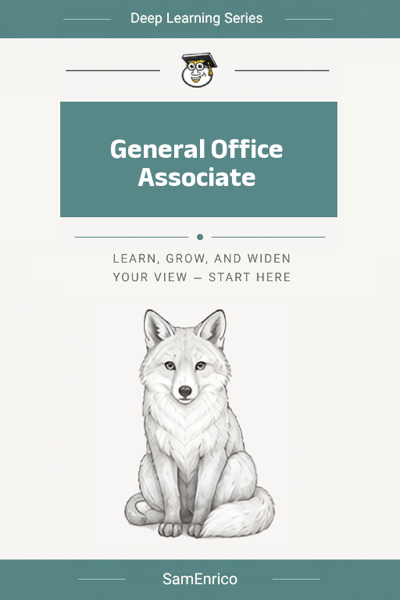
General Office Associate eBook
A Coursebook on General Office Associate
A Coursebook on General Office Associate
Formats
Free sample
Chapter 1: The Silent Architect--–- Most people walk into an office and see cubicles, computers, coffee machines, and coworkers. They see a physical space where work happens. But what they do not see is the invisible framework that holds everything together—the systems, the workflows, the quiet coordination that prevents chaos from swallowing the day whole. That framework does not build itself. It is designed, maintained, and continuously improved by someone who rarely appears in the org chart’s spotlight: the General Office Associate.If you have ever wondered why supplies magically reappear in the cabinet, why meetings start on time, why visitors are greeted warmly instead of ignored, or why your computer was already set up before you arrived on your first day, you have witnessed the work of a skilled office associate.
This role has been called many things over the decades—secretary, clerk, administrative assistant, office coordinator, operations associate. But the modern title “General Office Associate” signals something deeper than any of those labels. It signals a professional who does not merely execute tasks but who architects the environment in which tasks become possible.This chapter will redefine how you see this profession. We will dismantle outdated stereotypes, rebuild a contemporary understanding of the role, and give you a framework for assessing where you stand today. By the time you finish reading, you will no longer think of yourself as someone who “just works in an office.” You will recognize yourself as a silent architect of organizational success.The Great Misconception: Why “Just a Secretary” Is Dead Let us begin with a brutally honest admission.
For decades, the work of office support was undervalued, feminized, and dismissed as unskilled labor. Popular culture reinforced the stereotype: the boss barks orders, the assistant types memos and fetches coffee. Even the word “secretary” derives from the Latin secretum, meaning something hidden or private—suggesting the role was merely about keeping secrets and handling trivial correspondence.That version of the role died sometime in the late 1990s, though the corpse still haunts workplace assumptions.The contemporary General Office Associate operates nothing like that caricature. Consider what the role actually involves in a modern organization. You might be responsible for onboarding new employees, managing sensitive client data, coordinating complex travel itineraries across multiple time zones, troubleshooting printer networks when IT is unavailable, mediating scheduling conflicts between three managers who all need the same conference room at 2 p.m., and maintaining compliance with data protection regulations that carry criminal penalties for violations.That is not unskilled work.
That is systems management, crisis negotiation, technical troubleshooting, and legal compliance rolled into one position. The only thing “secretarial” about it is that much of it happens behind the scenes.The shift occurred because offices themselves transformed. When work moved from paper to digital, when teams became global, when remote and hybrid models exploded, the old model of a single executive with a single assistant became obsolete. Today, office associates often support entire departments, multiple managers, or entire floors of employees. They are no longer adjuncts to powerful people.
They are nodes in organizational networks, and when those nodes fail, the network fragments.Core Competencies: What Actually Makes You Effective If the old stereotype emphasized obedience and typing speed, the modern reality emphasizes a different set of capabilities. Drawing from decades of research in administrative excellence—including findings from The Administrative Professional and numerous workplace effectiveness studies—we can identify five core competencies that separate thriving office associates from those who burn out or stagnate.Adaptability The first and most essential competency is adaptability. Offices are unpredictable ecosystems. A server crashes. A key employee calls in sick.
A client moves a meeting up three hours. A fire alarm empties the building. The associate who panics or freezes becomes part of the problem. The associate who adapts becomes invaluable.Adaptability means shifting between tasks without emotional whiplash. It means recognizing when a planned procedure needs to be abandoned for a better improvised solution.
It means staying calm when the unexpected arrives—not because you are unfeeling, but because you have trained yourself to treat change as the default rather than the exception.Discretion The second competency is discretion, which differs from mere confidentiality. Confidentiality means not sharing secrets. Discretion means knowing which information is sensitive in the first place—a far more nuanced skill. An office associate might overhear a manager’s conversation about impending layoffs, see salary data while processing payroll documents, or learn that a colleague is under investigation for misconduct. Discretion requires not only silence but judgment: knowing when to speak to whom, and when to carry knowledge to the grave.Organizations collapse when trust erodes.
And trust erodes when information flows to the wrong people at the wrong time. Your discretion is not just a personal virtue; it is an organizational asset.Technical Proficiency The third competency is technical proficiency—not just in Microsoft Office (though that matters), but in the broader ability to learn new software quickly. The average office uses between 40 and 60 different software applications, from project management tools to CRMs to expense reporting systems. No one expects you to master all of them before your first day. But employers do expect you to learn them faster than the average person.Technical proficiency also means understanding why a tool exists, not just how to click its buttons.
When you understand that a CRM tracks customer interactions to improve sales forecasting, you will use it differently than if you see it merely as a digital rolodex. The “why” transforms data entry into strategy.Business Acumen The fourth competency is business acumen—a fancy term for understanding how your organization makes money and what keeps it from losing money. An office associate with business acumen does not just process reimbursements; they notice that travel expenses have spiked 40 percent this quarter and flag it for a manager. They do not just schedule meetings; they notice that certain recurring meetings produce no decisions and suggest canceling them.Business acumen turns a task-doer into a problem-spotter. And problem-spotters get promoted.Emotional Intelligence The fifth and final core competency is emotional intelligence (EQ).
Offices are not machines; they are collections of humans with egos, insecurities, ambitions, and bad days. EQ allows you to read a room, de-escalate tension, deliver bad news without creating enemies, and know when a frustrated coworker needs solutions versus when they just need someone to listen.Of all five competencies, EQ is the hardest to teach but the easiest to spot in its absence. You have worked with someone who lacked it—the associate who sends passive-aggressive emails, who gossips, who escalates minor conflicts into department-wide dramas. Do not be that person.Organizational Structures: One Size Does Not Fit All Your role as a General Office Associate will look different depending on where you work. Understanding these differences will help you adapt faster when you change jobs or when your current organization restructures.Small Business (Under 50 Employees)In a small business, you will wear many hats.
Reception, bookkeeping support, inventory management, social media assistance, event planning—the boundaries blur. Reporting structures are often informal; you might report directly to the owner or founder. Decision-making…
This is the end of the free sample. Get the eBook to keep going. Buy now
About this book
Details
- Author
- Santiago Ronnie
- Publisher
- SamEnrico
- Language
- English
- Genre
- Non-Fiction, Informative, Educational
- Released
- 2026-05-04
- Pages (approx.)
- 145
- Available as
- eBook, Audiobook

Read better in the ZLOADR app
Your eBooks on your phone or tablet. Sign in with your SamEnrico account and start reading.
More by Santiago Ronnie
 The Maharsha New InsightsSantiago Ronnie$11.99
 Hypnotic Induction ScriptsSantiago Ronnie$11.99
 Emotion Regulation for Burnout WorkbookSantiago Ronnie$11.99
 The Parent Anxiety Reduction GuideSantiago Ronnie$11.99
 AI Green Screen Keying MasterySantiago Ronnie$11.99
 The Vanishing Act of the Last Aztec EmperorSantiago Ronnie$11.99
 The Visionary Behind the Lens: James Cameron's Deep-Sea OdysseySantiago Ronnie$11.99
 Understanding Brachymesomelia Renal SyndromeSantiago Ronnie$17.99
 Ultimate Handbook Guide to Pyongyang : (North Korea) Travel GuideSantiago Ronnie$11.99
 B2B Ecommerce Five Year ForecastSantiago Ronnie$12.99
 Income Share Agreement GuideSantiago Ronnie$12.99