
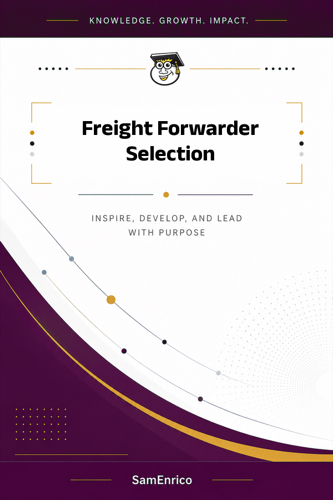
Freight Forwarder Selection eBook
Choose logistics partner for LCL and air freight t
by Dale Reid
Choose logistics partner for LCL and air freight to USA.
Formats
Free sample
Chapter 1: The $10,000 Lie--–- Every year, thousands of importers lose more than ten thousand dollars on their very first shipment. Not because the cargo was damaged. Not because it was stolen. Not even because of tariffs or trade wars. They lose this money because they believed a lie that the freight forwarding industry has spent decades perfecting.The lie sounds reasonable.
It sounds like good business. It sounds like this: “Freight is a commodity. Pick the cheapest quote.”Sitting in a small office outside Chicago, Sarah learned this lesson the hard way. She had spent eighteen months developing a line of smart home devices – wireless sensors, a hub, and an app. Her factory in Shenzhen was ready.
Her Amazon FBA shipment was booked. And the freight forwarder she chose? The one who quoted $2,800 for a 12 CBM LCL shipment from Shenzhen to Chicago, when everyone else was at $3,900 or higher.Ten days after the cargo left the factory, she received an email from the forwarder’s “destination agent” in Long Beach. The subject line read: “ARRIVAL NOTICE – ADDITIONAL CHARGES.”The list was staggering. A $1,200 “Customs Exam Facilitation Fee.” A $900 “Chassis Split Fee.” A $750 “Pier PASS Peak Hour Surcharge.” A $1,600 “Warehouse Unpacking Fee” because her pallets, she was told, were “non-conforming.” And a $2,300 “Demurrage” charge because the container had sat at the terminal for eight days while the forwarder’s paperwork was “being processed.”Total additional charges: $6,750.
On a $2,800 quote. Her ten-thousand-dollar loss? The $2,800 she paid upfront plus the $6,750 in surprises. Plus the $1,200 in lost sales because the shipment arrived two weeks late for Amazon Prime Day.Sarah’s story is not an exception. It is the rule.This chapter exists to ensure that you never become Sarah.
It will reframe how you think about freight forwarding – from a cost center to a strategic profit lever. It will expose the hidden economics of port congestion that forwarders exploit. It will give you a new language for evaluating partners based on three pillars that have nothing to do with the lowest rate. And by the end, you will understand why the cheapest quote is almost always the most expensive decision you can make.The Amazon Effect and the Race to the Bottom Fifteen years ago, freight forwarding was a relationship business. Importers worked with the same forwarder for decades.
Rates were high but predictable. Service levels were personal but inconsistent.Then Amazon happened.Not directly – Amazon doesn’t publish freight forwarding rates. But the consumer expectation that created – fast, free, and frictionless delivery – sent shockwaves up the supply chain. Retailers demanded lower costs from distributors. Distributors demanded lower costs from importers.
Importers demanded lower costs from forwarders.And forwarders, desperate to win business in a suddenly price-competitive market, learned a new strategy: quote low, then bill high.The mechanism is simple. When you ask five forwarders for a quote on the same shipment, three will give you honest numbers in the $3,500 to $4,200 range. One will give you a slightly higher number because they actually include everything. And one will give you a number that is 25 to 40 percent lower than everyone else – maybe $2,400 or $2,800.Your brain, trained by every other purchasing decision you have ever made, screams “take the low one.” And you do.What you don’t know is that the low quoter has a business model built on that exact behavior. They know you will compare rates.
They know you will choose the lowest number. So they give you that number – and then they wait.The moment your cargo is loaded on the vessel or the aircraft, you have no leverage. You cannot switch forwarders mid-ocean. You cannot retrieve your goods from a container on a ship. You are, for all practical purposes, a hostage.And that is when the “arrival notice” arrives.
The hidden fees. The accessorial charges. The surcharges you were never told about. The costs that the forwarder could have disclosed upfront but chose to hide because hiding them won them your business.This is not fraud in the legal sense. In most cases, the fine print of the forwarder’s quotation says something like “rates subject to change” or “accessorials may apply.” But in the practical sense, it is deception – and it costs importers billions of dollars every year.The Three Pillars of Intelligent Selection To escape the race to the bottom, you must reject its core premise.
You must stop asking “Who is cheapest?” and start asking three different questions entirely.These three questions form the pillars of intelligent forwarder selection. Every forwarder you evaluate should be scored against each of them. And any forwarder that fails any one of them should be eliminated immediately, regardless of price.Pillar One: Price Transparency Price transparency means the forwarder discloses every potential charge before you book the shipment. Not on the arrival notice. Not “in the fine print of our terms and conditions.” Not in a separate document they email after you have already paid the deposit.A transparent forwarder provides a document – sometimes called a “tariff sheet” or “rate schedule” – that lists every possible fee they might charge.
This includes:Base freight rate (per CBM for LCL, per kg for air)Origin handling fees (THC, LCL fees, documentation fees)Destination handling fees (CFS fees, terminal handling, customs clearance)Surcharges (fuel, peak season, currency adjustment, bunker)Accessorials (chassis splits, Pier PASS, warehouse unpacking, liftgate)Contingency fees (demurrage pass-through, exam facilitation, storage)A transparent forwarder does not hide behind vague terms like “local charges” or “destination fees.” They name the fee, state the amount or formula, and tell you under what conditions it applies.Pillar Two: Operational Compliance Operational compliance means the forwarder holds the licenses, bonds, and certifications required by US law – and can prove it.For ocean freight, an NVOCC (Non-Vessel Operating Common Carrier) must hold an active license from the Federal Maritime Commission (FMC) and maintain a $75,000 bond. This bond is not optional. It is not a “nice to have.” It is the law. A forwarder without an FMC license cannot legally issue a House Bill of Lading – and yet thousands do, leaving importers with no legal recourse when cargo disappears.For air freight, the forwarder must have TSA Known Shipper status if shipping from high-risk origins. Without it, your cargo faces 100 percent physical inspection at the airport – a delay of two to five days that will destroy any time-sensitive shipment.For customs clearance, the forwarder must either employ a Licensed Customs Broker (a professional who has passed the CBP broker exam, which has a pass rate below 20 percent) or partner with one.
A forwarder that tries to clear your goods without a broker is either breaking the law or about to make a very expensive mistake on your behalf.You will learn how to verify each of these credentials in Chapter 6. For now, understand that compliance is not a bureaucratic detail – it is the difference between cargo that moves and cargo that is seized.Pillar Three: Speed Reliability Speed reliability means the forwarder delivers consistent transit times, not just best-case scenarios.Every forwarder will tell you “Shanghai to Chicago in 28 days.” What they don’t tell you is that this is the time from vessel departure to…
This is the end of the free sample. Get the eBook to keep going. Buy now
About this book
Details
- Author
- Dale Reid
- Publisher
- SamEnrico
- Language
- English
- Genre
- Non-Fiction, Side Hustle Architect, Freight
- Released
- 2026-06-10
- Pages (approx.)
- 125
- Available as
- eBook, Audiobook

Read better in the ZLOADR app
Your eBooks on your phone or tablet. Sign in with your SamEnrico account and start reading.
More by Dale Reid
 Rainforest Relaxation JourneyDale Reid$11.99
 Perfectionism Failure Link GuideDale Reid$11.99
 Deep Trance TechniquesDale Reid$11.99
 The Metta for Anger ManagementDale Reid$11.99
 The Red Turban Rebellion: Peasants Rise, Dynasties Fall (1351–1368)Dale Reid$11.99
 Understanding Rectal NeoplasmDale Reid$17.99
 Hygiene Service TechnicianDale Reid$11.99
 Real Estate InvestmentDale Reid$12.99Real Estate InvestmentDale Reid$12.99Real Estate InvestmentDale Reid$12.99Real Estate InvestmentDale Reid$12.99Real Estate InvestmentDale Reid$12.99