
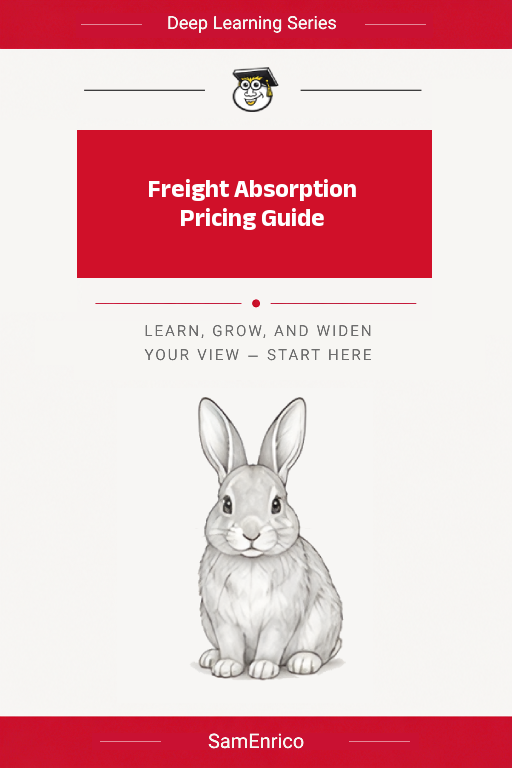
Freight Absorption Pricing Guide Audiobook
Absorb shipping costs while raising product prices
by Simon Penny
Absorb shipping costs while raising product prices to make inflation driven total seem lower to customers.
Formats
Free sample
Chapter 1: The Anchor That Sank...--The first price a customer sees is the only price that matters. Everything after that is just noise, friction, and—if you are not careful—a reason to leave.This is not an opinion. It is a neurological fact. When the human brain evaluates a purchase, it locks onto the first number it encounters with the tenacity of a drowning man gripping a lifeline. That number becomes the anchor.
Every subsequent cost—taxes, fees, handling, and yes, shipping—is judged against that anchor. If the anchor is low, everything added feels like a violation. If the anchor is strategically set, the additions become invisible.This chapter will introduce the single most important psychological mechanism in freight absorption pricing: cognitive anchoring. You will learn why customers remember the product price and forget the total, how the "pain of paying" works in the brain, and why traditional e-commerce advice about partitioned pricing (29.99+29.99 + 29.99+5 shipping) is dangerously incomplete. Most importantly, you will learn the critical caveat that separates successful absorption strategies from catastrophic failures: this approach is not for every customer.
By the end of this chapter, you will understand who benefits from absorption, who will punish you for it, and how to avoid the most common mistake that destroys conversion rates overnight.The Anatomy of an Anchor Let us begin with a simple experiment that has been replicated in dozens of pricing studies over the past two decades. Researchers showed two groups of consumers the exact same product—a standard kitchen blender—with two different price presentations. Group A saw the blender priced at 39.99withaseparate39.99 with a separate 39.99withaseparate9.99 shipping fee, for a total of 49.98.Group Bsawthesameblenderpricedat49.98. Group B saw the same blender priced at 49.98.Group Bsawthesameblenderpricedat49.98 with free shipping. The total was identical.
Yet when asked which offer felt like a better deal, Group A overwhelmingly chose their own offer. They perceived the 39.99anchorasabargain,eventhoughthe39.99 anchor as a bargain, even though the 39.99anchorasabargain,eventhoughthe9.99 shipping fee made them slightly annoyed. Group B perceived a higher anchor and felt no annoyance about shipping, but they also felt they were paying more for the product itself.This is the paradox of partitioned pricing. For decades, e-commerce experts have taught that splitting price into product plus shipping feels cheaper to customers. And they are right—for approximately sixty percent of shoppers.
But they are wrong for the other forty percent. And that forty percent, known as Shipping Skeptics, is growing rapidly…
This is the end of the free sample. Get the Audiobook to keep going. Buy now
About this book
Details
- Author
- Simon Penny
- Publisher
- SamEnrico
- Language
- English
- Genre
- Non-Fiction, Business Brief, Shipping Strategy
- Released
- 2026-06-01
- Pages (approx.)
- 159
- Available as
- eBook, Audiobook

Listen in the VoxFlicks app
Audiobooks and audio dramas wherever you go. Sign in with your SamEnrico account and press play.
More by Simon Penny
 Baseball Batting HypnosisSimon Penny$11.99
 Children of Addicts TriggersSimon Penny$11.99
 The Remote Time ChallengeSimon Penny$11.99
 Cynicism Reversal HandbookSimon Penny$11.99
 Early Riser Productivity PlanSimon Penny$11.99
 Cialdini Principles AppliedSimon Penny$11.99
 Burn Fluid ResuscitationSimon Penny$11.99
 Athlete Imposter SyndromeSimon Penny$11.99
 The Coral Sea Gambit: How a Forgotten Naval Battle Saved AustraliaSimon Penny$11.99
 The Puppet Master of Medellín: Colombia's Chilling Psychological ManipulatorSimon Penny$11.99
 How to Start a Hobby in BoatingSimon Penny$11.99
 Black Russian Terrier: Protective & CalmSimon Penny$11.99