
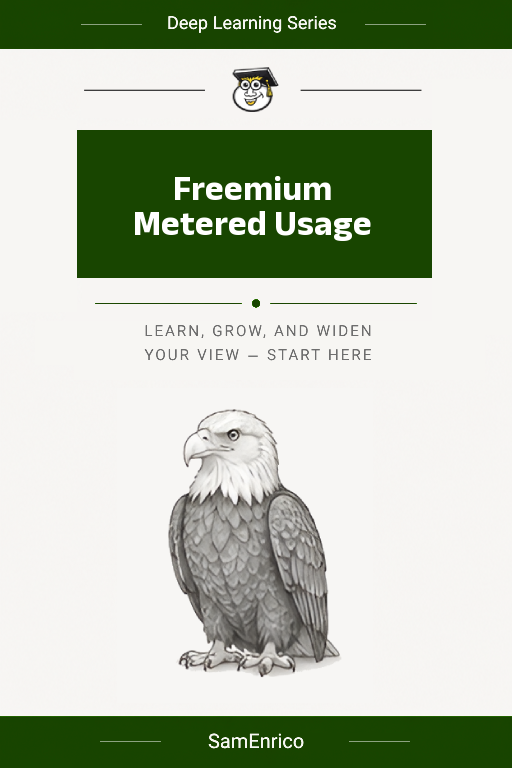
Non-FictionBusiness BriefMetered Usage
Freemium Metered Usage eBook
Implement metered freemium where users earn premiu
Implement metered freemium where users earn premium features through activity rather than payment.
Formats
Free sample
Chapter 1: The Zero-Price Trap--–- In the winter of 2016, a startup called Apester faced a problem that has killed more Saa S companies than bankruptcy: they had two million free users and exactly seventeen paying customers. Their product—an interactive content platform—was beloved. Users embedded polls, quizzes, and surveys on their websites by the millions. Engagement metrics sparkled. Monthly Active Users climbed every quarter.
The board was thrilled until someone asked the obvious question: “If two million people use this every month, why is our revenue only $3,400?”The answer was simple and devastating. Apester had built a traditional freemium model: a generous free tier that did 80% of what users needed, and a paid tier that did the remaining 20%. Users tried the paid tier, saw that the free tier was “good enough,” and never converted. The company had accidentally trained two million people to expect everything for nothing. They were not a business.
They were a charity with a server bill.Apester eventually pivoted to an enterprise-only model, abandoning their free users entirely. They survived, but the scar tissue remained. Their story is not unique. It is the default outcome of traditional freemium.This book exists because that default is no longer acceptable.The Million-Dollar Misunderstanding For the past fifteen years, the Saa S playbook has been simple: offer a free tier to acquire users, then convert a small percentage to paid. The math worked when acquisition costs were low and venture capital was cheap.
A 2% conversion rate on a million free users generated 20,000 paying customers. At 50permonth,thatwas50 per month, that was 50permonth,thatwas12 million in annual recurring revenue. Acceptable.But those days are over. Customer acquisition costs have tripled since 2015. Venture capital has tightened.
Users are more sophisticated and less patient. The average freemium conversion rate across B2C Saa S has dropped from 4% to less than 1.5% in five years. For every hundred users who sign up, ninety-eight leave without paying a cent. The two who do pay are subsidizing the server costs of the ninety-eight who do not.This is not a business model. It is a slowly sinking ship.The root cause is a behavioral economic phenomenon that most founders have never heard of: the Penny Gap.The Penny Gap Explained In 2007, behavioral economists Kristina Shampanier, Nina Mazar, and Dan Ariely ran a simple experiment.
They offered participants the choice between two chocolates: a Lindt truffle for 0.15anda Hershey’s Kissfor0.15 and a Hershey’s Kiss for 0.15anda Hershey’s Kissfor0.01. Seventy-three percent chose the Lindt truffle. The quality difference justified the price difference.Then they ran the same experiment with a twist. They lowered the price of the Hershey’s Kiss to $0.00. Free.
Suddenly, sixty-nine percent chose the Hershey’s Kiss. The Lindt truffle, objectively a better chocolate, lost to free.This is the Zero-Price Effect: when something is free, users shut down rational cost-benefit analysis. They stop asking “Is this worth the price?” because there is no price. They act on emotion—curiosity, excitement, fear of missing out—rather than logic. The rational brain takes a vacation.The Penny Gap is the logical extension of this effect.
The psychological distance between paying 0andpaying0 and paying 0andpaying0.01 is infinitely larger than the distance between 0.99and0.99 and 0.99and10.00. Moving from free to one cent requires a cognitive shift from “no decision needed” to “should I spend money?” That shift is so painful that most users simply abandon the journey.Traditional freemium models ask users to make that shift every single day. “You’ve been using our free tier for three months. Now give us your credit card.” The user feels the Penny Gap, hesitates, and leaves. The product team blames the pricing page.
They tweak the copy, change the button color, add a testimonials section. Conversion rates improve from 1.2% to 1.4%. They celebrate. They should be embarrassed.The Binary Cliff Traditional freemium presents users with a binary choice: stay in the shallow end (limited free tier) or jump to the deep end (paid tier). Most users choose neither.
They stand on the edge, look at the water, and walk back to the locker room.This is the Binary Cliff. It is the single greatest destroyer of Saa S growth in the modern era.Let me be precise about why the Binary Cliff fails. A typical freemium product offers:Free tier: basic features, limited usage, community support Paid tier: advanced features, unlimited usage, priority support The user tries the free tier. They learn the product. They invest time.
They build workflows. They invite teammates. After thirty to ninety days, they hit a limit. The product shows a modal: “Upgrade to Pro to continue.” The user has two options: pay or stop. There is no third option.This is a design failure, not a user failure.
The product has not given the user a way to earn their way forward. It has only given them a way to pay or leave. And because of the Zero-Price Effect, most choose to leave.The Hidden Cost of Free Here is the provocation at the heart of this book: The most expensive price is $0.00—not for the user, but for the company.Every free user costs you server bandwidth, customer support attention, and engineering resources. If they never convert, they are a liability, not an asset. Traditional freemium models treat free users as “future customers.” But most free users are not future customers.
They are permanent free riders who have been trained to expect infinite value for zero cost.The Saa S industry has normalized this insanity. We celebrate companies with millions of free users as if user count were the same as revenue. We optimize for Monthly Active Users while ignoring Monthly Active Losses. We have confused attention with value.This book argues that you should stop optimizing for attention and start optimizing for action. But before we get to the solution, we must fully understand the problem.The Three Ways Traditional Freemium Fails Based on analysis of over two hundred Saa S companies that attempted freemium and failed, I have identified three distinct failure modes.
Your product may suffer from one, two, or all three.Failure Mode One: The Generous Free Tier This is the Apester problem. The free tier is so capable that users never feel the need to upgrade. They accomplish their core jobs with zero friction. The paid tier offers “nice to have” features that users want but do not need. Conversion rates languish below 1%.The generous free tier is usually the result of product teams building features for free users first.
They want to delight the masses. They forget that delight does not pay rent. The solution is not to cripple the free tier—that drives users away entirely—but to rethink what belongs behind the meter.Failure Mode Two: The Abrupt Paywall This is the “try before you buy” model taken to its logical extreme. The free tier is deliberately limited. After fourteen or thirty days, users hit a hard wall.
They cannot proceed without paying. The product is essentially a trial with extra steps.The abrupt paywall creates a crisis moment. The user has invested time learning the product but has not yet generated enough…
This is the end of the free sample. Get the eBook to keep going. Buy now
About this book
Details
- Author
- Munson Georgiann
- Publisher
- SamEnrico
- Language
- English
- Genre
- Non-Fiction, Business Brief, Metered Usage
- Released
- 2026-05-29
- Pages (approx.)
- 141
- Available as
- eBook, Audiobook

Read better in the ZLOADR app
Your eBooks on your phone or tablet. Sign in with your SamEnrico account and start reading.
More by Munson Georgiann
 Four Laws of Habit ChangeMunson Georgiann$11.99
 Walking Meditation for PregnancyMunson Georgiann$11.99
 Dating App Messaging Starters WorkbookMunson Georgiann$11.99
 Decatastrophizing Food SlipsMunson Georgiann$11.99
 Observing Thoughts Meditation GuideMunson Georgiann$11.99
 The Lost Fleet of the Monsoon: Medieval Mariners and the Indian Ocean's Hidden IceMunson Georgiann$11.99
 The Last Out: The Miracle of the 1973 Baseball Game That Defied TimeMunson Georgiann$11.99
 PPC and Paid Advertising AgencyMunson Georgiann$11.99
 A Beginners Guide to Chicken Cha Cha Cha (Volume 1)Munson Georgiann$11.99
 One Page YouTube Channel WorkbookMunson Georgiann$12.99
 Understanding Gonadal Dysgenesis Xy Type Associated AnomaliesMunson Georgiann$17.99
You may also like
 Hong Kong Handover 1997Dunn Johnnie$11.99
 Zumba For Postnatal Recovery CourseNeal Christian$11.99
 Zumba for BeginnersLadner Nikia$11.99
 YouTube Comment Mining GuideHumes Pandora$12.99
 Worry Box MeditationCarlin Rudy$11.99
 Workplace Stress MeditationNguyen Lynn$11.99
 Workplace Stress and Sleep RepairHawley Ivory$11.99
 Workplace Perfectionism CureDelaney Jeffry$11.99
 Workplace Injustice Anger GuideWallen Isabelle$11.99
 Work Addiction and Burnout LinkGreenwood Ester$11.99
 Women in Yoga and WellnessBeattie Galina$11.99
 Women in Stand Up ComedyChun Evangeline$11.99