
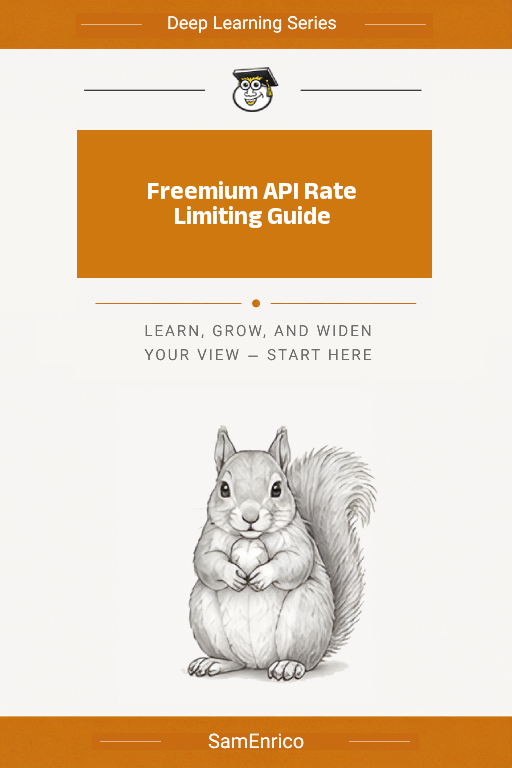
Freemium API Rate Limiting Guide Audiobook
Set stricter API limits on freemium tier for data-
Set stricter API limits on freemium tier for data-heavy operations, encouraging upgrade while keeping basic service usable on slow networks.
Formats
Free sample
Chapter 1: The Cost Blindspot-- Every API team I have ever consulted for believes they know which endpoints are expensive. They point to the AI inference service, the video transcoder, or the batch report generator. They are usually wrong. Not about those endpoints being expensive—they are. But about knowing all the expensive endpoints.
In nearly every case, the true cost bleeders are hiding in plain sight: a seemingly innocent GET /search that pages through ten thousand results, a POST /sync that triggers fifteen database joins, or a GET /export that everyone forgot existed. And because the rate limiter treats each of these calls exactly the same as a lightweight GET /status ping, the free tier becomes an unprofitable sinkhole while the engineering team blames “heavy users” instead of their own instrumentation.This chapter introduces the central problem that the rest of the book solves: the Cost Blindspot. You cannot design a freemium rate limiting strategy without first knowing, with numerical precision, what each endpoint actually costs to serve. Most teams skip this foundational step. They set limits based on guesses, past incidents, or worse—copied from a competitor’s documentation.
Then they wonder why the free tier loses money or why paid users feel artificially capped. The Cost Blindspot is the reason one-size-fits-all rate limiting fails, and eliminating it is the first and most critical action you will take.The One-Size-Fits-All Trap Let me describe a scenario I have seen at least forty times. A B2B Saa S company launches a freemium API. They have fifteen endpoints. The engineering lead says, “Let’s start with 100 requests per minute for free users and 1,000 for paid.” Everyone agrees.
It sounds reasonable. Six months later, the cloud bill has tripled, but usage has only doubled. Free users are consuming 80% of the compute resources but generating 0% of the revenue. The team’s first reaction is to lower the free tier limit to 50 requests per minute. Paid users complain about unrelated slowness.
Free users churn. Nobody wins.The problem is not the number 100. The problem is treating all endpoints equally. A GET /health endpoint might return an empty 200 response with no database query—cost effectively zero. A POST /search that scans a terabyte of data and returns ten thousand rows might cost ten cents per call.
Under a one-size-fits-all limit, both consume exactly one “request” from the user’s quota. The free user who calls GET /health…
This is the end of the free sample. Get the Audiobook to keep going. Buy now
About this book
Details
- Author
- Stoddard Kathern
- Publisher
- SamEnrico
- Language
- English
- Genre
- Non-Fiction, Business Brief
- Released
- 2026-05-28
- Pages (approx.)
- 160
- Available as
- eBook, Audiobook

Listen in the VoxFlicks app
Audiobooks and audio dramas wherever you go. Sign in with your SamEnrico account and press play.
More by Stoddard Kathern
 Infant Loss Recovery GuideStoddard Kathern$11.99
 Cocaine Use in Healthcare WorkersStoddard Kathern$11.99
 Sports Betting Addiction Recovery GuideStoddard Kathern$11.99
 Opioid Withdrawal MedicationsStoddard Kathern$11.99
 Teen Self Esteem GamificationStoddard Kathern$11.99
 Anxiety Distraction GuideStoddard Kathern$11.99
 Gambling Addiction And Self EsteemStoddard Kathern$11.99
 Hospital Bereavement PhotographyStoddard Kathern$11.99
 The Lost Ballgame of Babylon: The Ancient World Series That Never WasStoddard Kathern$11.99
 The Architect of Constantinople: The Black Master Builders of the Byzantine EmpireStoddard Kathern$11.99
 How to Start a Coal Recovery of From Culm Banks Business (Beginners Guide)Stoddard Kathern$11.99
 How to Produce Energy Saving EquipmentStoddard Kathern$11.99
You may also like
 Hong Kong Handover 1997Dunn Johnnie$11.99
 Zumba For Postnatal Recovery CourseNeal Christian$11.99
 Zumba for BeginnersLadner Nikia$11.99
 YouTube Comment Mining GuideHumes Pandora$12.99
 Worry Box MeditationCarlin Rudy$11.99
 Workplace Stress MeditationNguyen Lynn$11.99
 Workplace Stress and Sleep RepairHawley Ivory$11.99
 Workplace Perfectionism CureDelaney Jeffry$11.99
 Workplace Injustice Anger GuideWallen Isabelle$11.99
 Work Addiction and Burnout LinkGreenwood Ester$11.99
 Women in Yoga and WellnessBeattie Galina$11.99
 Women in Stand Up ComedyChun Evangeline$11.99