
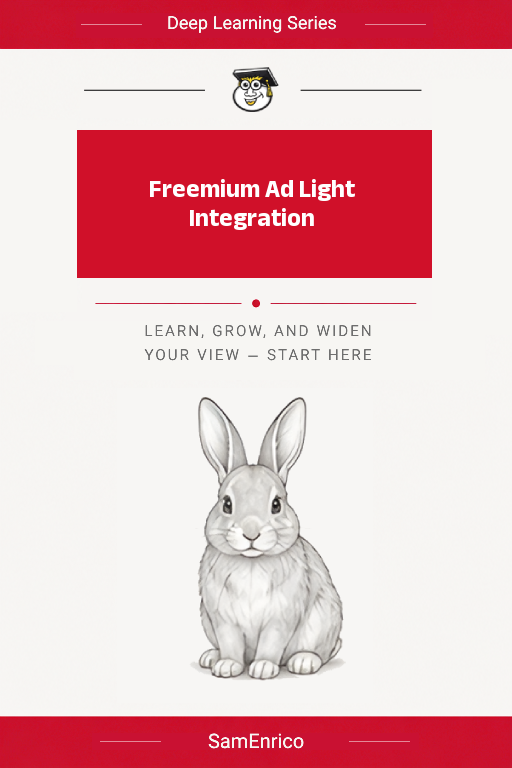
Non-FictionBusiness BriefAd Monetization
Freemium Ad Light Integration eBook
Show low resolution, text only ads to free users t
by Ellis Allan
Show low resolution, text only ads to free users to monetize without heavy data downloads.
Formats
Free sample
Chapter 1: The Freemium Trap...--–- It was 3:47 AM in Mumbai, and Priya had just downloaded what she hoped would be the perfect meditation app. Her phone was two years old, purchased on an EMI plan, with 27GB of storage already consumed by family photos, work documents, and Whats App videos from her cousin in Dubai. She had exactly 1.2GB of monthly data remaining, with eleven days left in her billing cycle. The app promised "free forever" with "minimal ads." What she got instead was a 47MB download, a mandatory video ad for a luxury car she could never afford, and an app that crashed three times before she uninstalled it in frustration. Priya is not an edge case.
She is the average mobile user on planet Earth.This is the freemium trap.For the past decade, the technology industry has operated under a seductive illusion: that "free" apps can be sustainably funded by "heavy" advertising. Developers build elegant, lightweight applications designed to solve specific problems—meditation, weather forecasts, offline maps, calculator tools, language learning, fitness tracking. Then, at the moment of monetization, they graft on ad units that were designed for desktop browsers in 2012 or video platforms in 2016. The result is not a profitable app. It is a contradiction packaged in an APK file.The freemium model contains an inherent paradox that most developers discover only after they have shipped their product and watched their retention curves plummet.
You must give your app away for free to attract users. You need revenue to sustain development, server costs, and (eventually) your own salary. Advertising is the most accessible path to that revenue. But the very ads that generate income also destroy the user experience that made your app valuable in the first place. This is not a trade-off.
It is a design failure disguised as a business model.The Unspoken Truth About "Free"Let us examine what actually happens when a user downloads a "free" app that relies on standard ad networks. The user opens your app store listing, reads your description promising "lightweight" and "fast," and clicks install. Behind the scenes, your app is competing for attention with every other notification, message, and distraction on their device. Within the first sixty seconds, the user must decide whether your app deserves a place on their home screen or belongs in the graveyard of "apps I tried once."In that critical first minute, what does the typical freemium app deliver? A loading screen that takes four seconds.
A mandatory interstitial ad for a mobile game featuring cartoon zombies. A permissions request that feels invasive. A tutorial that interrupts the user's natural exploration. And finally, buried beneath all of this friction, the actual utility they came for. By the time the user reaches that utility, their patience has been exhausted.
They do not blame the ad network or the advertising exchange. They blame you.The data confirms this pattern across hundreds of millions of app installations. According to internal analyses from major ad mediation platforms, apps that implement video interstitials within the first three sessions see 30-day retention rates that are 40-60% lower than apps that delay or avoid such formats. Users do not churn because they hate advertising. They churn because they hate having their time stolen.Consider the economics of this churn.
A typical video interstitial might generate 0.01to0.01 to 0.01to0.05 per completed view. If that ad causes a user to churn who would otherwise have generated $0.50 in lifetime value through subsequent interactions, the ad has produced negative return on investment. Yet most developers never calculate this equation. They look only at ad revenue, not at the lifetime value destroyed in the process of earning it.The Bandwidth Bottleneck The problem becomes exponentially worse when we consider the actual infrastructure that delivers apps to most of the world. Silicon Valley product managers habitually assume that all users have unlimited 5G data plans, flagship smartphones with 256GB of storage, and the patience to tolerate rich media advertising.
This assumption is catastrophically wrong.Let us examine the bandwidth bottleneck through concrete numbers. A standard pre-roll video ad for an app install campaign typically weighs between 2MB and 5MB. A rich media display ad with animation and tracking pixels weighs 500KB to 1.5MB. A standard banner ad with images weighs 100KB to 300KB. A text-only ad with a single tracking ping weighs less than 1KB.These differences are not merely quantitative.
They are qualitative. For a user in Lagos with a 1GB monthly data plan who pays $0.50 per gigabyte (a typical rate in many emerging markets), a single 3MB video ad consumes 0.3% of their monthly data budget for content they did not request and actively did not want. Five such ads consume 1.5% of their budget. Ten ads consume 3%. Over a month of regular app usage, the advertising payload alone can exceed the data cost of the app's actual functionality.The storage situation is equally dire.
Modern ad SDKs (software development kits) often bundle multiple rendering engines, font files, video codecs, and tracking libraries. A single ad network's SDK can add 5-15MB to an app's binary size. Most apps use three to five ad networks to maximize fill rates, resulting in 20-50MB of SDK overhead before a single ad is served. For a user with a 32GB device—still the most common storage tier globally—that overhead represents precious space that could have been used for photos, messages, or offline content.This is the bandwidth bottleneck: the structural mismatch between ad formats designed for unlimited connections and users who must count every megabyte. The bottleneck does not merely reduce ad performance.
It destroys the core value proposition of your application.The Case Study That Changes Everything Before the era of programmatic advertising, before real-time bidding, before video interstitials and rewarded ads, there was a simpler time when text-only classifieds built billion-dollar businesses. The case of Craigslist is instructive not because it is modern but precisely because it is not.Founded in 1995, Craigslist grew to become one of the most visited websites in the English-speaking world while displaying almost no images, no video, and nothing resembling a traditional "ad." The site's monetization came from classified listings in a handful of categories: job postings in major cities, apartment rentals in New York and San Francisco, and automotive listings. Everything else was free. The design was deliberately spartan. The user interface was text on a white background.
And users loved it.Why did Craigslist succeed where so many richly designed competitors failed? The answer lies in trust and utility. When a user visited Craigslist in 2005, they knew exactly what they were getting: a fast-loading, predictable, no-nonsense tool for finding an apartment, a job, or a used sofa. The lack of visual noise was not a bug. It was the feature.
Users did not resent the classified ads because those ads were the utility they came for. A job posting on Craigslist was not an interruption. It was the destination.The same principle applies to text-based advertising in mobile apps today. When a well-crafted text ad appears as a suggestion, a tip, or a relevant offer, users process it as content rather than interruption. They read it.…
This is the end of the free sample. Get the eBook to keep going. Buy now
About this book
Details
- Author
- Ellis Allan
- Publisher
- SamEnrico
- Language
- English
- Genre
- Non-Fiction, Business Brief, Ad Monetization
- Released
- 2026-05-30
- Pages (approx.)
- 126
- Available as
- eBook, Audiobook

Read better in the ZLOADR app
Your eBooks on your phone or tablet. Sign in with your SamEnrico account and start reading.
More by Ellis Allan
 Phone Screen Time ReviewEllis Allan$11.99
 The Parent Emotional RegulationEllis Allan$11.99
 Gratitude Self Talk ShiftEllis Allan$11.99
 Personal Guarantee Escape PlanEllis Allan$11.99
 Deborah Parker Tribal AdvocateEllis Allan$11.99
 Habit Formation for TherapistsEllis Allan$11.99
 Audience Analysis For SpeakersEllis Allan$11.99
 Alcohol Detox Insurance GuideEllis Allan$11.99
 The Visionary and the City: Christopher Wren and the Rebirth of LondonEllis Allan$11.99
 The Magician Who Stole the Spotlight: The Untold Story of Juan Tamariz at the Olympics of MagicEllis Allan$11.99
 Service Providers Guide to Bariatric MedicineEllis Allan$11.99
 How to Start a Hobby in BakingEllis Allan$11.99
You may also like
 Hong Kong Handover 1997Dunn Johnnie$11.99
 Zumba For Postnatal Recovery CourseNeal Christian$11.99
 Zumba for BeginnersLadner Nikia$11.99
 YouTube Comment Mining GuideHumes Pandora$12.99
 Worry Box MeditationCarlin Rudy$11.99
 Workplace Stress MeditationNguyen Lynn$11.99
 Workplace Stress and Sleep RepairHawley Ivory$11.99
 Workplace Perfectionism CureDelaney Jeffry$11.99
 Workplace Injustice Anger GuideWallen Isabelle$11.99
 Work Addiction and Burnout LinkGreenwood Ester$11.99
 Women in Yoga and WellnessBeattie Galina$11.99
 Women in Stand Up ComedyChun Evangeline$11.99