
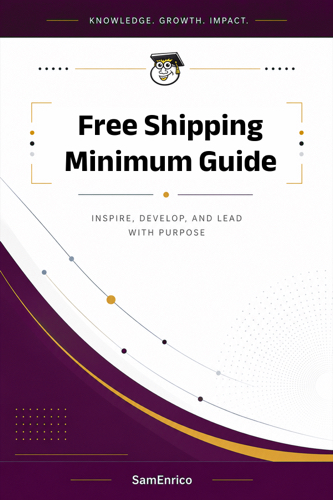
Non-FictionSelf-HelpShipping Trap
Free Shipping Minimum Guide eBook
Stop adding items to reach shipping thresholds usi
by Sayre Janita
Stop adding items to reach shipping thresholds using this practical cart management workbook.
Formats
Free sample
Chapter 1: The $49.99 Lie--I once added a cactus-shaped pencil sharpener to my online shopping cart.I do not own pencils. I have never owned pencils. I do not like cacti. And yet, there I was at 11:47 on a Tuesday night, staring at a digital image of a lime-green succulent with a blade embedded in its plastic flesh, calculating whether it was worth $4.99 to avoid paying $6.99 for shipping.I bought the pencil sharpener.It arrived seven days later in a box large enough to hold a small dog. I unwrapped it, placed it on my desk, and felt something I have since learned to name: the hollow thud of post-purchase stupidity.
The sharpener sat there for eighteen months. I never used it. I threw it away during a move, and I remember thinking, as it hit the bottom of the trash bag, that I had just completed a very expensive, very slow transaction in which I paid $4.99 for the privilege of feeling annoyed every time I looked at my desk.This book exists because I am not alone.The Confession This Book Requires Before we go any further, I need you to do something uncomfortable. I need you to admit that you have done this too. Maybe not with a cactus pencil sharpener.
Maybe with a phone case for a model you do not own. Maybe with a pack of batteries when your drawer already contains forty-seven batteries of unknown charge status. Maybe with a mystery novel from an author you have never heard of, purchased exclusively because it cost $8.99 and you were $8.23 short of free shipping.I need you to admit that you have spent money on things you did not want to avoid paying for a service you did want.This is not a book about saving money on shipping. That is what the internet will tell you this book is about, and the internet is wrong. This is a book about the gap between what you pay and what you get.
It is about the difference between a transaction and a trap. And it begins with a single number that has been engineered to exploit the most predictable flaw in human decision-making.The number is $49.99.The Architecture of Almost Let me describe a scenario that will feel familiar because it has happened to you dozens of times, and each time you have walked directly into a psychological snare that has been studied, measured, and optimized by people whose job is to understand your brain better than you do.You are shopping online. You find an item you actually want. A winter coat, perhaps. Or a set of kitchen knives.
Or a hard drive for your computer. The price is $40. You add it to your cart. You proceed to checkout, and then you see it: "Add $10.00 more for FREE Shipping."Something shifts in your brain. A switch flips.
You are no longer evaluating whether you need a winter coat. You are now on a mission. You need $10 worth of additional merchandise, and you need it immediately. The clock is ticking, even though there is no clock. The threshold is looming, even though it is an arbitrary number set by a corporation that does not know you exist.You begin to search.
You sort by price: low to high. You scroll past items that cost $1.99, $2.49, $3.75. You are not looking for something you want. You are looking for something that costs approximately $10 and will not make your cart total exceed $50 by too much. You find a candidate.
A phone case for $9.99. You do not need a phone case. Your current phone case is fine. You have never once thought about replacing your phone case. But $9.99 is almost exactly $10, and if you add it, the shipping becomes free, and that feels like winning.You complete the purchase.
You have spent $49.99. You have "saved" $6.99 on shipping. You close your laptop feeling efficient, clever, victorious.You have just lost.The Goal Gradient Effect What happened inside your brain during those sixty seconds of searching for filler has a name. It is called the Goal Gradient Effect, and it is one of the most replicated findings in the history of behavioral psychology.The Goal Gradient Effect was first described in 1932 by a psychologist named Clark Hull, who noticed something strange about laboratory rats running through mazes. The rats moved faster as they approached the reward.
Not just slightly faster—measurably, significantly faster. Their effort accelerated the closer they got to the cheese. Hull published his findings, and for decades, the Goal Gradient Effect was understood as a quirk of rodent behavior.Then, in 2006, a group of marketing researchers decided to test whether humans did the same thing. They designed a study using coffee loyalty cards. Customers were given cards that required ten stamps to earn a free coffee.
But here is where it gets interesting: half the customers received cards that already had two stamps. Not two free stamps toward their purchase—just two stamps printed on the card before they ever bought a single coffee. The other half received blank ten-stamp cards.The group that started with two stamps completed the loyalty program significantly faster than the group that started from zero. They bought more coffee, more quickly, even though both groups needed the same number of additional purchases to earn the free coffee. Why?
Because the customers who started with two stamps perceived themselves as closer to the goal. And being close to a goal, Hull's rats had shown, makes you run faster.Now apply this to your online shopping cart.You have $40 worth of items you actually want. The free shipping threshold is $50. You are 80% of the way to the goal. That is not almost there.
That is not close. That is a deliberate psychological trigger engineered by retailers who have read the same studies I am describing to you right now.Retailers do not set free shipping thresholds at random. They do not pick $50 because it is a round number, or $35 because it feels friendly, or $25 because it is low enough to feel attainable. Retailers set thresholds based on average order value data, and they set them **just above** what most customers naturally spend. If their data shows that most customers buy $35 worth of merchandise, the threshold will be $40 or $45.
If most customers buy $45, the threshold will be $50 or $55.The threshold is always, always, always just out of reach because being just out of reach triggers the Goal Gradient Effect. You perceive yourself as almost there. You accelerate your effort. You search for filler. You buy things you do not want.
And the retailer captures the margin on both the item you wanted and the item you never needed.The Emotional Pacifier Let me be explicit about what filler items actually are, because naming something correctly is the first step toward defeating it.A filler item is not a solution. A filler item is an emotional pacifier. It soothes the temporary discomfort of paying for shipping while creating long-term consequences that far outweigh the momentary relief.Consider what you are actually feeling when you see "Add $X more for FREE Shipping." You are not feeling a rational desire to acquire more goods. You are not…
This is the end of the free sample. Get the eBook to keep going. Buy now
About this book
Details
- Author
- Sayre Janita
- Publisher
- SamEnrico
- Language
- English
- Genre
- Non-Fiction, Self-Help, Shipping Trap
- Released
- 2026-06-06
- Pages (approx.)
- 124
- Available as
- eBook, Audiobook

Read better in the ZLOADR app
Your eBooks on your phone or tablet. Sign in with your SamEnrico account and start reading.
More by Sayre Janita
 Hungarian American Return To Budapest HandbookSayre Janita$11.99
 The Flood Ventilation Drying GuideSayre Janita$11.99
 Observing Impermanence Through BreathSayre Janita$11.99
 Baby Sleep Instagram AccountsSayre Janita$11.99
 The Silk Road Conspiracy: The Dark Web's First Crime EmpireSayre Janita$11.99
 Editing (Substantive)Sayre Janita$11.99
 How to Become a Nitroglycerin NeutralizerSayre Janita$11.99
 Green Methanol Capital GuideSayre Janita$12.99
 Legal Document Review ToolsSayre Janita$12.99
 Understanding Mixed Sclerosing Bone DystrophySayre Janita$17.99
You may also like
 Hong Kong Handover 1997Dunn Johnnie$11.99
 Zumba For Postnatal Recovery CourseNeal Christian$11.99
 Zumba for BeginnersLadner Nikia$11.99
 YouTube Comment Mining GuideHumes Pandora$12.99
 Worry Box MeditationCarlin Rudy$11.99
 Workplace Stress MeditationNguyen Lynn$11.99
 Workplace Stress and Sleep RepairHawley Ivory$11.99
 Workplace Perfectionism CureDelaney Jeffry$11.99
 Workplace Injustice Anger GuideWallen Isabelle$11.99
 Work Addiction and Burnout LinkGreenwood Ester$11.99
 Women in Yoga and WellnessBeattie Galina$11.99
 Women in Stand Up ComedyChun Evangeline$11.99