
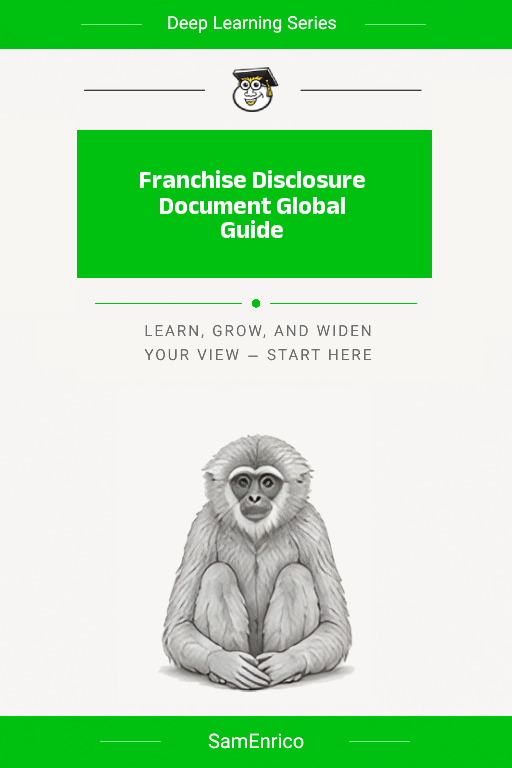
Franchise Disclosure Document Global Guide eBook
Adapt your FDD for cross border compliance with lo
Adapt your FDD for cross border compliance with local laws in each target market. Include country specific financial performance representations.
Formats
Free sample
Chapter 1: The Million-Dollar Mistake--The fax machine beeped at 2:47 AM Seoul time. On the other end of the line was a mid-sized American burger franchise that had just spent eighteen months and nearly two million dollars entering the South Korean market. They had done everything right—or so they thought. They had found a wealthy master franchisee with deep local connections. They had translated their entire operations manual into Korean.
They had flown their CEO to Seoul three times for meetings. They had even localized the menu, adding a bulgogi burger that was selling surprisingly well.Then the fax came. It was from the Korean Fair Trade Commission, and it was not an approval letter.The KFTC had discovered that the franchisor was offering franchises in Korea without a registered disclosure document. Under Korean law, this is not a paperwork technicality—it is a criminal offense. The fine was 500 million won, approximately $425,000 at the time.
But the fine was the least of their problems. The KFTC also ordered the franchisor to rescind all existing franchise agreements, meaning every Korean franchisee had the legal right to walk away and demand a full refund of their initial investment. Most of them did.The franchisor lost its entire Korean operation. The master franchisee sued for fraud. Legal fees exceeded $1.2 million before a settlement was reached.
The brand, once promising in Asia, was never able to re-enter the Korean market. Competitors moved in. The CEO was fired. The entire international division was shut down.What went wrong? The franchisor had assumed that their U.S.
Franchise Disclosure Document—carefully drafted, fully compliant with the FTC Rule, blessed by their expensive New York law firm—could simply be translated and handed to Korean prospects. They were wrong. Dead wrong.This chapter is about why that assumption fails, and why the "global template" myth is the most expensive mistake in international franchising.The Anatomy of a U.S. FDD: A Domestic Weapon, Not a Global Passport Let us start with what the U.S. FDD actually is.
The Federal Trade Commission's Franchise Rule requires franchisors to provide prospective franchisees with a disclosure document containing twenty-three specific items. These range from Item 1 (the franchisor and any predecessors) to Item 23 (receipts). The document is designed to give a prospective franchisee enough information to make an informed investment decision.But here is the critical insight that most franchisors miss: the twenty-three-item FDD was designed for a specific legal and commercial environment that exists only in the United States. That environment has five distinctive features that are not universal:First, the U.S. operates under at-will employment, meaning either party can terminate the employment relationship at any time for almost any reason.
This affects everything from staffing costs to the enforceability of post-termination restrictions. In France, by contrast, terminating an employee can take months and cost a year's salary in severance.Second, the U.S. has relatively strong enforcement of non-compete agreements, at least in most states. A two-year, fifty-mile non-compete that is routine in a U.S. franchise agreement would be laughed out of a German court, where non-competes require the franchisor to pay the franchisee during the restricted period.Third, the U.S.
legal system operates in English, and the FTC Rule assumes English-language disclosure. When you translate an FDD into Korean, Japanese, or French, you are not just changing words—you are changing legal meanings. The concept of "material fact" does not translate cleanly. The standard of "reasonable basis" for earnings claims has no direct equivalent in civil law systems.Fourth, the U.S. franchise relationship is governed by contract law with relatively limited statutory intervention.
In many other countries, the franchise relationship is heavily regulated by specific franchise legislation that overrides contract terms. In China, the franchisor cannot terminate a franchisee for convenience, regardless of what the contract says. In Brazil, the franchise agreement must be registered with the National Institute of Industrial Property before it has any legal effect.Fifth, and most importantly, the U.S. disclosure system is based on the principle of caveat emptor—let the buyer beware—with disclosure as the primary protection. Many other countries have moved toward a registration model where the government reviews and approves the disclosure document before any offer can be made.
In China, you cannot even advertise franchise opportunities without Mo FCOM registration. In South Korea, the KFTC reviews every FDD for compliance with substantive standards, not just completeness.The burger franchise in Seoul learned all of these lessons the hard way. Their beautifully translated U.S. FDD failed to include disclosures required under Korean law—specifically, a detailed history of litigation involving the franchisor's officers, which was not required in the U.S. but was mandatory in Korea.
Their non-compete clause was void as a matter of Korean law. Their revenue projections, based on U.S. store performance, were deemed "unfair and deceptive" because they had not been reviewed by the KFTC. And because they had never registered, every agreement was voidable at the franchisee's option.The Three Global Regulatory Models: Know Before You Go To avoid the Seoul Burger Disaster, you must understand that the world divides into three distinct regulatory models for franchise disclosure. Each model imposes different requirements, timelines, and risks.Model One: Comprehensive Disclosure and Registration In this model, you cannot offer or sell a franchise until your FDD has been reviewed and approved by a government agency.
The agency may also review the franchise agreement itself and required updates when material changes occur. The countries in this model include China, South Korea, Mexico, Brazil, Vietnam, Malaysia, Indonesia, and several others.China provides the most rigorous example. The Ministry of Commerce (Mo FCOM) requires a two-step filing process. First, the franchisor must register its trademark in China—a process that takes twelve to eighteen months on its own. Second, the franchisor must submit its FDD, franchise agreement, operations manual, and financial statements for review.
The review takes three to six months. Only after receiving Mo FCOM approval can the franchisor advertise or offer franchises.The timeline from initial interest to first franchisee signing in China is typically eighteen to twenty-four months. The cost, including local counsel, translation, and registration fees, often exceeds $100,000 before any franchisee has paid a dollar in fees.South Korea's KFTC operates similarly but with a different emphasis. The KFTC focuses heavily on earnings claims. If you include any financial performance representation in your FDD, the KFTC will require extensive substantiation.
Many franchisors choose to omit earnings claims entirely in Korea to avoid this scrutiny.Mexico requires registration with the Mexican Institute of Industrial Property (IMPI). The timeline is shorter—about three to four months—but the substantive requirements are strict. The FDD must be in Spanish, must include specific warnings in bold type, and must be renewed annually.Model Two: Disclosure at Signing, No Pre-Filing This model is most familiar to U.S. franchisors because the United States is in it. Canada is also in this model, though with provincial variations.
Australia used to be in this model but now has unique features we will discuss shortly.In this model, you do not need government approval before offering a…
This is the end of the free sample. Get the eBook to keep going. Buy now
About this book
Details
- Author
- Mcneill Serafina
- Publisher
- SamEnrico
- Language
- English
- Genre
- Non-Fiction, Business Brief
- Released
- 2026-05-30
- Pages (approx.)
- 141
- Available as
- eBook, Audiobook

Read better in the ZLOADR app
Your eBooks on your phone or tablet. Sign in with your SamEnrico account and start reading.
More by Mcneill Serafina
 Opioid Overdose Prevention GuideMcneill Serafina$11.99
 Road Rage and SpeedingMcneill Serafina$11.99
 Ayurvedic Anxiety GuideMcneill Serafina$11.99
 Loving Kindness for an Ex SpouseMcneill Serafina$11.99
 Anki For Daily To Do ListsMcneill Serafina$11.99
 Immigrant Founder Capital Raising CourseMcneill Serafina$11.99
 Feelings Inventory GuideMcneill Serafina$11.99
 Verbal Working MemoryMcneill Serafina$11.99
 Stress And Temperature RegulationMcneill Serafina$11.99
 The Stanford Prison Experiment: The Hidden TapesMcneill Serafina$11.99The Stanford Prison Experiment: The Hidden TapesMcneill Serafina$11.99
 The Great Unplug: How a Single Union Walkout Shut Down the InternetMcneill Serafina$11.99
You may also like
 Hong Kong Handover 1997Dunn Johnnie$11.99
 Zumba For Postnatal Recovery CourseNeal Christian$11.99
 Zumba for BeginnersLadner Nikia$11.99
 YouTube Comment Mining GuideHumes Pandora$12.99
 Worry Box MeditationCarlin Rudy$11.99
 Workplace Stress MeditationNguyen Lynn$11.99
 Workplace Stress and Sleep RepairHawley Ivory$11.99
 Workplace Perfectionism CureDelaney Jeffry$11.99
 Workplace Injustice Anger GuideWallen Isabelle$11.99
 Work Addiction and Burnout LinkGreenwood Ester$11.99
 Women in Yoga and WellnessBeattie Galina$11.99
 Women in Stand Up ComedyChun Evangeline$11.99