
Non-FictionInformativeEducational
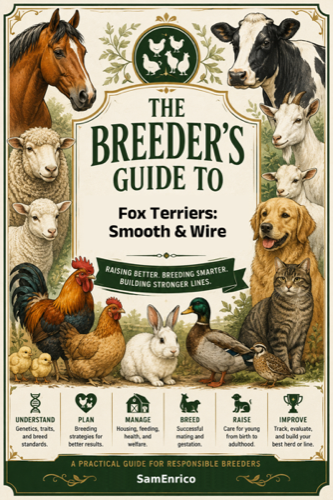
Fox Terriers: Smooth & Wire eBook
This wildlife publication, published by SamEnrico,
This wildlife publication, published by SamEnrico, covers Fox Terriers: Smooth & Wire
Formats
Free sample
Chapter 1: Born Underground...–- In the winter of 1750, a farmer in Norfolk, England, watched his flock of sheep with growing dread. Something had been taking lambs during the night—not from above, as a hawk or eagle would, but from below. The earth itself seemed to be betraying him. Scattered across his pasture were holes, some fresh, some old, all leading to a network of tunnels that had been dug not by rabbits or badgers, but by foxes. The red fox, Vulpes vulpes, had grown bold and numerous.
With wolves already hunted to extinction in England by the 1680s, the fox had no natural predator left above ground. And so it had moved underground—breeding, digging, and devastating the livelihoods of men who depended on livestock.The farmer did something that would, without his knowing it, change the course of canine history. He walked to his neighbor’s cottage and borrowed a small, wiry, white dog that had been bred for generations to enter dark places and not come out until the job was done. The dog’s name is lost to history. Its breed is disputed.
But its legacy is not. Within an hour, that small terrier had entered the earth, located the fox, and either driven it out into the open or held it at bay underground until the farmer could dig down and dispatch it. The lambs survived the following spring. And the Fox Terrier—the breed that would one day become known in two distinct forms, Smooth and Wire—was born not in a royal kennel or a show ring, but in the cold, dark, dangerous tunnels of rural England.This is the story of a dog that was never meant to be beautiful. It was meant to be useful.
And in its usefulness, it became one of the most admired, recognized, and beloved terrier breeds in the world.The Agricultural Crisis That Created a New Kind of Dog To understand the Fox Terrier, one must first understand the fox. In 18th-century England, the red fox was not the charming, bushy-tailed character of children’s stories. It was a pest—cunning, destructive, and remarkably adaptable. The Agricultural Revolution had transformed the English countryside. Common lands were being enclosed into private farms.
Sheep, cattle, and chickens were raised in greater numbers than ever before. And the fox, with its opportunistic appetite, followed the food.But the fox had an advantage that wolves and bears did not. It could go underground. While larger predators could be hunted down with hounds on open ground, the fox could retreat into a den—an earth, in the language of the hunt—and disappear. Horses could not follow.
Large hounds could not fit. And so the fox multiplied, and the farmers grew desperate.The solution came from an unlikely source: the humble terrier. The word terrier itself comes from the Latin terra, meaning earth. Terriers had existed in various forms across Britain and Ireland for centuries as vermin hunters—dogs bred to enter burrows and kill rats, rabbits, and other small pests. But these early terriers were not standardized.
They varied greatly in size, coat type, color, and temperament. What they shared was a willingness to go underground and a refusal to back down.What the farmers of Norfolk and neighboring counties needed was not just any terrier. They needed a specialized tool. The dog had to be small enough to fit into a fox’s earth—typically no more than 15 inches at the shoulder and 18 pounds. It had to have enough stamina to work underground for extended periods.
It had to have a coat that could withstand the abrasion of dirt, roots, and rocks. It had to be predominantly white so that hunters could see it emerge from dark tunnels against the dark soil. And above all, it had to have grit—that indefinable combination of courage, tenacity, and controlled aggression that allowed a small dog to confront a cornered fox, which could weigh nearly as much and possessed a set of teeth designed for killing.The Unlikely Ancestors of the Fox Terrier No single breed gave rise to the Fox Terrier. Instead, the breed emerged from a melting pot of working terrier types, each contributing essential traits. The most important ancestors included:The Black and Tan Terrier.
Now extinct as a distinct breed, this dog was common across Wales and northern England. It was a rough-coated, dark-colored terrier with legendary gameness—the willingness to fight to the death if necessary. The Black and Tan gave the Fox Terrier its courage and its tenacity. It also contributed the dark markings that still appear on the heads and bases of tails of many Fox Terriers today.The Bull Terrier. Before it became the egg-headed, wholly white companion of today, the Bull Terrier was a fighting dog—courageous, powerful, and remarkably pain-tolerant.
Early Fox Terrier breeders crossed in Bull Terrier blood to increase stamina and fearlessness. This influence is still visible in the strong jaw and powerful neck of the modern Fox Terrier.The Beagle. This may seem an odd ancestor for a terrier, but the Beagle contributed something essential: speed and endurance. Early fox hunting required dogs that could keep up with mounted hunters and packs of hounds. Beagles, bred for hare hunting, had the stamina to run for hours.
That endurance remains in the Fox Terrier, which is why even a small, apartment-dwelling Smooth can out-walk most owners.The Old English White Terrier. Another extinct breed, the Old English White Terrier was exactly what its name suggests—a terrier bred specifically for a white coat. This dog gave the Fox Terrier its most recognizable feature: the predominantly white body that made it visible against dark earth and allowed hunters to distinguish it from the fox in low light.The crossing of these types was not systematic or scientific. It was practical. If a farmer had a terrier that was particularly good at finding foxes, he bred it to another good working terrier, regardless of appearance.
Litters from the same parents could produce puppies with smooth coats, wire coats, or something in between. Coat type was simply not a priority. What mattered was what the dog could do.The Same Parents, Two Different Coats One of the most surprising facts about the early Fox Terrier is that Smooth and Wire puppies were born in the same litters. For decades—indeed, for more than a century—breeders did not separate the two coat types. A single mating could produce four Smooth puppies and three Wire puppies, and all would be considered Fox Terriers.
There was no distinction in function, no difference in temperament that anyone could reliably detect, no variation in working ability. The only difference was the texture of the hair on the dog’s back.This is because the genetic mechanism that determines coat type is relatively simple. In Fox Terriers, the wire coat is dominant over the smooth coat. This means that if one parent carries the wire coat gene (which is most of them), approximately half of the puppies will be Wire and half Smooth, with some variation. Early breeders did not understand genetics—Gregor Mendel would not publish his work on…
This is the end of the free sample. Get the eBook to keep going. Buy now
About this book
Details
- Author
- Rowland Alyse
- Publisher
- SamEnrico
- Language
- English
- Genre
- Non-Fiction, Informative, Educational
- Released
- 2026-05-09
- Pages (approx.)
- 143
- Available as
- eBook, Audiobook

Read better in the ZLOADR app
Your eBooks on your phone or tablet. Sign in with your SamEnrico account and start reading.
More by Rowland Alyse
 Online Learning After LayoffRowland Alyse$11.99
 The Growth Mindset for Language LearningRowland Alyse$11.99
 Teeth Grinding Sleep GuideRowland Alyse$11.99
 Stress and ElectrosensitivityRowland Alyse$11.99
 The Voice Under The MaskRowland Alyse$11.99
 Shockwave Therapy ED GuideRowland Alyse$11.99
 High Tone Pelvic FloorRowland Alyse$11.99
 Creative Habits for EntrepreneursRowland Alyse$11.99
 The Celestial Cartographers: Mapping the Heavens of the Western MindRowland Alyse$11.99
 The Diamond Heist of the Regent: London's Most Audacious Jewel TheftRowland Alyse$11.99The Diamond Heist of the Regent: London's Most Audacious Jewel TheftRowland Alyse$11.99
 A Beginners Guide to Amateur Pankration (Volume 1)Rowland Alyse$11.99
You may also like
 Hong Kong Handover 1997Dunn Johnnie$11.99
 Zumba For Postnatal Recovery CourseNeal Christian$11.99
 Zumba for BeginnersLadner Nikia$11.99
 YouTube Comment Mining GuideHumes Pandora$12.99
 Worry Box MeditationCarlin Rudy$11.99
 Workplace Stress MeditationNguyen Lynn$11.99
 Workplace Stress and Sleep RepairHawley Ivory$11.99
 Workplace Perfectionism CureDelaney Jeffry$11.99
 Workplace Injustice Anger GuideWallen Isabelle$11.99
 Work Addiction and Burnout LinkGreenwood Ester$11.99
 Women in Yoga and WellnessBeattie Galina$11.99
 Women in Stand Up ComedyChun Evangeline$11.99