
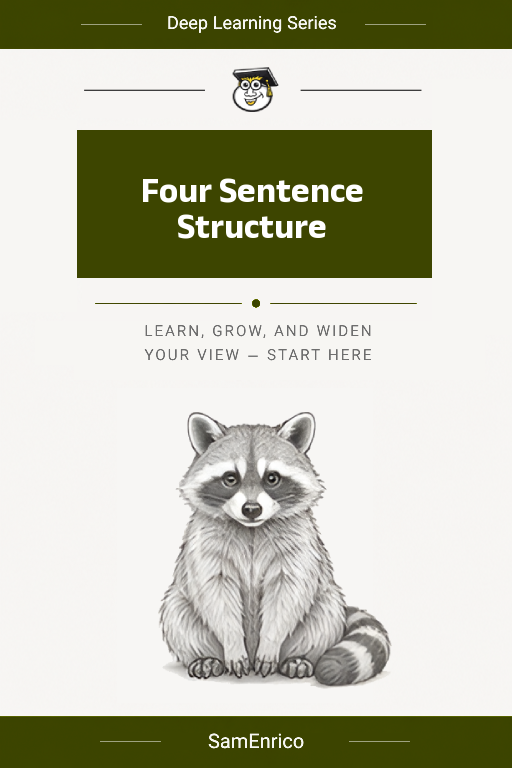
Non-FictionProfessional's Cheat SheetExecutive CommunicationConcise Writing
Four Sentence Structure eBook
Write the problem, solution, market, and ask in ex
Write the problem, solution, market, and ask in exactly four sentences to hook executives.
Formats
Free sample
Chapter 1: The Fog of More--–- Most professionals believe that adding sentences clarifies their thinking. They are exactly wrong.The hardest lesson in business writing is this: every sentence you add beyond the essential ones does not clarify—it obscures. Yet week after week, millions of executives, managers, and individual contributors open their email clients and commit the same error. They take a moderately unclear first draft and respond not by cutting, but by expanding. They add context.
They add caveats. They add “just to be thorough” explanations. And when they finish, the reader is more confused than when they started. This is the Fog of More: the counterintuitive reality that in decision-oriented communication, volume is the enemy of clarity.Consider a typical scene in any Fortune 500 company. A director named Sarah receives a project update from her manager, David.
David has spent forty-five minutes crafting an email. He wants to be thorough. He includes background on the project’s origins, a paragraph about a vendor delay, three bullet points of data, a hedging sentence about “potential headwinds,” a compliment to the team, and finally—buried in the last line—a request for approval. Sarah reads the email twice. She cannot find the request.
She replies, “Can you clarify what you need from me?” David feels frustrated. He was clear. He wrote seven sentences. But here is the truth that no one tells David: the seventh sentence destroyed the first six.This chapter diagnoses the most common writing mistake in business: the belief that more words mean more clarity. Drawing on the foundational work of Strunk & White’s The Elements of Style (“Omit needless words”) and William Zinsser’s On Writing Well (“The secret to good writing is to strip every sentence to its cleanest components”), we will examine three specific mechanisms of fog: redundancy, hedging, and tangential context.
We will prove—through real examples and cognitive research—that a four-sentence version of almost any business communication is not only clearer than a fourteen-sentence version but also more persuasive, more trustworthy, and more likely to produce action. And we will begin the process of retraining your brain to see every extra sentence not as thoroughness, but as noise.By the end of this chapter, you will understand why smart, well-intentioned professionals write poorly. More importantly, you will have a diagnostic tool to catch fog before you send it.The Paradox of Professional Writing Here is the paradox that drives the Fog of More: in school, length was rewarded. The five-paragraph essay. The ten-page term paper.
The twenty-page thesis. Teachers and professors operated on an implicit contract: more words showed more effort, more research, more thinking. A three-page paper on the Civil War could not possibly be as good as a fifteen-page paper. Length signaled seriousness.Business inverts this contract entirely.In business, every additional sentence is scrutinized not for its insight but for its necessity. Executives read under time pressure.
They are interrupted every six to eight minutes. They process information in short bursts, and their primary cognitive filter is not “Is this interesting?” but “Can I act on this?” The professional who writes a fourteen-sentence email is not being thorough—they are being unkind to the reader. They are forcing the reader to do the work of extraction, which should have been done by the writer.Consider two versions of the same project update:Version A (14 sentences):“I hope you’re doing well. I wanted to give you an update on the Q3 launch. As you may recall, we originally planned to launch on September 15.
However, we’ve been working with our vendor in Taiwan. They informed us last week that they are experiencing some delays. The delay is due to a shortage of semiconductor chips. This is a global issue right now. Many companies are facing similar challenges.
We have been exploring alternative suppliers. We found one in Vietnam. They can deliver by October 1. The cost would be about 12% higher. I think we should consider delaying the launch.
Let me know your thoughts.”Version B (4 sentences):“We should delay the Q3 launch from September 15 to October 1. Our Taiwan vendor faces a semiconductor shortage—a global issue we cannot solve. A Vietnamese supplier can meet October 1 but at a 12% cost increase. Please approve the delay and the cost increase by Friday.”Which version is clearer? Which version respects the reader’s time?
Which version is more likely to produce a decision? Version B, by every measure. And yet most professionals—especially those who were good students—instinctively write Version A. They have been trained to believe that the preamble, the hedging, and the tangential context are signs of rigor. They are not.
They are fog.The Three Mechanisms of Fog Fog does not appear by accident. It is produced by three specific writing behaviors, each of which feels productive in the moment and each of which destroys clarity in aggregate.Mechanism 1: Redundancy Redundancy is saying the same thing twice in different words. It is the most common form of fog, and it is almost invisible to the writer because each repetition feels like emphasis.Examples of redundancy in business writing:“We need to increase revenue and grow sales.” (Increasing revenue is growing sales.)“The project is behind schedule and not on time.” (Behind schedule means not on time.)“I think we should consider possibly delaying.” (Think, consider, and possibly all hedge the same action.)“The vendor failed to deliver on their commitment as promised.” (A commitment is a promise.)Redundancy often appears in pairs: two adjectives where one would do (“a difficult and challenging situation”), two verbs where one would do (“analyze and review the data”), two nouns where one would do (“we need a solution and a resolution”).Why do professionals write redundantly? Two reasons. First, they are following a spoken language pattern—in conversation, repetition adds emphasis.
But written business communication is not conversation. Second, they are anxious about being misunderstood, so they add a second phrase “just to be sure.” The irony is that redundancy creates ambiguity. The reader must now ask: do these two phrases mean the same thing? Or am I missing a distinction? The safest assumption is that the writer is imprecise.The fix for redundancy is ruthless: when you see two words or phrases that seem to say the same thing, delete one.
If you are unsure whether they are identical, assume they are and delete the second one. If the meaning changes, you will catch it in editing. If it does not, you have removed fog.Mechanism 2: Hedging Hedging is the addition of qualifiers that weaken claims until almost nothing is asserted. Common hedges include: “sort of,” “kind of,” “maybe,” “perhaps,” “possibly,” “I think,” “I believe,” “it seems that,” “one might argue that,” “to a certain extent,” “in some ways.”A hedge is not always wrong. In scientific writing, hedging reflects uncertainty in the data.
In legal writing, hedging creates defensible positions. But in business decision-making, hedging is cowardice disguised as humility.Consider two statements to an executive:Hedged: “I think we might want to consider possibly delaying the launch if the vendor’s issues continue.”Unhedged: “We should delay the launch.”The first statement gives…
This is the end of the free sample. Get the eBook to keep going. Buy now
About this book
Details
- Author
- Gilbert Rachel
- Publisher
- SamEnrico
- Language
- English
- Genre
- Non-Fiction, Professional's Cheat Sheet, Executive Communication, Concise Writing
- Released
- 2026-05-30
- Pages (approx.)
- 153
- Available as
- eBook, Audiobook

Read better in the ZLOADR app
Your eBooks on your phone or tablet. Sign in with your SamEnrico account and start reading.
More by Gilbert Rachel
 Tennis Elbow Prevention GuideGilbert Rachel$11.99
 Metta For Environmental GriefGilbert Rachel$11.99
 Blocked Mergers CasebookGilbert Rachel$11.99
 The Stress Physiology WorkbookGilbert Rachel$11.99
 The Anger LogGilbert Rachel$11.99
 Indigo Planters AbusesGilbert Rachel$11.99
 Anxious Parent Child ImpactGilbert Rachel$11.99
 Reactive Devaluation GuideGilbert Rachel$11.99
 The Last Flight of the Iron PhoenixGilbert Rachel$11.99
 The Angels of Bastogne: Surgeons Under Fire in the ArdennesGilbert Rachel$11.99
 The Bitcoin Bubble: When Digital Dreams Turned to GoldGilbert Rachel$11.99
 Growing LophomyrtusGilbert Rachel$11.99
You may also like
 Hong Kong Handover 1997Dunn Johnnie$11.99
 Zumba For Postnatal Recovery CourseNeal Christian$11.99
 Zumba for BeginnersLadner Nikia$11.99
 YouTube Comment Mining GuideHumes Pandora$12.99
 Worry Box MeditationCarlin Rudy$11.99
 Workplace Stress MeditationNguyen Lynn$11.99
 Workplace Stress and Sleep RepairHawley Ivory$11.99
 Workplace Perfectionism CureDelaney Jeffry$11.99
 Workplace Injustice Anger GuideWallen Isabelle$11.99
 Work Addiction and Burnout LinkGreenwood Ester$11.99
 Women in Yoga and WellnessBeattie Galina$11.99
 Women in Stand Up ComedyChun Evangeline$11.99