
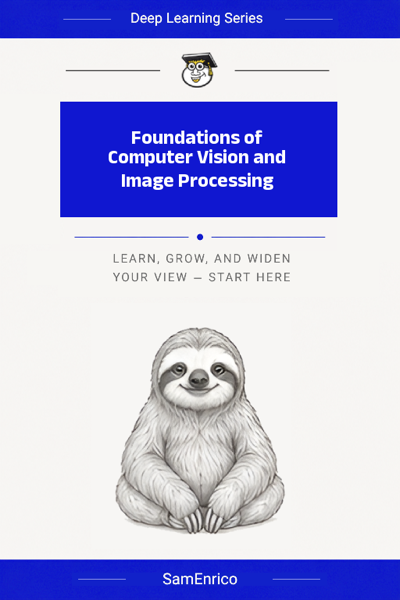
Non-FictionInformativeEducational
Foundations of Computer Vision and Image Processing
A Coursebook on Foundations of Computer Vision and
A Coursebook on Foundations of Computer Vision and Image Processing
Formats
About this book
Free sample
Chapter 1: The Pixel Compass...--You are about to teach a machine how to see. This is not a metaphor — you will literally write code that transforms raw numbers into meaningful descriptions of the world: “a dog,” “a face,” “a car moving left,” “a tumor.” But before a computer can recognize anything, it must first understand what an image actually is. Most people think of an image as a picture — something they look at. A computer has no eyes. To a computer, an image is simply a rectangular grid of numbers. That is the first and most important truth of computer vision: perception begins with measurement, not meaning.This chapter builds your internal compass for navigating every subsequent chapter. You will learn how light becomes pixels, how pixels become histograms, how colors are encoded, and how all of these pieces fit into a coherent pipeline. By the end, you will load your first image, inspect its numerical structure, convert between color spaces, and understand why the order of operations matters. Let us begin.1.1 The Fundamental Difference: Human Vision vs. Computer Vision Human vision is a miracle of biological engineering. Your eyes have approximately 120 million rod cells (for low-light intensity) and 6 million cone cells (for color). Your brain dedicates nearly half of its cortex to visual processing. You recognize a face in 100 milliseconds, handle variations in lighting, pose, and expression effortlessly, and you never need to be “trained” on a million labeled images of chairs to know what a chair looks like.Computer vision is none of these things. A camera sensor records numbers — nothing more. There is no innate understanding of objects, no common sense, no ability to infer what is hidden behind an occlusion unless explicitly programmed. The gap between human perception and machine measurement is the entire reason computer vision is difficult.Consider this: when you look at a photograph of a forest, you see trees, leaves, shadows, and perhaps a hidden bird. A computer sees an array of integers: [120,125,130],[118,122,128],…[120, 125, 130], [118, 122, 128], \ldots[120,125,130],[118,122,128],…. That is all. Every sophisticated algorithm you will learn…
This is the end of the free sample. Get the eBook to keep going. Buy now
Contents
- Chapter 1
- Chapter 2
- Chapter 3
- Chapter 4
- Chapter 5
- Chapter 6
- Chapter 7
- Chapter 8
- Chapter 9
- Chapter 10
- Chapter 11
- Chapter 12
Details
- Author
- Marshall Renee
- Publisher
- SamEnrico
- Language
- English
- Genre
- Non-Fiction, Informative, Educational
- Released
- 2026-05-04
- Pages (approx.)
- 155
- Available as
- eBook, Audiobook

Read better in the ZLOADR app
Your eBooks on your phone or tablet. Sign in with your SamEnrico account and start reading.
More by Marshall Renee
 Forehead Wrinkles and EmotionMarshall Renee$11.99
 The Financial Self Care PlanMarshall Renee$11.99
 Metta for Flying FearMarshall Renee$11.99
 The Self Talk ResetMarshall Renee$11.99
 The Nobel Peace Science LinkMarshall Renee$11.99
 Mindfulness Of Emotions PracticeMarshall Renee$11.99
 Anapanasati for SwimmingMarshall Renee$11.99
 Michael Burry ScionMarshall Renee$11.99
 The Baltic Phoenix: Lübeck and the Rise of the Hanseatic LeagueMarshall Renee$11.99
 The Vanishing Diamond: The Heist That Shocked MonacoMarshall Renee$11.99
 Growing CommidendrumMarshall Renee$11.99
 Pet Influencer Comparison TrapMarshall Renee$12.99
You may also like
 Hong Kong Handover 1997Dunn Johnnie$11.99
 Zumba For Postnatal Recovery CourseNeal Christian$11.99
 Zumba for BeginnersLadner Nikia$11.99
 YouTube Comment Mining GuideHumes Pandora$12.99
 Worry Box MeditationCarlin Rudy$11.99
 Workplace Stress MeditationNguyen Lynn$11.99
 Workplace Stress and Sleep RepairHawley Ivory$11.99
 Workplace Perfectionism CureDelaney Jeffry$11.99
 Workplace Injustice Anger GuideWallen Isabelle$11.99
 Work Addiction and Burnout LinkGreenwood Ester$11.99
 Women in Yoga and WellnessBeattie Galina$11.99
 Women in Stand Up ComedyChun Evangeline$11.99