
Non-FictionBiographyMental Health
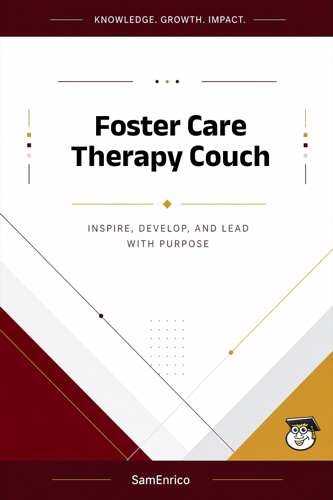
Foster Care Therapy Couch eBook
Details weekly mandated counseling sessions and th
Details weekly mandated counseling sessions and the struggle to open up to strangers.
Formats
Free sample
Chapter 1: Why Bother With This Stranger...--–- The first time a therapist asked me “How does that make you feel?” I was eleven years old, sitting on a couch that smelled like lavender air freshener and someone else’s anxiety. I didn’t answer. Not because I was being difficult—though that’s what the report said—but because the question made no sense in my world. How did it make me feel? It made me feel like you had no right to ask.
It made me feel like you were collecting something from me that I would never get back. It made me feel like a specimen under a microscope, and the person holding the microscope was getting paid by the same government that had pulled me out of my mother’s house at three in the morning.This chapter is not a warm invitation to hold hands with a therapist and sing about healing. If you are looking for that, close the book now and give it to someone who believes in magic. This chapter is a cold, honest look at the power dynamic you are trapped in, why every instinct in your body is screaming at you to stay silent, and why—despite all of that—there might be one or two reasons to crack the door open just enough to peek through. Not trust.
Not love. Not vulnerability porn for a professional who will write down your tears and file them in a cabinet. Just a crack.Let’s start with the truth that no one tells you in the group home, in the case worker’s office, or in the court-appointed therapist’s waiting room: You are not crazy for hating this. Your resistance is not a symptom of your “disorder.” Your refusal to open up is not proof that you have “attachment issues.” Your silence is not a problem to be fixed. It is a strategy.
And strategies keep people alive.The Waiting Room as a Cage Think about where you are right now. Not literally—I don’t know if you are reading this on a cracked phone screen in a group home, on a bunk bed in a treatment center, or hiding in a bathroom to get five minutes away from a foster sibling who won’t stop touching your stuff. Think about the room you were in the last time you had to go to therapy. The waiting room. The chairs that are somehow both sticky and cold.
The magazines from three years ago. The receptionist who calls you by the wrong name even though you have been coming here for six months. The clipboard with the same fourteen questions about your mood on a scale of one to ten. (One: I am fine. Ten: I am lying because I don’t want to be here.)That waiting room is not neutral.
It is the antechamber of a system. And the system owns you in ways that no one will admit out loud. You are not a paying customer. You are not a volunteer. You are a mandated participant in a process that you did not choose, whose rules you do not fully understand, whose consequences you cannot escape.
The therapist holds a license. You hold a court order. Those are not the same thing.This is the first thing you need to understand before we go any further: The power imbalance in that room is real, and pretending it doesn’t exist is a lie that bad therapists tell themselves so they can sleep at night.A good therapist—and yes, they exist, though I know that might be hard to believe right now—will acknowledge the power imbalance out loud. They will say something like, “I know you didn’t choose to be here. I know I have access to information about you that you don’t have about me.
I know I write reports that can affect your life. That’s not fair, and I’m not going to pretend it is.” A therapist who says that is at least honest. A therapist who pretends you are equals is either naive or manipulative.But whether your therapist is good, bad, or somewhere in between, the imbalance remains. And until you understand exactly what that imbalance looks like—the legal limits, the reporting requirements, the file that follows you, the judge who reads the notes—you are flying blind. You are trying to navigate a maze when no one has shown you the map.So let me be the one to show you the map.
Not because I want you to trust your therapist. Not because I think therapy is the answer to all your problems. But because knowledge is the only weapon you have in that room that they cannot take away from you.Who Is This Person, Anyway?Here is a pop quiz. Do not write down your answers. Just notice how many of these you have secretly wondered.Is my therapist going to report this to my case worker?If I tell the truth about how angry I am, will they put me on more medication?Does my therapist talk to my foster parents behind my back?Has my therapist already decided what is wrong with me before I even open my mouth?If I cry, will they write it down and use it against me in court?What happens if I say I don’t want to visit my biological parent anymore?What happens if I say I do want to visit them, and the therapist thinks that’s a bad idea?Is there anything I can say that will stay in this room and never leave?These are not paranoid questions.
These are strategic questions. Every foster youth I have ever met—and I have met more than I can count—has asked versions of these questions in the dark, alone, trying to figure out how much to say and how much to hide. The fact that you are asking them means you are smarter than the adults who tell you to “just be honest.” Honesty without understanding the consequences is not bravery. It is a gamble. And you have already lost too many gambles in your life.Let me give you the answers.
Not the answers that therapists give you in the first session when they are trying to build rapport and make you feel safe. The real answers. The ones that come from reading the laws, the ethics codes, and the court procedures that most therapists hope you never bother to look up.First: Your therapist is a mandated reporter. That is a legal term that means they are required by law to report certain things to child protective services or law enforcement, even if you beg them not to. What things?
Generally: current abuse or neglect of a minor (including you or another child), intent to seriously harm yourself, intent to seriously harm someone else, and—in some states—abuse that happened in the past if a child is still at risk. The exact list varies by state, but the core is the same: if someone is in danger right now, they…
This is the end of the free sample. Get the eBook to keep going. Buy now
About this book
Details
- Author
- Renteria Anamaria
- Publisher
- SamEnrico
- Language
- English
- Genre
- Non-Fiction, Biography, Mental Health
- Released
- 2026-06-07
- Pages (approx.)
- 127
- Available as
- eBook, Audiobook

Read better in the ZLOADR app
Your eBooks on your phone or tablet. Sign in with your SamEnrico account and start reading.
More by Renteria Anamaria
 Born Standing Up MemoirRenteria Anamaria$11.99
 Cognitive Restructuring MDDRenteria Anamaria$11.99
 Failure Resilience for TeensRenteria Anamaria$11.99
 The Gender App Preference StudyRenteria Anamaria$11.99
 Arachne's Web: The Weaver Who Defied the GodsRenteria Anamaria$11.99
 Multiple Domain StrategyRenteria Anamaria$12.99
 Interim CTO GuideRenteria Anamaria$12.99
 The Breeder's Guide to Romeldale SheepRenteria Anamaria$11.99
 Park InterpreterRenteria Anamaria$11.99
 How to Become a Oven OperatorRenteria Anamaria$11.99
You may also like
 Hong Kong Handover 1997Dunn Johnnie$11.99
 Zumba For Postnatal Recovery CourseNeal Christian$11.99
 Zumba for BeginnersLadner Nikia$11.99
 YouTube Comment Mining GuideHumes Pandora$12.99
 Worry Box MeditationCarlin Rudy$11.99
 Workplace Stress MeditationNguyen Lynn$11.99
 Workplace Stress and Sleep RepairHawley Ivory$11.99
 Workplace Perfectionism CureDelaney Jeffry$11.99
 Workplace Injustice Anger GuideWallen Isabelle$11.99
 Work Addiction and Burnout LinkGreenwood Ester$11.99
 Women in Yoga and WellnessBeattie Galina$11.99
 Women in Stand Up ComedyChun Evangeline$11.99