
Non-FictionBiographySeasonal Trauma
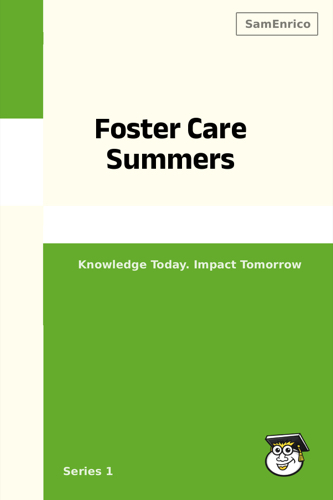
Foster Care Summers eBook
Move to respite care every summer while regular fo
Move to respite care every summer while regular foster families vacation.
Formats
Free sample
Chapter 1: The Trash Bag Test...–- Maya is seven years old, and she knows how to pack a trash bag before she knows how to tie her shoes.Not the thin, black lawn bags that tear if you look at them wrong. Not the white kitchen bags with the red drawstrings that snap when you pull too hard. The good ones—the heavy-duty black bags with the orange twist ties, the kind her foster mother keeps under the kitchen sink next to the bleach. Maya has become something of a connoisseur. She can tell by the crinkle whether a bag will survive the drive to a new house or split open in the backseat, spilling her life onto someone else's floor mats.She is sitting on the bedroom floor of the Thompson family's split-level home in suburban Ohio.
It is May 28th. The calendar on the kitchen wall has a cruise ship circled in red marker, and underneath it, in Mrs. Thompson's neat handwriting: "FAMILY VACATION—JUNE 12–26." Maya's name is not written anywhere on that calendar. It never is.The bedroom is beige. Everything in the Thompson house is beige, except for the biological children's rooms, which are painted soft lavender and pale blue.
Maya's room is the guest room, though no one calls it that. They call it "Maya's room" with the kind of gentle emphasis that sounds like a lie. She has been here for nine months—her third placement since being removed from her biological mother's apartment at age five. The first placement lasted six weeks. The second lasted four months.
The Thompsons are supposed to be different. They attended the training. They read the pamphlets. They said the right things during the home study: "We have so much love to give."Maya is not thinking about any of this as she stares at the open trash bag on the carpet. She is thinking about her stuffed rabbit, Barnaby.Barnaby is missing one eye.
The left one popped off last year when Maya hid him inside her pillowcase during a supervised visit with her biological mother, Tonya. Tonya had been crying, and Maya had squeezed Barnaby so hard that the plastic eye shot across the Mc Donald's playplace and landed in a pile of ketchup packets. A social worker fished it out. Maya still has the eye in her pocket. She has been meaning to ask Mrs.
Thompson to sew it back on, but she never knows when it is the right time to ask for things. In foster care, asking for things is dangerous. It gives people permission to say no.Barnaby is currently under Maya's pillow, where she left him three days ago when she first saw the packing list on the kitchen counter. The packing list is a test. Maya has learned that everything in foster care is a test, though no one ever tells her the answers.
The packing list says: "Maya's Summer Things—Please pack for 14 days. Label everything." The list is printed on a sticky note, not the nice stationery Mrs. Thompson uses for grocery lists. Maya noticed this. She notices everything.She has not told anyone about Barnaby.
She wants to see if the Thompsons will find him. If they find him, if they wash him, if they put him on her bed where he belongs—that will mean they love her. If they throw him away, if they pack him in a box for the attic, if they forget he exists—that will mean what she already suspects: that she is a temporary guest in a house that has already decided she is not staying.This is the first wound of the foster care summer. It opens not when the car pulls away from the curb, but when the packing list appears. When the trash bag comes out from under the sink.
When the child realizes that the family she has been learning to trust is already planning their escape from her.The 30-Day Window (And Why Respite Breaks It)Here is what the research says, though no one explains this to seven-year-olds: foster children typically take three to four weeks to feel even minimally safe in a new home. Social workers call this "the settling period." The child stops scanning every room for exits. They learn where the snacks are kept. They figure out which adults flinch at loud noises and which ones will hold them when they cry.Maya arrived at the Thompsons on May 1st. By May 28th, she had finally started to settle.
She had learned that Mrs. Thompson's coffee mug is the blue one with the chip on the handle, and that Mr. Thompson sneezes three times in a row before breakfast. She had stopped flinching when the dishwasher rattled. She had, for the first time in nine months, gone three full nights without wetting the bed.And then the packing list appeared.This is the cruel mathematics of respite care.
The child finally begins to feel safe—not fully safe, not the way a biological child feels safe, but safe enough—and the system responds by sending them away. The 30-day window closes in late May, just as summer begins. Just as the foster family books their Disney cruise. Just as the child realizes that their presence is not a permanent addition to the family calendar but a temporary inconvenience that must be scheduled around.But here is what the research does not capture: respite creates a different timeline entirely. In long-term placement, safety builds slowly, like a bruise healing from the outside in.
In respite, the child often experiences a compressed sense of safety—faster, shallower, more fragile. They may feel comfortable within 48 hours, but that comfort is not trust. It is situational relief. It is the absence of threat, not the presence of belonging.Maya does not know any of these words. She knows only that her stomach hurts when she sees the trash bag.
She knows that Mrs. Thompson has been using a different voice lately—softer, more careful, the voice adults use when they are about to deliver bad news wrapped in good language. "We're going on a trip," Mrs. Thompson said at dinner. "And YOU get to go on YOUR OWN vacation!"Maya did not ask where her vacation would be.
She has learned not to ask. Asking implies that her opinion matters. Her opinion does not matter. She knows this because no one has ever asked her whether she wants to spend two weeks with strangers. They tell her.
They pack for her. They drop her off. They pick her up. They call it a vacation.She calls it survival.The Indestructible Bag (Or, What Your Luggage Says About Your Worth)The trash bag is not Maya's first. Her first placement—the six-week one, when she was five—used white kitchen bags.
Those tore on the second day. Maya remembers walking into a stranger's house with her underwear visible through a hole in the plastic, and the foster mother looking at her with something that was not quite pity and not quite disgust. Somewhere in between. The look. Every foster child knows the look.
It says: You are not a child. You are a problem to be managed.Her second placement used a duffel bag…
This is the end of the free sample. Get the eBook to keep going. Buy now
About this book
Details
- Author
- Barajas Tiffiny
- Publisher
- SamEnrico
- Language
- English
- Genre
- Non-Fiction, Biography, Seasonal Trauma
- Released
- 2026-06-09
- Pages (approx.)
- 160
- Available as
- eBook, Audiobook

Read better in the ZLOADR app
Your eBooks on your phone or tablet. Sign in with your SamEnrico account and start reading.
More by Barajas Tiffiny
 Painted Walls VOC ReductionBarajas Tiffiny$11.99
 Major Depressive Disorder Treatment Options ManualBarajas Tiffiny$11.99
 School Teacher Impact StoryBarajas Tiffiny$11.99
 Remote Work Time Tracking GuideBarajas Tiffiny$11.99
 Success Without Burnout for SalesBarajas Tiffiny$11.99
 Assertive Text MessagingBarajas Tiffiny$11.99
 Atlantic Crossing Death TollBarajas Tiffiny$11.99
 The Infanticide Laws: How Child Murder Cases Shaped 19th-Century JusticeBarajas Tiffiny$11.99
 Charlemagne's Crown: The Renaissance That Rebuilt the WestBarajas Tiffiny$11.99
 Service Providers Guide to Nature HikesBarajas Tiffiny$11.99
 How to Produce a List of Blu-ray Player ManufacturersBarajas Tiffiny$11.99
 Entry Level Supply Chain BlueprintBarajas Tiffiny$12.99
You may also like
 Hong Kong Handover 1997Dunn Johnnie$11.99
 Zumba For Postnatal Recovery CourseNeal Christian$11.99
 Zumba for BeginnersLadner Nikia$11.99
 YouTube Comment Mining GuideHumes Pandora$12.99
 Worry Box MeditationCarlin Rudy$11.99
 Workplace Stress MeditationNguyen Lynn$11.99
 Workplace Stress and Sleep RepairHawley Ivory$11.99
 Workplace Perfectionism CureDelaney Jeffry$11.99
 Workplace Injustice Anger GuideWallen Isabelle$11.99
 Work Addiction and Burnout LinkGreenwood Ester$11.99
 Women in Yoga and WellnessBeattie Galina$11.99
 Women in Stand Up ComedyChun Evangeline$11.99