
Non-FictionSelf-HelpJournaling
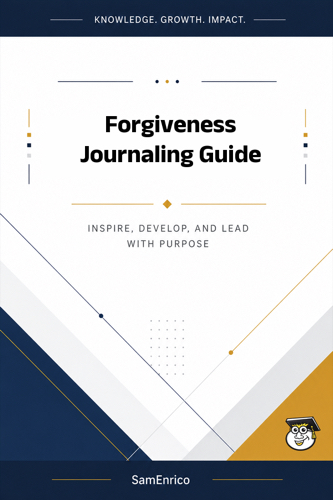
Forgiveness Journaling Guide eBook
Uses structured prompts to work through forgivenes
Uses structured prompts to work through forgiveness.
Formats
Free sample
Chapter 1: The Unpaid Ledger--–- Every grudge is a loan you never agreed to make, with interest compounding daily while the borrower walks free. This is the truth that forgiveness books rarely state outright: your resentment is not hurting them. It is not punishing them. It is not even reaching them. The only person paying interest on that emotional debt is you.
And yet, you have been told your whole life that holding onto anger is justified, that forgiveness is weakness, that letting go means letting them win. What if the opposite is true? What if holding on is the real trap, and forgiveness is simply the key to a door you did not even know you were locked behind?Welcome to The Forgiveness Journaling Guide. This is not a book about becoming a saint, turning the other cheek until you collapse, or pretending that what happened to you did not matter. This is a book about reclaiming your own nervous system, your own sleep, your own attention, and your own future from people who do not deserve to rent space in your head for free.
Over the next eleven chapters, you will move through a structured, research-backed, trauma-informed process that has helped thousands of readers transform chronic resentment into quiet freedom. But before you can release anything, you must understand what you are carrying. And before you can understand what you are carrying, you must dispense with every lie you have been told about what forgiveness actually is.Let us begin with the lie that keeps most people stuck for decades.The Myth of the Moral High Ground You have probably heard some version of this statement: "I have every right to be angry. They owe me an apology. I will forgive them when they deserve it." On the surface, this sounds reasonable.
After all, if someone wronged you, why should you be the one to do the emotional labor? Why should you extend grace to someone who has not even said they are sorry? This is the most seductive trap in all of forgiveness work. It feels righteous. It feels fair.
It feels like justice delayed rather than justice denied.But here is the problem that your nervous system does not care about fairness. Your body does not pause its stress response while you wait for an apology that may never come. Your sleep does not improve because you are morally correct. Your blood pressure does not lower because you are holding onto a justified grudge. The research on psychoneuroimmunology—the study of how your mind affects your body's defenses—is brutally clear: chronic unforgiveness elevates cortisol, weakens immune function, increases inflammation, and keeps your body in a low-grade fight-or-flight state for years.
You are not punishing the person who hurt you. You are slowly poisoning yourself while they go about their day, probably not thinking about you at all.This is the unpaid ledger. Every resentment is an IOU you have written to yourself, promising that someday, when they apologize, when they suffer, when they finally understand what they did, you will feel better. But they are not paying that debt. They may never pay it.
And while you wait, you are the one losing sleep, losing patience with your children, losing presence at work, losing the ability to enjoy a quiet evening without replaying arguments in your head. The borrower has defaulted. The only question is whether you will keep carrying the paper or tear it up for your own sake.The Four Boundaries That Will Save You Years of Confusion Before we go any further, we need to establish four firm boundaries around what forgiveness is not. These boundaries will protect you from the most common objections and fears that keep people stuck. You will see them applied throughout this book, but they are established here once, clearly, so you never have to wonder if this guide is asking you to do something harmful.First, forgiveness is not trust.
Trust is earned through consistent behavior over time. You can forgive someone completely and still not trust them with your money, your children, or your heart. Trust requires evidence of change. Forgiveness requires only a decision. These are separate tracks, and confusing them is one of the main reasons people refuse to forgive.
They think, "If I forgive them, I have to let them back in." No. You do not. Trust is a bridge they must rebuild. Forgiveness is you deciding to stop standing guard at the burned remains.Second, forgiveness is not reconciliation. Reconciliation takes two willing people who both want to repair the relationship.
Forgiveness takes only you. You can forgive a dead parent, an ex-spouse who has moved to another country, or a former friend who has shown zero remorse. Reconciliation requires mutuality. Forgiveness requires only your own choice. This means you are never trapped waiting for someone else to change.
The power is entirely in your hands.Third, forgiveness is not forgetting. Your brain does not work that way. Trauma and betrayal leave neural traces that cannot be erased by an act of will. Anyone who tells you to "forgive and forget" is selling you spiritual bypass dressed up as wisdom. Forgiveness changes your relationship to the memory, not the memory itself.
You will still remember what happened. But instead of the memory triggering a full-body stress response, it becomes a neutral data point in your personal history. You remember that it happened, but you no longer relive it.Fourth, forgiveness is not condoning. You can call an action wrong, evil, unfair, or unforgivable in the moral sense and still decide to release the emotional debt. Condoning means saying "what you did was fine." Forgiveness says "what you did was not fine, but I am done carrying the weight of it." These are opposites, not the same thing.
You do not have to minimize the offense to forgive it. In fact, the most powerful forgiveness often comes from people who fully acknowledge how deeply they were wronged and then choose to let go anyway.The Hidden Blocks That Have Been Protecting You If forgiveness is so beneficial, why do so many people resist it? The answer is not stubbornness or ignorance. It is usually fear. Your resistance to forgiveness has been protecting you in ways you may not have recognized.
Let us name those protections now, without judgment, because you cannot dismantle what you refuse to see.Some people resist forgiveness because they believe it makes them weak. They were raised in environments where vulnerability was punished, where holding a grudge was framed as strength, where letting go meant losing a fight. If this is you, recognize that your resistance is trying to keep you safe from being hurt again. The fear is not irrational. But the strategy is outdated.
Holding a grudge does not prevent future harm; it only exhausts your present self. True strength is not the ability to hold onto anger indefinitely. True strength is the ability to choose where to invest your limited emotional energy.Other people resist forgiveness because they fear that letting go means the offender "wins." This is a zero-sum mindset: if you release your anger…
This is the end of the free sample. Get the eBook to keep going. Buy now
About this book
Details
- Author
- Emery Lizzette
- Publisher
- SamEnrico
- Language
- English
- Genre
- Non-Fiction, Self-Help, Journaling
- Released
- 2026-06-07
- Pages (approx.)
- 124
- Available as
- eBook, Audiobook

Read better in the ZLOADR app
Your eBooks on your phone or tablet. Sign in with your SamEnrico account and start reading.
More by Emery Lizzette
 Gut Brain Axis and PolyphenolsEmery Lizzette$11.99
 The Networking Scorecard for SolopreneursEmery Lizzette$11.99
 Mindful Technology Use MBSREmery Lizzette$11.99
 The Lost City of the Dogon: Guardians of the Sirius StarEmery Lizzette$11.99
 US LLC Bank Account SetupEmery Lizzette$12.99
 How to Start a Bomb Fuse Business (Beginners Guide)Emery Lizzette$11.99
 How to Produce Bath CaddiesEmery Lizzette$11.99
 FX ArtistEmery Lizzette$11.99
You may also like
 Hong Kong Handover 1997Dunn Johnnie$11.99
 Zumba For Postnatal Recovery CourseNeal Christian$11.99
 Zumba for BeginnersLadner Nikia$11.99
 YouTube Comment Mining GuideHumes Pandora$12.99
 Worry Box MeditationCarlin Rudy$11.99
 Workplace Stress MeditationNguyen Lynn$11.99
 Workplace Stress and Sleep RepairHawley Ivory$11.99
 Workplace Perfectionism CureDelaney Jeffry$11.99
 Workplace Injustice Anger GuideWallen Isabelle$11.99
 Work Addiction and Burnout LinkGreenwood Ester$11.99
 Women in Yoga and WellnessBeattie Galina$11.99
 Women in Stand Up ComedyChun Evangeline$11.99