
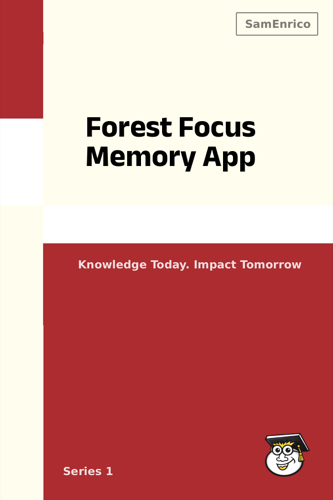
Forest Focus Memory App eBook
Stay on task and build focus trees with this gamif
Stay on task and build focus trees with this gamified productivity guide.
Formats
Free sample
Chapter 1: The Wilted Seed--–- You sit down at your desk. The coffee is hot. The morning light is soft. You have three hours before your first meeting. This is the perfect moment to make progress on that project—the one that has been hovering over your shoulders for weeks, the one that could change your career trajectory, the one that requires your deepest thinking.You open your laptop.And then, without conscious decision, your fingers type "I" into the browser.
The autocomplete suggests Instagram. You press enter. Thirty seconds later, you are watching a stranger's dog dance to a song you don't recognize. Two minutes later, you check the news. Three minutes later, you refresh email—nothing new.
Five minutes have passed. Then ten. Then twenty.The coffee is now lukewarm. The soft morning light has shifted into harsh midday glare. Your three-hour window has shrunk to ninety minutes.
The project remains untouched. And you feel a familiar sensation: not quite guilt, not quite failure, but something in between. A low-grade nausea of lost time.You close Instagram. You open your document. You stare at the blinking cursor.And then your phone buzzes.You pick it up.This is not a story about laziness.
This is not a story about weak willpower. This is a story about a war you did not sign up for, fought on a battlefield you did not choose, against an enemy that employs thousands of engineers whose sole job is to keep your eyes on a screen.Welcome to the attention economy. And welcome to the first step out of it.The Crisis You Didn't Know You Were Losing Let me tell you a number that will ruin your day: the average smartphone user touches their phone 2,617 times per day. That is not a typo. According to research from Dscout, the median user interacts with their phone every four to five minutes of waking life.
For heavy users, that number climbs to over 5,000 touches—roughly one touch every two minutes.Now let me tell you a number that should terrify you: the average knowledge worker switches tasks every three minutes and five seconds. According to a study by Gloria Mark at the University of California, Irvine, once interrupted, it takes an average of twenty-three minutes to return to the original task with the same depth of focus.Do the math. If you switch tasks every three minutes and need twenty-three minutes to recover each time, you never recover. You are permanently shallow. You are drinking from a fire hose of notifications, email threads, Slack pings, and breaking news alerts, and you have convinced yourself that this is simply what modern work feels like.It is not.
It is what modern distraction feels like.I know because I lived it. Before I became the person writing this book, I was the person scrolling Instagram at 9:47 AM when I should have been writing a proposal that would determine whether my company received a million-dollar contract. I was the person who told myself "just one quick check" twenty times per day. I was the person who ended each week wondering where the time had gone, why I felt exhausted despite producing so little, and why everyone else seemed to be thriving while I was barely treading water.The answer was not that I lacked discipline. The answer was that I was playing a rigged game.The Architecture of Addiction To understand why you cannot focus, you must first understand that your inability to focus is not an accident.
It is by design.In the early 2000s, a small group of engineers at Stanford, MIT, and various startups began experimenting with a psychological mechanism called the dopamine loop. Here is how it works: you perform an action, you receive an unpredictable reward, and your brain releases a small amount of dopamine—not because you are happy, but because you are anticipating the possibility of reward. This is the same mechanism that makes slot machines addictive. It is the same mechanism that makes checking your phone feel irresistible.The engineers who built the first social media platforms did not invent the dopamine loop. They simply weaponized it.Every time you open Instagram, you do not know what you will see.
It might be a photo of your best friend's new baby. It might be an advertisement for a product you mentioned aloud three days ago. It might be nothing at all. The unpredictability is the point. Your brain releases dopamine in anticipation, you scroll, and the cycle repeats.
You are not using the app. The app is using you.Now consider the scale of this operation. The average person spends two hours and twenty-four minutes per day on social media. Over a lifetime, that adds up to nearly six years. Six years of scrolling.
Six years of watching other people's highlight reels while your own real life passes by in a blur of notifications.Tristan Harris, a former Google design ethicist and one of the most important voices in the movement toward ethical technology, puts it this way: "Never before in history have a handful of people at a handful of technology companies shaped how a billion people spend their attention." These companies are not evil. They are simply optimized for a goal that is fundamentally opposed to your well-being: maximizing time on screen.Every notification is a tiny tug on your sleeve. Every red badge is a small anxiety. Every "like" is a micro-dose of social validation. These are not bugs.
These are features. They are the product. And you are not the customer. You are the inventory.The Myth of Willpower Given this landscape, the traditional response has been to blame yourself. "I just need more discipline," you tell yourself.
"I should put my phone away. I should close my browser tabs. I should just focus."This is like telling someone drowning in a rip current to just swim harder.The research on willpower is clear: it is a finite resource that depletes with use. In the famous "radish and cookie" study conducted by Roy Baumeister and his colleagues at Case Western Reserve University, participants were asked to resist eating fresh-baked cookies while sitting next to a bowl of radishes. Later, they gave up on difficult puzzles much faster than participants who had been allowed to eat the cookies.
The act of resisting the cookies drained their willpower, leaving nothing left for the puzzles.Every time you resist the urge to check your phone, you are spending willpower. Every time you close a tab and return to work, you are spending willpower. By 2:00 PM, you are running on fumes. By 4:00 PM, you are lost. By Friday, you are a zombie.You do not need more willpower.
You need a system that does not require willpower. You need to change the game entirely.The Paradox of the Digital Cure This is where most productivity advice gets stuck. The standard prescription is to disconnect: turn off your phone, throw away your television, move to a cabin in the woods, and write with a fountain pen by candlelight. This advice is not wrong, exactly. It is just useless for the 99…
This is the end of the free sample. Get the eBook to keep going. Buy now
About this book
Details
- Author
- Neville Adrianne
- Publisher
- SamEnrico
- Language
- English
- Genre
- Non-Fiction, Self-Help, Focus Apps
- Released
- 2026-06-06
- Pages (approx.)
- 138
- Available as
- eBook, Audiobook

Read better in the ZLOADR app
Your eBooks on your phone or tablet. Sign in with your SamEnrico account and start reading.
More by Neville Adrianne
 Pomodoro For OutliningNeville Adrianne$11.99
 LGBTQ Mayor's MemoirNeville Adrianne$11.99
 Dad Burnout Recovery GuideNeville Adrianne$11.99
 Financial Stress and Sleep RepairNeville Adrianne$11.99
 Validating In Therapy PracticeNeville Adrianne$11.99
 Central Sleep Apnea GuideNeville Adrianne$11.99
 Sleep For Memory Consolidation GuideNeville Adrianne$11.99
 Akkermansia MuciniphilaNeville Adrianne$11.99
 Silk and Steel: The Rise and Fall of the Opium Wars' Forgotten TycoonNeville Adrianne$11.99
 The Silent Roar: The Larry Nassar Scandal and the Power of Survivor StoriesNeville Adrianne$11.99
 The Last Emperor's Secret: The Untold Story of Puyi's Escape to TaiwanNeville Adrianne$11.99
 The Mineral Guide to Gadolinite (Mineral Group)Neville Adrianne$11.99