
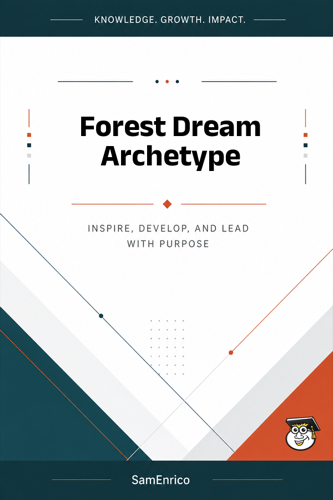
Non-FictionSelf-HelpForest Symbolism
Forest Dream Archetype eBook
Explores forest as unconscious, mystery, or wild n
by Nolan Elenor
Explores forest as unconscious, mystery, or wild nature.
Formats
Free sample
Chapter 1: The Green Threshold...–- Every human being, regardless of culture, age, or era, has dreamed of the forest. Not merely the pleasant woodland of a Sunday stroll, nor the manicured park of a city's edge, but the deep, trackless, twilight wood—the place where the path vanishes, where the trees lean in a little too close, where something watches from just beyond the range of sight. This chapter argues that such dreams are not random noise from a sleeping brain. They are, instead, a universal invitation across a threshold: from the small, familiar territory of the conscious self into the vast, living wilderness of the unconscious. The forest in your dream is not a backdrop.
It is a call.The Primal Geography of the Psyche Why the forest? Why not the desert, the ocean, or the mountain peak? The answer lies buried in our evolutionary and cultural bones. For most of human history, the forest was the boundary of the known world. Beyond the firelight of the camp, beyond the cleared field of the village, lay the wood—dark, rustling, and full of teeth.
Our ancestors carried in their bodies an atavistic fear of predators in the undergrowth, of losing the sun’s direction, of the cold and the hunger that waited in the shadowed hollows. That biological memory has not left us. It is the reason a sudden snap of a twig can still raise the hair on your neck, even in a suburban backyard.But fear is only half the story. The forest also called to something deeper: curiosity, longing, and the promise of mystery. In nearly every mythological system, the hero must eventually leave the village and enter the wood.
It is there that they meet the witch, the wolf, the hermit, or the god. It is there that they lose their name and find a new one. The forest is the place where the ordinary rules of society—manners, laws, schedules—no longer apply. In Shakespeare’s A Midsummer Night’s Dream, the young lovers flee the rigid court of Athens for the enchanted wood, where identities swap, lovers quarrel and reunite, and a donkey-headed man becomes a queen’s beloved. They return changed, not because the forest taught them a lesson, but because the forest dissolved them and let them reform.This dual nature—terrifying and magnetic, dangerous and healing—is the signature of the archetype.
The forest is not one thing. It is a living symbol that contains its own opposite.The Three Levels of the Forest Archetype Before we journey further, we must establish a framework that will guide every chapter of this book. In the dreams and stories we will explore, the forest operates on three interconnected levels. Understanding these levels will prevent the confusion that plagues so much dream literature, where a symbol is treated as either purely internal or purely external, when it is almost always both.First, the forest can be identical to the unconscious. This is the most direct, experiential level.
When you dream of standing in a dense, silent wood and feel the weight of years of unspoken grief pressing against your chest, you are not in a symbol of your grief. You are, for the duration of the dream, inside your own unconscious. The trees are not standing for something else. They are the structures of your psyche: the tall, upright pines of your defended beliefs; the tangled undergrowth of forgotten memories; the sudden clearing of unexpected peace. At this level, there is no separation between the dreamer and the dreamed.
You walk through yourself.Second, the forest can be a symbol of the unconscious. This is the level of art, myth, and reflection. When we read about Bilbo Baggins entering Mirkwood, we understand that the suffocating darkness and the giant spiders represent something about fear, disorientation, and the loss of the path. Tolkien is not claiming that Bilbo literally entered a psychological interior; he is using the forest as a symbol to communicate a psychological truth. This is the level of interpretation, where we step back from a dream and say, “The rotting log in my dream stands for the ancestral trauma I carry.” The symbol points beyond itself.Third, the forest can be a projection onto external nature.
This is the level of waking perception and ecology. When you walk through a real, physical forest and feel suddenly melancholic or strangely at peace, you are projecting inner states onto the outer world. The forest does not have feelings, but you cannot help but feel with it. This is not a mistake; it is a fundamental feature of the psyche. The environmental crisis of our age is, in part, a crisis of projection: we have projected our inner deadness onto the planet and are now horrified to see a dying world staring back.
Healing the outer forest requires healing the inner one, because the two are linked by the bridge of projection.Throughout this book, we will move fluidly among these three levels. The key is to know which level you are on at any given moment. A dream journal entry asks you to stay at the first level (direct experience). A literary analysis asks you to move to the second level (symbolic interpretation). A walk in the woods with a question about your life asks you to engage the third level (projection and reflection).
None is superior. All are necessary.The Five Modes of the Dream Forest Beyond these three levels, every forest dream also falls into one of five archetypal modes. Think of these modes as emotional and psychological weather patterns. The same forest—the same collection of trees and shadows—can feel radically different depending on the mode you are in. In fact, a single dream can shift from one mode to another as the dreamer’s relationship to the unconscious changes.
The dream that begins as a terrifying chase may, if the dreamer turns to face the pursuer, transform into a challenging initiation. The dark wood that feels like a trap may, with a shift of perception, become a sacred grove.Here, then, is the Unified Forest Typology that will organize every chapter to come.Mode One: The Shadow Forest. This is the forest of fear, pursuit, and paralysis. The dreamer is lost, running, or frozen. The trees press close.
The path vanishes. Something—often unseen, or only glimpsed—hunts. The emotional signature of the Shadow Forest is threat without relief. This mode corresponds to repressed trauma, unacknowledged desires, and the parts of the self that have been exiled to the margins. We will explore this mode in depth in Chapter 4.Mode Two: The Initiatory Forest.
This is the forest of challenge, testing, and transformation. The dreamer is not merely lost but on a journey. There are figures—the Witch, the Wolf, the Hermit, the Hunter—who speak, set tasks, offer bargains, or block the way. The emotional signature of the Initiatory Forest is challenging tension: fear mixed with purpose, discomfort mixed with curiosity. This mode corresponds to rites of passage, the hero’s journey, and the necessary ordeals of psychological growth.
We will explore this mode in Chapter 5.Mode Three: The Refuge Forest. This is the forest of healing, rest, and…
This is the end of the free sample. Get the eBook to keep going. Buy now
About this book
Details
- Author
- Nolan Elenor
- Publisher
- SamEnrico
- Language
- English
- Genre
- Non-Fiction, Self-Help, Forest Symbolism
- Released
- 2026-06-10
- Pages (approx.)
- 119
- Available as
- eBook, Audiobook

Read better in the ZLOADR app
Your eBooks on your phone or tablet. Sign in with your SamEnrico account and start reading.
More by Nolan Elenor
 Micro Movement BreaksNolan Elenor$11.99
 Traffic Frustration Relief GuideNolan Elenor$11.99
 Loving Kindness for a StillbirthNolan Elenor$11.99
 Depreciation for Real Estate InvestorsNolan Elenor$11.99
 Ojas Vitality GuideNolan Elenor$11.99
 The Business Constraints InnovationNolan Elenor$11.99
 Ilya YashinNolan Elenor$11.99
 Caregiver Grief ProcessingNolan Elenor$11.99
 Silk Roads and Silver Tongues: The Untold Journey of the First Chinese Diplomat in EuropeNolan Elenor$11.99
 The Billion-Dollar Bet: How a Gambler Built the World's Most Powerful Casino EmpireNolan Elenor$11.99
 Shadows Over the Pacific: The Untold Story of the 1960 U-2 Spy Plane IncidentNolan Elenor$11.99
 The Complete Guide to Fat: The Weight Loss SecretNolan Elenor$11.99
You may also like
 Hong Kong Handover 1997Dunn Johnnie$11.99
 Zumba For Postnatal Recovery CourseNeal Christian$11.99
 Zumba for BeginnersLadner Nikia$11.99
 YouTube Comment Mining GuideHumes Pandora$12.99
 Worry Box MeditationCarlin Rudy$11.99
 Workplace Stress MeditationNguyen Lynn$11.99
 Workplace Stress and Sleep RepairHawley Ivory$11.99
 Workplace Perfectionism CureDelaney Jeffry$11.99
 Workplace Injustice Anger GuideWallen Isabelle$11.99
 Work Addiction and Burnout LinkGreenwood Ester$11.99
 Women in Yoga and WellnessBeattie Galina$11.99
 Women in Stand Up ComedyChun Evangeline$11.99