
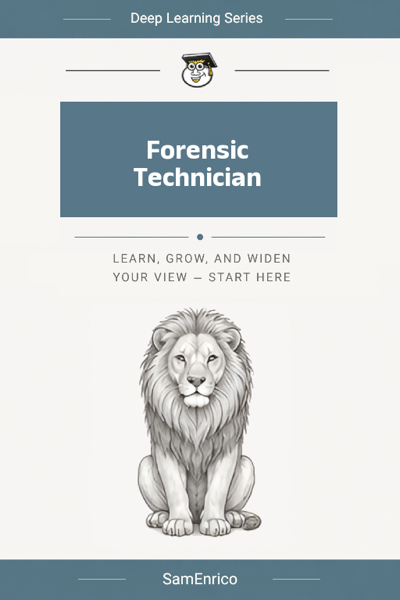
Non-FictionInformativeEducational
Forensic Technician eBook
A Coursebook on Forensic Technician
A Coursebook on Forensic Technician
Formats
Free sample
Chapter 1: The Invisible Gatekeeper--–- The call comes at 3:47 AM. You have been asleep for ninety minutes. Your phone vibrates across the nightstand, and before your brain fully engages, your hand is already reaching for it. Dispatch. A body.
A suburban house. A husband who “found her when he came home from work.” You roll out of bed, pull on dark trousers and a polo shirt with a small forensic bureau patch over the left breast, and you are out the door inside four minutes. You do not know it yet, but the next twelve hours will determine whether a killer walks free or spends the rest of his life behind bars. And no one will remember your name either way.This is the reality of the forensic technician. Not the glamorous, sunglasses-at-dawn, one-liner-delivering hero of network television.
Not the lab-coated genius who looks through a microscope for thirty seconds and announces the killer’s exact height, weight, and shoe size. You are something both less dramatic and more essential. You are the invisible gatekeeper. You are the first systematic presence at the intersection of chaos and order. You are the person who stands between a crime scene and its destruction, between evidence and its contamination, between justice and a mistrial.This chapter establishes who you are as a forensic technician, what you are not, and why the distinction matters more than any single piece of evidence you will ever touch.
By the time you finish reading, you will understand the scope of your authority, the limits of your expertise, the weight of your ethical obligations, and the single most important truth of this profession: credibility is everything, and everything you do either builds it or burns it to the ground.The Three-Way Confusion: Technician versus CSI versus Criminalist Before you can understand what you do, you must understand what you are not. The forensic field suffers from a profound identity crisis, fueled by decades of television shows that use the titles “crime scene investigator,” “forensic scientist,” and “technician” interchangeably. In reality, these are distinct roles with different training, different responsibilities, and different legal standards for testimony.The Forensic Technician is the person who responds to the scene, documents what exists, collects physical evidence, performs approved presumptive tests, and packages items for laboratory analysis. You are the hands of the forensic enterprise. You do not reconstruct bloodstain patterns.
You do not calculate trajectories. You do not determine cause of death. You do not match fingerprints to a database and announce a hit. You document, collect, preserve, and transfer. Your superpower is meticulousness.
Your weapon is a checklist. Your shield is chain of custody.The Crime Scene Investigator, often abbreviated as CSI, is a higher-level position requiring additional training and certification. In many jurisdictions, CSIs are sworn law enforcement officers with arrest powers. They perform scene reconstruction, interpret bloodstain patterns, analyze trajectory paths, and may testify as experts on these interpretations. The technician reports to the CSI or works alongside them.
The distinction is critical: the CSI offers opinions based on specialized training in reconstruction. The technician offers observations based on protocol-driven documentation.The Criminalist works exclusively in a laboratory. You will never see a criminalist at a scene except in rare major incidents. Criminalists hold advanced degrees, typically master’s or doctoral, in chemistry, biology, or forensic science. They run DNA sequencers, gas chromatographs-mass spectrometers, and comparison microscopes.
They issue final, confirmatory reports. They are the ones who can say, with scientific certainty, “This stain is human blood” or “This fiber matches the suspect’s carpet.” The technician can only say, “This stain tested presumptive positive for blood, pending confirmatory analysis.”The confusion between these roles is not merely academic. It has real legal consequences. Defense attorneys routinely ask technicians on the witness stand, “You are a crime scene investigator, aren’t you?” If you answer yes, you have misrepresented your qualifications. If you answer no, the jury may wonder why you are there at all.
The correct answer is precise: “I am a forensic technician. I document scenes and collect evidence. I do not perform the type of reconstruction or laboratory analysis that a crime scene investigator or criminalist performs.”The CSI Effect: How Television Ruined Everything In October 2000, a television show called CSI: Crime Scene Investigation premiered on CBS. By 2005, it was the most watched show in the world. By 2010, prosecutors across the United States were reporting a strange new phenomenon: juries were acquitting defendants because the prosecution had not presented enough forensic evidence.
Not because the evidence was weak. Because the jury expected what they saw on television: instant DNA results, perfect fingerprints from every surface, and a lab technician who could identify the exact brand of ammunition from a single fragment under a microscope in thirty seconds.This phenomenon has a name: the CSI Effect. It has two distinct components that every forensic technician must understand.The first component is the expectation of forensic perfection. Jurors believe that every crime scene contains usable DNA, every latent print can be lifted and matched, and every test is infallible. They do not understand that DNA degrades in heat and moisture.
They do not know that most latent prints are partial, smudged, or unusable. They have never heard of false positives or contamination. They believe what they have seen a thousand times on a screen.The second component is the expectation of speed. In television, the lab technician runs a DNA sample and gets a result before the commercial break. In reality, DNA analysis takes weeks or months.
Toxicology results take even longer. Backlogged labs mean that evidence from a homicide may not be processed for a year or more. When the technician testifies that the DNA results are not yet available, the jury may assume the prosecution is hiding something.The CSI Effect puts the forensic technician in an impossible position. You cannot control what jurors have seen on television. You can only control what you say on the witness stand.
And what you say must be truthful, even when the truth sounds like an excuse to a jury raised on crime dramas.Here is the technician’s script for combating the CSI Effect without overpromising and without damaging the prosecution’s case.When asked about DNA evidence, never say: “The DNA will prove who did this.” Instead say: “I collected biological samples that will be submitted to the laboratory for DNA analysis. I cannot predict whether the laboratory will obtain a usable profile, as that depends on the quality and quantity of the DNA present.”When asked about fingerprint evidence, never say: “This fingerprint matches the suspect.” Instead say: “I lifted a latent print from this surface. A latent print examiner will compare it to known prints and make a determination. I do not perform latent print comparisons.”When asked about blood identification, never say: “There is no doubt this is blood.” Instead say: “This substance tested presumptive positive for blood using the Kastle-Meyer test. Presumptive positive means it is likely blood, but confirmatory testing is required for a definitive identification.
See Chapter 5 for a complete discussion of presumptive versus confirmatory testing.”The CSI Effect is not your enemy. It is…
This is the end of the free sample. Get the eBook to keep going. Buy now
About this book
Details
- Author
- Carlisle Cathryn
- Publisher
- SamEnrico
- Language
- English
- Genre
- Non-Fiction, Informative, Educational
- Released
- 2026-06-02
- Pages (approx.)
- 136
- Available as
- eBook, Audiobook

Read better in the ZLOADR app
Your eBooks on your phone or tablet. Sign in with your SamEnrico account and start reading.
More by Carlisle Cathryn
 Dog Walking Mindfulness GuideCarlisle Cathryn$11.99
 Poor Listening Anger Triggers HandbookCarlisle Cathryn$11.99
 Assertiveness for People Pleasers GuideCarlisle Cathryn$11.99
 Walking Meditation PostpartumCarlisle Cathryn$11.99
 TTC With Chronic IllnessCarlisle Cathryn$11.99
 The Jade Flute's Lament: The Dragon King's Forgotten MaestroCarlisle Cathryn$11.99
 Understanding Omsk Hemorrhagic FeverCarlisle Cathryn$17.99
 Shopify Remote Internship SecretsCarlisle Cathryn$12.99
 Pricing Playbook for Inflationary TimesCarlisle Cathryn$12.99
 A Beginners Guide to Flying trapeze (Volume 1)Carlisle Cathryn$11.99
You may also like
 Hong Kong Handover 1997Dunn Johnnie$11.99
 Zumba For Postnatal Recovery CourseNeal Christian$11.99
 Zumba for BeginnersLadner Nikia$11.99
 YouTube Comment Mining GuideHumes Pandora$12.99
 Worry Box MeditationCarlin Rudy$11.99
 Workplace Stress MeditationNguyen Lynn$11.99
 Workplace Stress and Sleep RepairHawley Ivory$11.99
 Workplace Perfectionism CureDelaney Jeffry$11.99
 Workplace Injustice Anger GuideWallen Isabelle$11.99
 Work Addiction and Burnout LinkGreenwood Ester$11.99
 Women in Yoga and WellnessBeattie Galina$11.99
 Women in Stand Up ComedyChun Evangeline$11.99